SEATTLE — A federal judge in Spokane on Monday officially denied a request to throw out a lawsuit against two psychologists who helped design the CIA’s harsh interrogation program used in the war on terror.
In his written order, U.S. District Judge Justin Quackenbush said a jury will hear the lawsuit filed by the American Civil Liberties Union on behalf of three former detainees against James Mitchell and John “Bruce” Jessen, who were under contract with the federal government following the Sept. 11 terror attacks.
The lawsuit claims the psychologists “designed, implemented, and personally administered an experimental torture program for the U.S. Central Intelligence Agency.” Under the program, detainees were subjected to physical assaults and sleep deprivation, forced to stand for days in diapers with their arms chained overhead, doused with icy water and stuffed into boxes, the ACLU said.
Quackenbush heard arguments from both sides on July 28 and issued a partial ruling in which he said he would consider whether all three detainees, Suleiman Abdullah Salim, Mohamed Ahmed Ben Soud and the estate of Gul Rahman, who died in custody, should be included the lawsuit.
http://www.seattletimes.com/seattle-news/judge-orders-cia-interrogation-lawsuit-to-trial/
Showing posts with label torture. Show all posts
20170816
20161204
Justifying Torture: CIA Psychologist’s Book Defends His Role
WASHINGTON ― A former CIA contractor who is being sued for his role in the spy agency’s torture program argues in a forthcoming book that his actions were legal, morally justified and necessary to protect Americans from terrorist attacks.
In “Enhanced Interrogation: Inside the Minds and Motives of the Islamic Terrorists Trying to Destroy America,” James Mitchell and his coauthor, Bill Harlow, deliver a firsthand account of how he joined the CIA’s interrogation program in 2002 as an adviser and eventually became one of the agency’s top interrogators, using techniques now widely recognized as torture against suspected al Qaeda members imprisoned at secret torture locations, known as black sites.
In his book, Mitchell is dismissive of former interrogators who say that building rapport with prisoners is more effective than violent coercion. The CIA’s “enhanced interrogation techniques,” Mitchell says, saved lives.
Mitchell was one of two psychologists hired by the CIA in 2002 to help develop ways to break down detainees’ ability to resist interrogations. He and his colleague John “Bruce” Jessen worked at the military’s Survival, Evasion, Resistance, Escape (SERE) school, where they taught U.S. troops how to endure brutal treatment if they were taken captive by a country that does not adhere to the Geneva Conventions. Under Mitchell and Jessen’s guidance, the CIA used modified SERE techniques against suspected terrorists between 2002 and 2008.
President Barack Obama banned enhanced interrogation techniques in 2009, and the Senate Intelligence Committee released a scathing report on the CIA program, using code names for Mitchell and Jessen, in 2014. Mitchell admitted his role in the program to Vice News in 2014, but his book, which will be released Tuesday, is his comprehensive defense of his work with the CIA and the methods they used.
Mitchell, one of the few public faces of the CIA’s torture program, may appear in court next year in a civil case brought by former CIA black site prisoners. He has a vested interest in convincing readers that he was motivated by a sense of patriotic duty and that the interrogation techniques used by the CIA were less horrifying than described in a 500-page report by its Senate overseers...
http://www.huffingtonpost.com/entry/james-mitchell-cia-psychologist-book_us_583cccd4e4b04b66c01b90cd
In “Enhanced Interrogation: Inside the Minds and Motives of the Islamic Terrorists Trying to Destroy America,” James Mitchell and his coauthor, Bill Harlow, deliver a firsthand account of how he joined the CIA’s interrogation program in 2002 as an adviser and eventually became one of the agency’s top interrogators, using techniques now widely recognized as torture against suspected al Qaeda members imprisoned at secret torture locations, known as black sites.
In his book, Mitchell is dismissive of former interrogators who say that building rapport with prisoners is more effective than violent coercion. The CIA’s “enhanced interrogation techniques,” Mitchell says, saved lives.
Mitchell was one of two psychologists hired by the CIA in 2002 to help develop ways to break down detainees’ ability to resist interrogations. He and his colleague John “Bruce” Jessen worked at the military’s Survival, Evasion, Resistance, Escape (SERE) school, where they taught U.S. troops how to endure brutal treatment if they were taken captive by a country that does not adhere to the Geneva Conventions. Under Mitchell and Jessen’s guidance, the CIA used modified SERE techniques against suspected terrorists between 2002 and 2008.
President Barack Obama banned enhanced interrogation techniques in 2009, and the Senate Intelligence Committee released a scathing report on the CIA program, using code names for Mitchell and Jessen, in 2014. Mitchell admitted his role in the program to Vice News in 2014, but his book, which will be released Tuesday, is his comprehensive defense of his work with the CIA and the methods they used.
Mitchell, one of the few public faces of the CIA’s torture program, may appear in court next year in a civil case brought by former CIA black site prisoners. He has a vested interest in convincing readers that he was motivated by a sense of patriotic duty and that the interrogation techniques used by the CIA were less horrifying than described in a 500-page report by its Senate overseers...
http://www.huffingtonpost.com/entry/james-mitchell-cia-psychologist-book_us_583cccd4e4b04b66c01b90cd
20161110
Appellate Court Reinstates Abu Ghraib Torture Lawsuit Against Private Military Contractor
RICHMOND, Va. - Today, a panel of the Fourth Circuit Court of Appeals reinstated a lawsuit against private military contractor CACI Premier Technology, Inc. (CACI) for the corporation’s role in torture and other inhumane treatment at the infamous Abu Ghraib prison in Iraq. A lower court had dismissed the case, ruling that CACI’s responsibility for its established role in the torture was a “political question” to be left to the discretion of the political branches and unreviewable by the courts, and that a “cloud of ambiguity” surrounds the definition of torture. This was the fourth time the case has been before the court of appeals.
“There is no question that torture is unlawful under domestic, military, and international law. The only issue in this case is whether CACI will be held accountable – or treated with impunity – for its role in torture at Abu Ghraib,” said Center for Constitutional Rights Legal Director Baher Azmy. “Today’s decision reaffirms the role of the courts to assess illegality, including torture, and we are optimistic this case will finally move forward and our clients will have their day in court.”
In its ruling today, the Court firmly rejected CACI’s argument that its conduct was beyond the reach of the courts. As the concurring judge emphasized, “It is beyond the power of even the President to declare [torture] lawful…. The determination of specific violations of law is constitutionally committed to the courts, even if that law touches military affairs.” The court concluded, “the military cannot lawfully exercise its authority by directing a contractor to engage in unlawful activity.”
CCR lawyers say the lower court’s ruling was essentially a return to the widely discredited Bush-era legal theories of Torture Memo author John Yoo. Constitutional scholars, military officers, and human rights groups submitted briefs in support of reinstating the lawsuit.
Salah Hassan, one of the plaintiffs in the long-running case, reacted to the news: "Today, part of justice was achieved and this is something wonderful, not only for me and the other plaintiffs, but for all the just causes in the world. I wish to see in the coming period a ruling in our favor in this case. No doubt the result will be a white light in the process of justice in the world at the time."...
http://www.commondreams.org/newswire/2016/10/21/appellate-court-reinstates-abu-ghraib-torture-lawsuit-against-private-military
“There is no question that torture is unlawful under domestic, military, and international law. The only issue in this case is whether CACI will be held accountable – or treated with impunity – for its role in torture at Abu Ghraib,” said Center for Constitutional Rights Legal Director Baher Azmy. “Today’s decision reaffirms the role of the courts to assess illegality, including torture, and we are optimistic this case will finally move forward and our clients will have their day in court.”
In its ruling today, the Court firmly rejected CACI’s argument that its conduct was beyond the reach of the courts. As the concurring judge emphasized, “It is beyond the power of even the President to declare [torture] lawful…. The determination of specific violations of law is constitutionally committed to the courts, even if that law touches military affairs.” The court concluded, “the military cannot lawfully exercise its authority by directing a contractor to engage in unlawful activity.”
CCR lawyers say the lower court’s ruling was essentially a return to the widely discredited Bush-era legal theories of Torture Memo author John Yoo. Constitutional scholars, military officers, and human rights groups submitted briefs in support of reinstating the lawsuit.
Salah Hassan, one of the plaintiffs in the long-running case, reacted to the news: "Today, part of justice was achieved and this is something wonderful, not only for me and the other plaintiffs, but for all the just causes in the world. I wish to see in the coming period a ruling in our favor in this case. No doubt the result will be a white light in the process of justice in the world at the time."...
http://www.commondreams.org/newswire/2016/10/21/appellate-court-reinstates-abu-ghraib-torture-lawsuit-against-private-military
20160828
CIA Psychologists Sue CIA For Documents To Prove Torture Program Wasn’t Their Idea
The motion to compel the documents, filed in the U.S. District Court for the District of Columbia on Monday, alleged that the CIA and Justice Department had been uncooperative in supplying James Elmer Mitchell and John “Bruce” Jessen with “documents critical to their defense.”
Their request is related to a separate ongoing lawsuit in Spokane, Washington, where the American Civil Liberties Union, on behalf of three former CIA detainees, is suing Jessen and Mitchell for their alleged role in creating and implementing an interrogation program that used techniques now considered to be torture.
The pair was hired by the CIA as contractors in 2002, as the agency was rounding up individuals suspected of having ties to al Qaeda and the Taliban and interrogating them in secret black sites around the world. Jessen and Mitchell’s company ultimately collected $81 million for their work...
http://www.huffingtonpost.com/entry/cia-psychologists-sue-torture_us_57bcd359e4b03d51368b9167
20160809
Inside the CIA’s Penal Colonies
In June 2006, President George W. Bush told Central Intelligence Agency (CIA) director Michael Hayden that he was worried. The subject of Bush’s concern was a picture of a CIA detainee chained to the ceiling, clothed in a diaper. This came almost five years into the agency’s detention and interrogation program, four years since it began waterboarding prisoners, three years after the revelations of Abu Ghraib, two years after a top-secret report had condemned the agency’s “inhumane and undocumented techniques,” and a year after the Washington Post reported the existence of the CIA’s “covert prison system” — but now President Bush was concerned.
The public knows this because the CIA recently released fifty previously classified documents — 821 pages in all. Among them is a two-page memorandum from June 7, 2006, consisting of nothing but redactions, save one sentence in which Hayden passed along the president’s concern.
Three months later, Bush gave a major speech in which he admitted to the existence of the CIA’s detention and interrogation program, run through an archipelago of gulag-like secret prisons strung around the world. After the speech the program began to slowly wind down: once its existence was officially acknowledged, it could no longer function.
The fifty newly released documents ought to be read in full. They are in turns fascinating, infuriating, baffling, illuminating, and elliptical. They describe the day-to-day banality and terror inside the CIA’s black sites during those first five years — from their authorization less than one week after 9/11 to Bush’s public acknowledgment in September 2006.
The documents report field agents’ protests against the violence and the cruelty hidden behind euphemisms like “detention” and “interrogation”; they lay out the bureaucratic logic and headquarter cowardice prevalent inside the national security state; and they tell us, in their own way, that there is much more that remains unknown.
A Dark, Cold Day
Consider what we know about the plights of Gul Rahman and Khaled el-Masri, two CIA detainees whose ordeals can finally be reconstructed.
The report on the CIA’s internal investigation into the death of Gul Rahman makes for some of the grimmest reading in the collection. The contours of Rahman’s demise could have been pieced together from accounts already in the public record, but the report’s rendering of his final days captures the realities of detainee life like nothing else.
The report redacts the prison’s location, but this owes more to the agency’s stubbornness than its secrecy: we already know that Rahman died at a CIA compound near Kabul, Afghanistan known as the Salt Pit. “The facility is hot in the summer and cold in the winter,” states the report. It was the winter cold that killed Rahman.
In October 2002, the CIA captured Rahman in Islamabad. By November, he was on site, and the CIA was attempting to break him with “48 hours of sleep deprivation, auditory overload, total darkness, isolation, a cold shower, and rough treatment.”
In his first two days, his captors repeatedly pushed and shoved him while he was hooded; one person later described witnessing “a rough takedown,” which CIA officers had “thoroughly planned and rehearsed.” Later, when Rahman’s corpse was inspected, he had “surface abrasions” all over: “on his shoulders, pelvis, arms, legs, and face.” But all superficial, no severe wounds: an expert working-over.
While alive, Rahman refused to cooperate, even denying his identity. His obstinacy impressed his interrogators so much that they concluded that he had clearly received “a sophisticated level of resistance training.” They cited other evidence too: the fact that Rahman “claimed inability to think due to conditions” — in particular, the cold — and that he “[c]omplained about poor treatment” and “about the violation of his human rights.”
Although it was already cold outside and the prison had no central heating or insulation, his captors gave him a cold shower. Actually, according to one person interviewed, it was because it was cold that Rahman “was deliberately given a cold shower as a deprivation technique.” One witness remembered how Rahman began to show signs of hypothermia. Guards gave him a blanket, then later took it away.
In his cell, Rahman was kept “nude, with the exception of a diaper for most of his incarceration.” At some point, he was given a sweatshirt, and his diaper was taken off. (The report notes, “There is uncertainty as to when Rahman’s diaper had been removed.”) At the end of his life, he was restrained in a sitting position on a bare concrete floor, wearing nothing but a sweatshirt and shackled so that he could not stand up.
On his final day alive, at 4 AM, guards found him “sitting in his cell, alive, and shaking.” They continued their rounds. At 8 AM, guards again found him “alive, sitting on the floor, and shaking.” They continued their rounds. One guard later explained that nothing seemed amiss, “because all of the prisoners shake.”
Two hours later, Rahman was dead. Seeing that he had stopped shaking, guards entered his cell and examined him, finding blood in his nose and mouth.
They performed CPR. Blood flowed from his mouth and mucous from his nose after each chest compression. A doctor found “no evidence that the prisoner had been abused and no evidence of a cause of death.” An autopsy ruled the cause of death “undetermined,” though someone noted that “it was his clinical impression that Rahman died of hypothermia.”
During his last night, the temperature had been below freezing; Rahman was dehydrated; he died chained to a concrete floor, half naked, unable to move around to warm himself.
In the CIA’s report, the only individual found responsible is Gul Rahman himself: he had thrown his last meal — a plate of rice — across the floor, thus depriving his body of a “source of fuel to keep him warm.” Further, it had, after all, been Rahman’s violent behavior that “resulted in his restraint,” which “brought him” into sustained contact with the cold floor. With that, the report ends...
https://www.jacobinmag.com/2016/07/cia-torture-bush-cheney-waterboarding-interrogation/
The public knows this because the CIA recently released fifty previously classified documents — 821 pages in all. Among them is a two-page memorandum from June 7, 2006, consisting of nothing but redactions, save one sentence in which Hayden passed along the president’s concern.
Three months later, Bush gave a major speech in which he admitted to the existence of the CIA’s detention and interrogation program, run through an archipelago of gulag-like secret prisons strung around the world. After the speech the program began to slowly wind down: once its existence was officially acknowledged, it could no longer function.
The fifty newly released documents ought to be read in full. They are in turns fascinating, infuriating, baffling, illuminating, and elliptical. They describe the day-to-day banality and terror inside the CIA’s black sites during those first five years — from their authorization less than one week after 9/11 to Bush’s public acknowledgment in September 2006.
The documents report field agents’ protests against the violence and the cruelty hidden behind euphemisms like “detention” and “interrogation”; they lay out the bureaucratic logic and headquarter cowardice prevalent inside the national security state; and they tell us, in their own way, that there is much more that remains unknown.
A Dark, Cold Day
Consider what we know about the plights of Gul Rahman and Khaled el-Masri, two CIA detainees whose ordeals can finally be reconstructed.
The report on the CIA’s internal investigation into the death of Gul Rahman makes for some of the grimmest reading in the collection. The contours of Rahman’s demise could have been pieced together from accounts already in the public record, but the report’s rendering of his final days captures the realities of detainee life like nothing else.
The report redacts the prison’s location, but this owes more to the agency’s stubbornness than its secrecy: we already know that Rahman died at a CIA compound near Kabul, Afghanistan known as the Salt Pit. “The facility is hot in the summer and cold in the winter,” states the report. It was the winter cold that killed Rahman.
In October 2002, the CIA captured Rahman in Islamabad. By November, he was on site, and the CIA was attempting to break him with “48 hours of sleep deprivation, auditory overload, total darkness, isolation, a cold shower, and rough treatment.”
In his first two days, his captors repeatedly pushed and shoved him while he was hooded; one person later described witnessing “a rough takedown,” which CIA officers had “thoroughly planned and rehearsed.” Later, when Rahman’s corpse was inspected, he had “surface abrasions” all over: “on his shoulders, pelvis, arms, legs, and face.” But all superficial, no severe wounds: an expert working-over.
While alive, Rahman refused to cooperate, even denying his identity. His obstinacy impressed his interrogators so much that they concluded that he had clearly received “a sophisticated level of resistance training.” They cited other evidence too: the fact that Rahman “claimed inability to think due to conditions” — in particular, the cold — and that he “[c]omplained about poor treatment” and “about the violation of his human rights.”
Although it was already cold outside and the prison had no central heating or insulation, his captors gave him a cold shower. Actually, according to one person interviewed, it was because it was cold that Rahman “was deliberately given a cold shower as a deprivation technique.” One witness remembered how Rahman began to show signs of hypothermia. Guards gave him a blanket, then later took it away.
In his cell, Rahman was kept “nude, with the exception of a diaper for most of his incarceration.” At some point, he was given a sweatshirt, and his diaper was taken off. (The report notes, “There is uncertainty as to when Rahman’s diaper had been removed.”) At the end of his life, he was restrained in a sitting position on a bare concrete floor, wearing nothing but a sweatshirt and shackled so that he could not stand up.
On his final day alive, at 4 AM, guards found him “sitting in his cell, alive, and shaking.” They continued their rounds. At 8 AM, guards again found him “alive, sitting on the floor, and shaking.” They continued their rounds. One guard later explained that nothing seemed amiss, “because all of the prisoners shake.”
Two hours later, Rahman was dead. Seeing that he had stopped shaking, guards entered his cell and examined him, finding blood in his nose and mouth.
They performed CPR. Blood flowed from his mouth and mucous from his nose after each chest compression. A doctor found “no evidence that the prisoner had been abused and no evidence of a cause of death.” An autopsy ruled the cause of death “undetermined,” though someone noted that “it was his clinical impression that Rahman died of hypothermia.”
During his last night, the temperature had been below freezing; Rahman was dehydrated; he died chained to a concrete floor, half naked, unable to move around to warm himself.
In the CIA’s report, the only individual found responsible is Gul Rahman himself: he had thrown his last meal — a plate of rice — across the floor, thus depriving his body of a “source of fuel to keep him warm.” Further, it had, after all, been Rahman’s violent behavior that “resulted in his restraint,” which “brought him” into sustained contact with the cold floor. With that, the report ends...
https://www.jacobinmag.com/2016/07/cia-torture-bush-cheney-waterboarding-interrogation/
20160626
Spokane-based psychologists admit harsh treatment of CIA prisoners but deny torture
SPOKANE — Two former Air Force psychologists who helped design the CIA’s enhanced interrogation techniques for terrorism suspects acknowledge using waterboarding and other harsh tactics but deny allegations of torture and war crimes leveled by a civil-liberties group, according to new court records.
The American Civil Liberties Union (ACLU) sued consultants James E. Mitchell and John “Bruce” Jessen of Washington state last October on behalf of three former CIA prisoners, including one who died, creating a closely watched case that will likely include classified information.
In response, the pair’s attorneys filed documents this week in which Mitchell and Jessen acknowledge using waterboarding, loud music, confinement, slapping and other harsh methods but refute that they were torture.
“Defendants deny that they committed torture, cruel, inhuman and degrading treatment, nonconsensual human experimentation and/or war crimes,” their lawyers wrote, asking a federal judge in Spokane to throw out the lawsuit and award them court costs.
The records don’t say why Mitchell and Jessen don’t consider the techniques to be torture. They declined to respond to many of the ACLU’s allegations, saying much of the information is classified.
“This is historic,” ACLU attorney Dror Ladin said Wednesday, whose group also has sued the CIA and its former Director George Tenet over a program that has since been discontinued and widely discredited. “Until now, no one responsible for the CIA torture program has ever been forced to admit their actions in court...”
http://www.seattletimes.com/seattle-news/psychologists-behind-cia-interrogation-tactics-deny-torture/
The American Civil Liberties Union (ACLU) sued consultants James E. Mitchell and John “Bruce” Jessen of Washington state last October on behalf of three former CIA prisoners, including one who died, creating a closely watched case that will likely include classified information.
In response, the pair’s attorneys filed documents this week in which Mitchell and Jessen acknowledge using waterboarding, loud music, confinement, slapping and other harsh methods but refute that they were torture.
“Defendants deny that they committed torture, cruel, inhuman and degrading treatment, nonconsensual human experimentation and/or war crimes,” their lawyers wrote, asking a federal judge in Spokane to throw out the lawsuit and award them court costs.
The records don’t say why Mitchell and Jessen don’t consider the techniques to be torture. They declined to respond to many of the ACLU’s allegations, saying much of the information is classified.
“This is historic,” ACLU attorney Dror Ladin said Wednesday, whose group also has sued the CIA and its former Director George Tenet over a program that has since been discontinued and widely discredited. “Until now, no one responsible for the CIA torture program has ever been forced to admit their actions in court...”
http://www.seattletimes.com/seattle-news/psychologists-behind-cia-interrogation-tactics-deny-torture/
20160616
The Luxury Homes That Torture and Your Tax Dollars Built
The CIA paid torture teachers James Mitchell and Bruce Jesser more than $80 million. As they now live out their wildest dreams, their barbarity has cost the U.S. far more.
Call them the houses that torture built: Two sprawling luxury homes purchased by the CIA-contracted psychologists at the center of the scathing Senate report.
James Elmer Mitchell and John Bruce Jessen are not the first Americans to employ waterboarding and other “enhanced interrogation techniques” against our enemies.
But they are almost certainly the only ones to get rich doing it.
They did so by employing what is widely dismissed as “voodoo science” based on misapplied principles in a program that CIA records suggest produced little, if any, intelligence of significant value.
And they might have gotten even richer. The Senate Intelligence Committee report says they secured a contract with the CIA in 2006 valued “in excess of $180 million.”
The CIA canceled the deal three years later, but by then the duo had received $81 million. They had more than enough to build fabulous new domiciles that surely at least equal their wildest dreams.
Mitchell’s pied a torture is in Florida. Records describe a waterfront residence on six-tenths of an acre and appraised at more than $880,000, with 4,233 square feet of living space, four bathrooms, a three-car garage, a pool, central air-conditioning, and a wooded walkway leading to a lakeside combination dock and gazebo.
Jessen’s is in the state of Washington, situated on 15 acres and appraised at $1,599,900. Records describe this house as 6,916 square feet, with six bedrooms and eight bathrooms. An aerial image shows what appears to be a spa, roiling water apparently carrying no nasty connotations.
“We are proud of the work we have done for our country,” Mitchell and Jessen have said in a joint statement...
http://www.thedailybeast.com/articles/2014/12/12/the-beach-houses-that-torture-built.html
http://jameselmermitchell.com/
https://en.wikipedia.org/wiki/James_Elmer_Mitchell
Call them the houses that torture built: Two sprawling luxury homes purchased by the CIA-contracted psychologists at the center of the scathing Senate report.
James Elmer Mitchell and John Bruce Jessen are not the first Americans to employ waterboarding and other “enhanced interrogation techniques” against our enemies.
But they are almost certainly the only ones to get rich doing it.
They did so by employing what is widely dismissed as “voodoo science” based on misapplied principles in a program that CIA records suggest produced little, if any, intelligence of significant value.
And they might have gotten even richer. The Senate Intelligence Committee report says they secured a contract with the CIA in 2006 valued “in excess of $180 million.”
The CIA canceled the deal three years later, but by then the duo had received $81 million. They had more than enough to build fabulous new domiciles that surely at least equal their wildest dreams.
Mitchell’s pied a torture is in Florida. Records describe a waterfront residence on six-tenths of an acre and appraised at more than $880,000, with 4,233 square feet of living space, four bathrooms, a three-car garage, a pool, central air-conditioning, and a wooded walkway leading to a lakeside combination dock and gazebo.
Jessen’s is in the state of Washington, situated on 15 acres and appraised at $1,599,900. Records describe this house as 6,916 square feet, with six bedrooms and eight bathrooms. An aerial image shows what appears to be a spa, roiling water apparently carrying no nasty connotations.
“We are proud of the work we have done for our country,” Mitchell and Jessen have said in a joint statement...
http://www.thedailybeast.com/articles/2014/12/12/the-beach-houses-that-torture-built.html
http://jameselmermitchell.com/
https://en.wikipedia.org/wiki/James_Elmer_Mitchell
CIA Releases New and Gruesome Details on Its Torture Program
The CIA released 50 new documents yesterday relating to its post-9/11 torture and rendition program. Despite the many disclosures that have come in the course of our decade-long fight to reveal the details of the program, the new revelations still have the capacity to shock.
The documents, released in response to an ACLU Freedom of Information Act lawsuit, vividly depict the brutality of torture, and further expose the fiction that this abuse is a scientific method for extracting information from victims. The documents also reveal how hard the CIA worked to bury the evidence of its crimes — including by seeking to silence its victims.
A few of the many new findings include:
CIA pressure to “break” detainees was deadly. A newly released CIA inspector general report about the death of detainee Gul Rahman concluded that he was singled out for especially harsh torture because of “pressure” to “break him.” We learned that he was kept nude or in a diaper for most of his detention, “solely for humiliation.” When they ran out of diapers, the guards would use “a handcrafted diaper secured by duct tape.” CIA torturers kept Rahman naked in “cold conditions with minimal food or sleep” and kept questioning him even when he “appeared incoherent.” When they decided he wasn’t sufficiently “broken,” CIA personnel brutalized, starved, and froze him to death — and then lied about it.
We also learned just why the CIA and Bruce Jessen, one of the psychologists who designed the program, considered Rahman “resistant,” leading to torture so extreme that it resulted in his death. Based on pseudoscientific theories of torture and “resistance,” they assessed Rahman to have a “sophisticated level of resistance training,” because — among other reasons — he “complained about poor treatment” and said he couldn’t “think due to conditions (cold).” No one has yet been held accountable for Mr. Rahman’s death, but the ACLU represents Mr. Rahman’s family in suing Jensen and James Mitchell, the other psychologist who collaborated with the CIA in designing and overseeing the torture program...
https://www.aclu.org/blog/speak-freely/cia-releases-new-and-gruesome-details-its-torture-program
The documents, released in response to an ACLU Freedom of Information Act lawsuit, vividly depict the brutality of torture, and further expose the fiction that this abuse is a scientific method for extracting information from victims. The documents also reveal how hard the CIA worked to bury the evidence of its crimes — including by seeking to silence its victims.
A few of the many new findings include:
CIA pressure to “break” detainees was deadly. A newly released CIA inspector general report about the death of detainee Gul Rahman concluded that he was singled out for especially harsh torture because of “pressure” to “break him.” We learned that he was kept nude or in a diaper for most of his detention, “solely for humiliation.” When they ran out of diapers, the guards would use “a handcrafted diaper secured by duct tape.” CIA torturers kept Rahman naked in “cold conditions with minimal food or sleep” and kept questioning him even when he “appeared incoherent.” When they decided he wasn’t sufficiently “broken,” CIA personnel brutalized, starved, and froze him to death — and then lied about it.
We also learned just why the CIA and Bruce Jessen, one of the psychologists who designed the program, considered Rahman “resistant,” leading to torture so extreme that it resulted in his death. Based on pseudoscientific theories of torture and “resistance,” they assessed Rahman to have a “sophisticated level of resistance training,” because — among other reasons — he “complained about poor treatment” and said he couldn’t “think due to conditions (cold).” No one has yet been held accountable for Mr. Rahman’s death, but the ACLU represents Mr. Rahman’s family in suing Jensen and James Mitchell, the other psychologist who collaborated with the CIA in designing and overseeing the torture program...
https://www.aclu.org/blog/speak-freely/cia-releases-new-and-gruesome-details-its-torture-program
20160605
20160514
Wiki: CACI
CACI International, Inc, is a multinational professional services and information technology company headquartered in Arlington, Virginia, United States. CACI provides services to many branches of the federal government including defense, homeland security, intelligence and healthcare.
CACI has over 20,000 employees in over 120 offices in the U.S. and Europe.[2]
CACI is a member of the Fortune 1000 Largest Companies, the Russell 2000 index, and the S&P SmallCap 600 Index.[2]...
...CACI was founded by businessman Herb Karr and Harry Markowitz, who left RAND Corporation in 1962 to commercialize the SIMSCRIPT simulation programming language. The company went public in 1968.[2] "CACI," which was originally an acronym for "California Analysis Center, Incorporated,"[3] was changed to stand for "Consolidated Analysis Center, Incorporated" in 1967. In 1973, the acronym alone was adopted as the firm's official name; reflecting the name customers had grown familiar with. In 1975 CACI Limited was founded in the UK. CACI's corporate motto is "Ever Vigilant"...
Abu Ghraib[edit]
On June 9, 2004, a group of 256 Iraqis sued CACI International and Titan Corporation (now L-3 Services, part of L-3 Communications) in U.S. federal court. The plaintiffs, former prisoners, allege that the companies directed and participated in torture, war crimes, crimes against humanity, sexual assault, as well as cruel, inhuman and degrading treatment at Abu Ghraib prison. The U.S. Government had hired CACI and Titan to provide interrogation and translation services at military prisons in Iraq.[28]
CACI employees Joe Ryan and Steven Stephanowicz were investigated in the Taguba inquiry. The Department of the Army found that "contractors were involved in 36 percent of the [Abu Ghraib] proven incidents" and identified 6 employees as "individually culpable", although none have faced prosecution, unlike Department of Defense servicemen.[29]
According to an early Army report, a CACI interrogator "[m]ade a false statement to the investigation team regarding the locations of his interrogations, the activities during his interrogations, and his knowledge of abuses". Further, investigators found the CACI interrogator encouraged Military Policemen to terrorize inmates, and "clearly knew his instructions equated to physical abuse".[30]...
August 2013 counter-suit[edit]
In August 2013, CACI sued the former Abu Ghraib prison inmates for legal expenses related to the dismissed suit. Maxwell O. Chibundu, a law professor at the University of Maryland Francis King Carey School of Law, expressed his surprise at the decision to sue the inmates.
June 2014 Appeal[edit]
The U.S. Court of Appeals for the 4th Circuit found that the lower court had erred in the June 2013 dismissal, as it lacked jurisdiction to hear the case because the alleged incidents occurred overseas.[42] The case will be returned to the U.S. District Court in Alexandria, Virginia, who had originally dismissed it in June 2013.
Irish Census 2011[edit]
CACI was contracted to evaluate Irish Census 2011. Because of their involvement in Abu Ghraib, some members of the Irish public decided to boycott Census 2011.[43]...
https://en.wikipedia.org/wiki/CACI
CACI has over 20,000 employees in over 120 offices in the U.S. and Europe.[2]
CACI is a member of the Fortune 1000 Largest Companies, the Russell 2000 index, and the S&P SmallCap 600 Index.[2]...
...CACI was founded by businessman Herb Karr and Harry Markowitz, who left RAND Corporation in 1962 to commercialize the SIMSCRIPT simulation programming language. The company went public in 1968.[2] "CACI," which was originally an acronym for "California Analysis Center, Incorporated,"[3] was changed to stand for "Consolidated Analysis Center, Incorporated" in 1967. In 1973, the acronym alone was adopted as the firm's official name; reflecting the name customers had grown familiar with. In 1975 CACI Limited was founded in the UK. CACI's corporate motto is "Ever Vigilant"...
Abu Ghraib[edit]
On June 9, 2004, a group of 256 Iraqis sued CACI International and Titan Corporation (now L-3 Services, part of L-3 Communications) in U.S. federal court. The plaintiffs, former prisoners, allege that the companies directed and participated in torture, war crimes, crimes against humanity, sexual assault, as well as cruel, inhuman and degrading treatment at Abu Ghraib prison. The U.S. Government had hired CACI and Titan to provide interrogation and translation services at military prisons in Iraq.[28]
CACI employees Joe Ryan and Steven Stephanowicz were investigated in the Taguba inquiry. The Department of the Army found that "contractors were involved in 36 percent of the [Abu Ghraib] proven incidents" and identified 6 employees as "individually culpable", although none have faced prosecution, unlike Department of Defense servicemen.[29]
According to an early Army report, a CACI interrogator "[m]ade a false statement to the investigation team regarding the locations of his interrogations, the activities during his interrogations, and his knowledge of abuses". Further, investigators found the CACI interrogator encouraged Military Policemen to terrorize inmates, and "clearly knew his instructions equated to physical abuse".[30]...
August 2013 counter-suit[edit]
In August 2013, CACI sued the former Abu Ghraib prison inmates for legal expenses related to the dismissed suit. Maxwell O. Chibundu, a law professor at the University of Maryland Francis King Carey School of Law, expressed his surprise at the decision to sue the inmates.
June 2014 Appeal[edit]
The U.S. Court of Appeals for the 4th Circuit found that the lower court had erred in the June 2013 dismissal, as it lacked jurisdiction to hear the case because the alleged incidents occurred overseas.[42] The case will be returned to the U.S. District Court in Alexandria, Virginia, who had originally dismissed it in June 2013.
Irish Census 2011[edit]
CACI was contracted to evaluate Irish Census 2011. Because of their involvement in Abu Ghraib, some members of the Irish public decided to boycott Census 2011.[43]...
https://en.wikipedia.org/wiki/CACI
20160412
Wiki: Donald Ewen Cameron
Donald Ewen Cameron (24 December 1901 – 8 September 1967)[1] — known as D. Ewen Cameron or Ewen Cameron— was a Scottish-born psychiatrist who served as President of the Canadian Psychiatric Association, American (1952–1953) and World Psychiatric Associations, the American Psychopathological Association and the Society of Biological Psychiatry during the 1950s. Notwithstanding his high professional reputation, he has been criticized for his administration, without informed consent, of disproportionately intense electroshock therapy and experimental drugs, including LSD, which rendered some patients permanently comatose. Some of this work took place in the context of the Project MKUltra mind control program.[2]...
...Cameron started to distinguish populations between "the weak" and "the strong". Those with anxieties or insecurities and who had trouble with the state of the world were labeled as "the weak"; in Cameron's analysis, they could not cope with life and had to be isolated from society by "the strong". The mentally ill were thus labeled as not only sick, but also weak. Cameron further argued that "the weak" must not influence children. He promoted a philosophy where chaos could be prevented by removing the weak from society.[citation needed]...
Project MKUltra[edit source | edit]
During the 1950s and 1960s, Cameron became involved in what has later become known as the MKUltra mind control program, which was covertly sponsored by the Central Intelligence Agency (CIA)[2] and which eventually led to the publication of the KUBARK Counterintelligence Interrogation manual. He is unrelated to another CIA psychiatrist, Alan S. Cameron, who helped pioneer psychological profiling of world leaders during the 1970s and was not associated with the behavioral modification research program.[18]
Cameron had been hoping to correct schizophrenia by erasing existing memories and reprogramming the psyche. He commuted from Albany to Montreal every week to work at McGill's Allan Memorial Institute and was paid $69,000 from 1957 to 1964 to carry out MKUltra experiments there. In addition to LSD, he experimented with various paralytic drugs and electroconvulsive therapy at thirty to forty times the normal power.[19] His "driving" experiments consisted of putting a subject into a drug-induced coma for weeks at a time (up to three months in one case) while playing tape loops of noise or simple statements. These experiments were typically carried out on patients who had entered the institute for minor problems such as anxiety disorders and postpartum depression; many suffered permanent debilitation after these treatments.[20] Such consequences included incontinence, amnesia, forgetting how to talk, forgetting their parents, and thinking their interrogators were their parents.[21]His work was inspired and paralleled by the British psychiatrist William Sargant, who was also involved with the Intelligence Services and experimented extensively on his patients without their consent, causing similar long-term damage.[22]
Naomi Klein states in her book The Shock Doctrine that Cameron's research and his contribution to MKUltra were not about mind control and brainwashing, but "to design a scientifically based system for extracting information from 'resistant sources.' In other words, torture."[23] She then cites Alfred W. McCoy: "Stripped of its bizarre excesses, Cameron's experiments, building upon Donald O. Hebb's earlier breakthrough, laid the scientific foundation for the CIA's two-stage psychological torture method."[24]...
MKULTRA Subproject 68[edit source | edit]
MKULTRA Subproject 68 was one of Cameron's ongoing "attempts to establish lasting effects in a patient's behaviour" using a combination of particularly intensive electroshock, intensive repetition of prearranged verbal signals, partial sensory isolation, and repression of the driving period carried out by inducing continuous sleep for seven to ten days at the end of the treatment period. During research on sensory deprivation, Cameron used curare to immobilise his patients. After one test he noted: "Although the patient was prepared by both prolonged sensory isolation (35 days) and by repeated depatterning, and although she received 101 days of positive driving, no favourable results were obtained." Patients were regularly treated with hallucinogenic drugs, long periods in the "sleep room", and testing in the Radio Telemetry Laboratory, which was built under Cameron's direction. Here, patients were exposed to a range of RF and electromagnetic signals and monitored for changes in behaviour. It was later stated by staff members who had worked at the Institute during this time that not one patient sent to the Radio Telemetry Lab showed any signs of improvement afterwards...
https://en.wikipedia.org/wiki/Donald_Ewen_Cameron
...Cameron started to distinguish populations between "the weak" and "the strong". Those with anxieties or insecurities and who had trouble with the state of the world were labeled as "the weak"; in Cameron's analysis, they could not cope with life and had to be isolated from society by "the strong". The mentally ill were thus labeled as not only sick, but also weak. Cameron further argued that "the weak" must not influence children. He promoted a philosophy where chaos could be prevented by removing the weak from society.[citation needed]...
Project MKUltra[edit source | edit]
During the 1950s and 1960s, Cameron became involved in what has later become known as the MKUltra mind control program, which was covertly sponsored by the Central Intelligence Agency (CIA)[2] and which eventually led to the publication of the KUBARK Counterintelligence Interrogation manual. He is unrelated to another CIA psychiatrist, Alan S. Cameron, who helped pioneer psychological profiling of world leaders during the 1970s and was not associated with the behavioral modification research program.[18]
Cameron had been hoping to correct schizophrenia by erasing existing memories and reprogramming the psyche. He commuted from Albany to Montreal every week to work at McGill's Allan Memorial Institute and was paid $69,000 from 1957 to 1964 to carry out MKUltra experiments there. In addition to LSD, he experimented with various paralytic drugs and electroconvulsive therapy at thirty to forty times the normal power.[19] His "driving" experiments consisted of putting a subject into a drug-induced coma for weeks at a time (up to three months in one case) while playing tape loops of noise or simple statements. These experiments were typically carried out on patients who had entered the institute for minor problems such as anxiety disorders and postpartum depression; many suffered permanent debilitation after these treatments.[20] Such consequences included incontinence, amnesia, forgetting how to talk, forgetting their parents, and thinking their interrogators were their parents.[21]His work was inspired and paralleled by the British psychiatrist William Sargant, who was also involved with the Intelligence Services and experimented extensively on his patients without their consent, causing similar long-term damage.[22]
Naomi Klein states in her book The Shock Doctrine that Cameron's research and his contribution to MKUltra were not about mind control and brainwashing, but "to design a scientifically based system for extracting information from 'resistant sources.' In other words, torture."[23] She then cites Alfred W. McCoy: "Stripped of its bizarre excesses, Cameron's experiments, building upon Donald O. Hebb's earlier breakthrough, laid the scientific foundation for the CIA's two-stage psychological torture method."[24]...
MKULTRA Subproject 68[edit source | edit]
MKULTRA Subproject 68 was one of Cameron's ongoing "attempts to establish lasting effects in a patient's behaviour" using a combination of particularly intensive electroshock, intensive repetition of prearranged verbal signals, partial sensory isolation, and repression of the driving period carried out by inducing continuous sleep for seven to ten days at the end of the treatment period. During research on sensory deprivation, Cameron used curare to immobilise his patients. After one test he noted: "Although the patient was prepared by both prolonged sensory isolation (35 days) and by repeated depatterning, and although she received 101 days of positive driving, no favourable results were obtained." Patients were regularly treated with hallucinogenic drugs, long periods in the "sleep room", and testing in the Radio Telemetry Laboratory, which was built under Cameron's direction. Here, patients were exposed to a range of RF and electromagnetic signals and monitored for changes in behaviour. It was later stated by staff members who had worked at the Institute during this time that not one patient sent to the Radio Telemetry Lab showed any signs of improvement afterwards...
https://en.wikipedia.org/wiki/Donald_Ewen_Cameron
20160408
CIA torture techniques in Libya included prolonged diapering and insects
Wired News did a report detailing some of the alleged Central Intelligence Agency (CIA) torture techniques used in Libya (see article: U.S. Used This Torture Box to Interrogate Gadhafi’s Enemies http://www.wired.com/dangerroom/2012/09/helping-gadhafi-torture/all/ ).
The article alleges that the CIA engaged in all sorts of horrific abuses including “Prolonged diapering” which was permissible under the “enhanced interrogation” technique mentioned by former CIA Director George Tenet in 2003-era CIA documents declassified in 2009 (see article: The
Other approved torture techniques described included “the attention grasp, walling, the facial hold, the facial slap (insult slap), the abdominal slap, cramped confinement, wall standing, stress positions, sleep deprivation beyond 72 hours … the use of harmless insects, the water board.” In 2002, Bush administration officials considered a CIA request to place al-Qaida member Abu Zubaydah inside a “confinement box.”
Detainees reported that they were “restrained in painful stress positions for long periods of time,” “beaten and slammed into walls,” “denied food,” “denied sleep by continuous, deafeningly loud Western music” and “subjected to different forms of water torture including waterboarding.
Waterboarding is a form of torture in which water is poured over the face of an immobilized captive, thus causing the individual to experience the sensation of drowning. Waterboarding can cause extreme pain, dry drowning, damage to lungs, brain damage from oxygen deprivation, other physical injuries including broken bones due to struggling against restraints, lasting psychological damage and death...
http://www.examiner.com/article/cia-torture-techniques-libya-included-prolonged-diapering-and-insects
20160407
Wiki: Dry-boarding
Dry-boarding is a torture method that induces the first stages of death by asphyxiation.[1][2][3][4] Unlike waterboarding, where water is poured on a wet cloth placed over a supine subject's airways, so their breathing slowly fills their lungs with water, dryboarding induces asphyxiation through stuffing the subject's airways with rags, then taping shut his mouth and nose. It is among techniques used by the United States during its war on terror: CIA and military agents under the Bush administration described this as among enhanced interrogation techniques. It has since legally been defined by US courts as torture.
Ali Saleh al-Marri, a legal resident of the United States, was arrested while in graduate school. After being classified by the Department of Defense as an enemy combatant, he was held in a Navy brig in the USA. He described to his lawyer that, during his early interrogation, agents stuffed rags down his throat, and then taped his mouth and nose shut.[2][3] His attorney described this procedure as dry-boarding. This material was reported by the press after being received following an eight-year-old FOIA request.
When this information was published in 2011, Almerindo Ojeda, the director of the Center for the Study of Human Rights in the Americas, made the connection to the deaths of three detainees on June 10, 2006 at the Guantanamo Bay detention camp. At the time, DOD had said each of the men committed suicide, all on the same night. The NCIS investigative report (2008) described the men as having rags stuffed down their throats. Ojeda and the journalists Tony Bartelme and Scott Horton said this sounded like dry-boarding.[2][3] Ojeda expressed skepticism that the men could have committed suicide by stuffing rags down their throats, then tying their hands behind their backs, and suspending themselves by their necks, as described in the NCIS report of 2008 and DOD accounts. He wrote: "It is clear that dryboarding can dispose, single-handedly, of all the questions we have raised thus far."[3]
https://en.wikipedia.org/wiki/Dry-boarding
Ali Saleh al-Marri, a legal resident of the United States, was arrested while in graduate school. After being classified by the Department of Defense as an enemy combatant, he was held in a Navy brig in the USA. He described to his lawyer that, during his early interrogation, agents stuffed rags down his throat, and then taped his mouth and nose shut.[2][3] His attorney described this procedure as dry-boarding. This material was reported by the press after being received following an eight-year-old FOIA request.
When this information was published in 2011, Almerindo Ojeda, the director of the Center for the Study of Human Rights in the Americas, made the connection to the deaths of three detainees on June 10, 2006 at the Guantanamo Bay detention camp. At the time, DOD had said each of the men committed suicide, all on the same night. The NCIS investigative report (2008) described the men as having rags stuffed down their throats. Ojeda and the journalists Tony Bartelme and Scott Horton said this sounded like dry-boarding.[2][3] Ojeda expressed skepticism that the men could have committed suicide by stuffing rags down their throats, then tying their hands behind their backs, and suspending themselves by their necks, as described in the NCIS report of 2008 and DOD accounts. He wrote: "It is clear that dryboarding can dispose, single-handedly, of all the questions we have raised thus far."[3]
https://en.wikipedia.org/wiki/Dry-boarding
20160404
Wiki: Richard Zuley
Richard Zuley is a former American interrogator. He developed a reputation as being able to coerce confessions from suspects during his 37 years with the Chicago Police Department. Zuley was also an officer in the United States Navy Reserve, and was placed in charge of the interrogation of Guantanamo captive Mohamedou Ould Slahi.[1] Slahi was one of a small number of Guantanamo captive for whom Secretary of Defense authorized the use of extended interrogation techniques that legal scholars and human rights critics have characterized as torture...
...After his retirement, multiple inquiries into overturned convictions that had relied on confessions he coerced triggered the Conviction Integrity Unit of the Cook County State's Attorney's Office to plan to subpoena Zuley's entire complaint history.[3]
Zuley faces multiple lawsuits from individuals who claim he framed them, or beat confessions from them.[3] Lathierial Boyd, who launched one lawsuit, claims Zuley framed him for a killing outside a nightclub in 1990. Anthony Garrett, who received a 100-year sentence for killing a seven-year-old boy, alleges Zuley beat his confession out of him.
Michael Homan, reporting in the Indiana Daily Student, wrote that Zuley had run covert interrogation site for the Chicago Police Department as bad as the CIA covert black site interrogation sites.[6][not in citation given]...
https://en.wikipedia.org/wiki/Richard_Zuley
http://www.theguardian.com/us-news/2015/feb/18/american-police-brutality-chicago-guantanamo
http://www.theguardian.com/us-news/2015/feb/19/chicago-police-richard-zuley-abuse-innocent-man
...After his retirement, multiple inquiries into overturned convictions that had relied on confessions he coerced triggered the Conviction Integrity Unit of the Cook County State's Attorney's Office to plan to subpoena Zuley's entire complaint history.[3]
Zuley faces multiple lawsuits from individuals who claim he framed them, or beat confessions from them.[3] Lathierial Boyd, who launched one lawsuit, claims Zuley framed him for a killing outside a nightclub in 1990. Anthony Garrett, who received a 100-year sentence for killing a seven-year-old boy, alleges Zuley beat his confession out of him.
Michael Homan, reporting in the Indiana Daily Student, wrote that Zuley had run covert interrogation site for the Chicago Police Department as bad as the CIA covert black site interrogation sites.[6][not in citation given]...
https://en.wikipedia.org/wiki/Richard_Zuley
http://www.theguardian.com/us-news/2015/feb/18/american-police-brutality-chicago-guantanamo
http://www.theguardian.com/us-news/2015/feb/19/chicago-police-richard-zuley-abuse-innocent-man
20160322
20160309
20160228
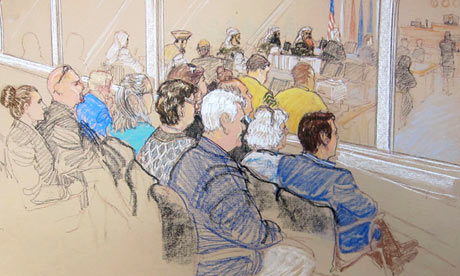
Female guard testimony illegally redacted in 9/11 hearing: lawyers
Lawyers for five men charged with plotting the Sept. 11 attacks argued on Monday that government officials illegally redacted testimony about treatment of Muslim prisoners made during a pre-trial hearing at Guantanamo Bay.
The dispute arose over blacked-out testimony by a female guard in October about whether women guards at the U.S. military base in Cuba should be barred for religious reasons from touching Muslim prisoners.
Lawyers for the accused say prisoners' objections to being touched must be respected on religious grounds while a U.S. military official in December said the protests were an attempt to stall proceedings in the slow-moving 9/11 death penalty trial.
The guard, who used the pseudonym Sergeant Jinx, spoke in open court in 2015 about contact between female guards and Guantanamo Bay detainees. She detailed how a guard team would handle prisoners.
Intelligence agencies later scrubbed Jinx’s statements from an online transcript that had been available to the public on a government website...
http://www.reuters.com/article/us-usa-guantanamo-idUSKCN0VV2I1
...According to Nevin, the Eighth Amendment is implicated in one of two ways here, and both lead to the conclusion that the policy change may violate the detainees’ rights.
Either the Eighth Amendment flatly prohibits the intentional imposition of punishment on pretrial detainees, or it flatly prohibits the unnecessary and wanton infliction of pain on detainees. Whether the court analyzes female guard touching as intentional punishment or unnecessary and wanton infliction of pain, Nevin argues, the new policy meets this standard and therefore violates the Eighth Amendment. First, the record bears out the inference that the change in policy was made with an intent to punish—female guard touching was never a problem in the past, and the changed policy occurred amidst “remarks of political leaders that these men should be allowed to rot in hell, that we should return to waterboarding.” Second, Nevin argues, female guard touching is an unnecessary and wanton infliction of pain on these detainees (emphasis added).
To support this conclusion, Nevin explains that all five of these defendants have personal histories of sexualized torture that specifically involved extensive unwanted touching by women and forced nakedness, contrary to their religious beliefs. The torture programs they endured were specifically designed by psychologists to inflict pain based on the degradation of their religion. The forced touching by female guards revives the torture experience and generates intense physiological responses of pain. Nevin asks the court for the opportunity to conduct discovery into whether there is a valid penological purpose behind this policy change or whether the change was made to intentionally inflict punishment or pain on the defendants...
https://www.lawfareblog.com/222-session-transcript-touching-and-technology-woes
The dispute arose over blacked-out testimony by a female guard in October about whether women guards at the U.S. military base in Cuba should be barred for religious reasons from touching Muslim prisoners.
Lawyers for the accused say prisoners' objections to being touched must be respected on religious grounds while a U.S. military official in December said the protests were an attempt to stall proceedings in the slow-moving 9/11 death penalty trial.
The guard, who used the pseudonym Sergeant Jinx, spoke in open court in 2015 about contact between female guards and Guantanamo Bay detainees. She detailed how a guard team would handle prisoners.
Intelligence agencies later scrubbed Jinx’s statements from an online transcript that had been available to the public on a government website...
http://www.reuters.com/article/us-usa-guantanamo-idUSKCN0VV2I1
...According to Nevin, the Eighth Amendment is implicated in one of two ways here, and both lead to the conclusion that the policy change may violate the detainees’ rights.
Either the Eighth Amendment flatly prohibits the intentional imposition of punishment on pretrial detainees, or it flatly prohibits the unnecessary and wanton infliction of pain on detainees. Whether the court analyzes female guard touching as intentional punishment or unnecessary and wanton infliction of pain, Nevin argues, the new policy meets this standard and therefore violates the Eighth Amendment. First, the record bears out the inference that the change in policy was made with an intent to punish—female guard touching was never a problem in the past, and the changed policy occurred amidst “remarks of political leaders that these men should be allowed to rot in hell, that we should return to waterboarding.” Second, Nevin argues, female guard touching is an unnecessary and wanton infliction of pain on these detainees (emphasis added).
To support this conclusion, Nevin explains that all five of these defendants have personal histories of sexualized torture that specifically involved extensive unwanted touching by women and forced nakedness, contrary to their religious beliefs. The torture programs they endured were specifically designed by psychologists to inflict pain based on the degradation of their religion. The forced touching by female guards revives the torture experience and generates intense physiological responses of pain. Nevin asks the court for the opportunity to conduct discovery into whether there is a valid penological purpose behind this policy change or whether the change was made to intentionally inflict punishment or pain on the defendants...
https://www.lawfareblog.com/222-session-transcript-touching-and-technology-woes
20160219
Former Guantánamo Chief Summoned by French Court Over Torture Allegations
A French judge has summoned the former chief of Guantánamo Bay, retired U.S. General Geoffrey Miller, to appear in court on March 1 to face allegations of torture against detainees.
Miller presided over the U.S. military prison in Cuba from 2002 to 2004, shortly after then-President George W. Bush approved the use of so-called “enhanced interrogation” tactics, including waterboarding, hooding, stress positions, sleep deprivation, solitary confinement, removal of clothing, and exposure to extreme heat or cold.
Former prisoners of the camp for years have urged international courts to subpoena Miller over his role in the torture and mistreatment of detainees during his time as Guantánamo commander.
The investigation against Miller began after two French citizens, Nizar Sassi and Mourad Benchellali, who were detained at Guantánamo from 2001 to 2004 and 2005 respectively, lodged a criminal complaint against Miller in a French court. The Paris Court of Appeals approved their request last April.
William Bourdon, an attorney who represents some of the detainees in the case, told France 24 on Thursday that it was unlikely Miller would show up because “top U.S. civilian and military officials refuse to be held to account by [foreign] judges.”...
http://disinfo.com/2016/02/former-guantanamo-chief-summoned-by-french-court-over-torture-allegations/
Miller presided over the U.S. military prison in Cuba from 2002 to 2004, shortly after then-President George W. Bush approved the use of so-called “enhanced interrogation” tactics, including waterboarding, hooding, stress positions, sleep deprivation, solitary confinement, removal of clothing, and exposure to extreme heat or cold.
Former prisoners of the camp for years have urged international courts to subpoena Miller over his role in the torture and mistreatment of detainees during his time as Guantánamo commander.
The investigation against Miller began after two French citizens, Nizar Sassi and Mourad Benchellali, who were detained at Guantánamo from 2001 to 2004 and 2005 respectively, lodged a criminal complaint against Miller in a French court. The Paris Court of Appeals approved their request last April.
William Bourdon, an attorney who represents some of the detainees in the case, told France 24 on Thursday that it was unlikely Miller would show up because “top U.S. civilian and military officials refuse to be held to account by [foreign] judges.”...
http://disinfo.com/2016/02/former-guantanamo-chief-summoned-by-french-court-over-torture-allegations/
20160218
IDF soldiers electrocute blindfolded Palestinian for fun, laugh while filming (GRAPHIC VIDEO)
One soldier from the Netzach Yehuda battalion has been sentenced to seven months in prison for his role in the abuse of a Palestinian detainee who was blindfolded and zapped with electrodes as soldiers laughed and filmed the abuse.
The military trial of four members of the Israeli Defense Forces (IDF) centred on mobile phone footage showing soldiers laughing as a blindfolded Palestinian man is subjected to electric shocks with a medical device.
The incident was uncovered after authorities, suspicious of abusive treatment towards prisoners, confiscated one of the soldiers’ phones, report Mako.
Warning: the following video contains graphic content of a violent nature. Viewer discretion is advised...
https://www.rt.com/news/332742-israeli-soldiers-electrocute-palestinian/
The military trial of four members of the Israeli Defense Forces (IDF) centred on mobile phone footage showing soldiers laughing as a blindfolded Palestinian man is subjected to electric shocks with a medical device.
The incident was uncovered after authorities, suspicious of abusive treatment towards prisoners, confiscated one of the soldiers’ phones, report Mako.
Warning: the following video contains graphic content of a violent nature. Viewer discretion is advised...
https://www.rt.com/news/332742-israeli-soldiers-electrocute-palestinian/
20160131
‘They caused problems’: CIA involved with Gitmo inmates’ suicides – former guard to RT
TrendsGitmo hunger strike
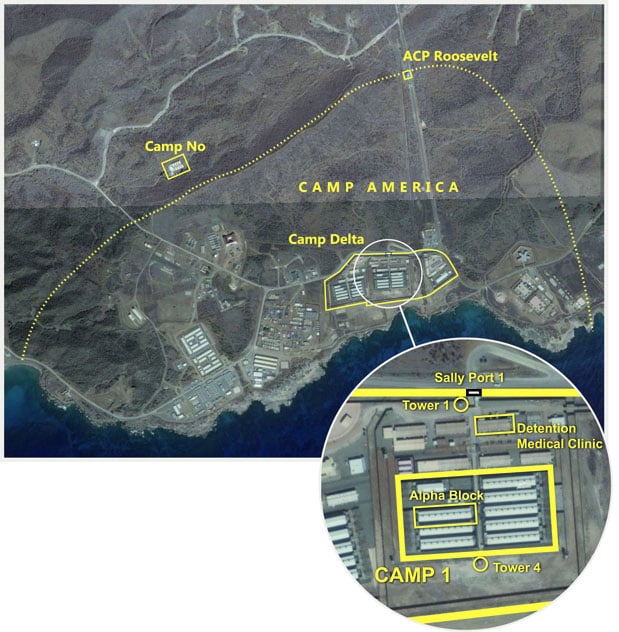
On June 10, 2006, the Department of Defense reported that Saudi Arabians Mani al-Utaybi and Yasser al-Zahrani, and a Yemeni citizen, Ali Abdullah Ahmed, “killed themselves in an apparent suicide pact.”
“Two Saudis and one Yemeni, each located in Camp 1, were found unresponsive and not breathing in their cells by guards,” Joint Task Force-Guantanamo said at that time, adding that “all lifesaving measures had been exhausted.”
The following day, the camp quickly went into lockdown.
Contrary to the official statement, unsubstantiated reports started to surface, accusing the Bush administration of hiding the truth behind what was described as a “planned event”.
Nearly 10 years on, former Guantanamo guard Joseph Hickman is stepping forward to unveil what he saw in the few hours leading up to the secretive deaths. Speaking to RT, Hickman shared why he thinks that the US government might have had an interest in silencing the prisoners who “caused a lot of problems for the command” of Guantanamo Bay.
‘CIA Black site’
“At around 5:30pm and 6:00pm on June 9, I went to the tower guards – I was visiting them to see how they were going to perform their duties that night,” the former sergeant of the guard recalled.
While there, Hickman noticed what he thought was an unusually suspicious commotion for a Friday evening.
“I witnessed a van – we used to call it paddy wagon – it was a detainee transport van,” he said. “The van came into the gate, backed up to Camp 1 and took a detainee out of Camp 1 Alpha Block and put him into the paddy wagon and drove [him away].”...
https://www.rt.com/usa/329882-guantanamo-prisoners-suicide-cia/
Subscribe to:
Posts (Atom)