Showing posts with label Nazis. Show all posts

20170117

Wiki: Richard B. Spencer

Richard Bertrand Spencer (born May 11, 1978) is an American white nationalist, known for promoting white supremacist views.[2][3][4] He is president of the National Policy Institute, a white nationalist think-tank, and Washington Summit Publishers, an independent publishing firm. Spencer has stated that he rejects the description of white supremacist, and describes himself as an identitarian.[5][6] He advocates for a white homeland for a "dispossessed white race" and calls for "peaceful ethnic cleansing" to halt the "deconstruction" of European culture.

Spencer and others have said that he created the term "alt-right",[7] a term he considers a movement about white identity.[8][9][10]

Spencer has repeatedly quoted from Nazi propaganda and spoken critically of the Jewish people,[10][11] although he has denied being a neo-Nazi. Spencer and his organization drew considerable media attention in the weeks following the 2016 presidential election, where, in response to his cry "Hail Trump, hail our people, hail victory!", a number of his supporters gave the Nazi salute similar to the Sieg Heil chant used at the Nazis' mass rallies. Spencer has defended their conduct, stating that the Nazi salute was given in a spirit of "irony and exuberance".[12]..

https://en.wikipedia.org/wiki/Richard_B._Spencer

20160717

Wiki: The Gehlen Organization

The Gehlen Organization or Gehlen Org was an intelligence agency established in June 1946 by U.S. occupation authorities in the United States Zone of Germany, and consisted of former Nazi members of the 12th Department of the German Army General Staff (Foreign Armies East, or FHO). It carries the name of Wehrmacht Major general Reinhard Gehlen, head of the Nazi German military intelligence in the Eastern Front during World War II.

Establishment

Reinhard Gehlen had all along been under the tutelage of US Army G-2 (intelligence), but he wished to establish and succeeded in establishing an association with the Central Intelligence Agency (CIA), in 1947. In alliance with the CIA, the military orientation of the organization turned increasingly toward political, economic and technical espionage against the Eastern bloc and the moniker "Pullach" became synonymous with secret service intrigues.[1]

The Org was for many years the only eyes and ears of the CIA on the ground in the Soviet Bloc nations during the Cold War. The CIA kept close tabs on the Gehlen group: the Org supplied the manpower while the CIA supplied the material needs for clandestine operations, including funding, cars and airplanes....

...The Gehlen Org employed hundreds of ex-Nazis.[8]

Criticism[edit]

Once the Org emerged into the public eye, Gehlen and his group drew criticism of varying quality from both sides, the West and the East. The British in particular had a problem with Gehlen and segments of the English press made sure it became known. Beginning with an article on 17 March 1952, Sefton Delmer, senior correspondent for London's Daily Express, dragged Gehlen into the news. On 10 August 1954, Delmer set the tone by announcing that "Gehlen and his Nazis are coming". Delmer, incredibly, implied in his story that a continuation of nothing less than Hitler's aims was at hand through this "monstrous underground power in Germany".[9] In more recent days,[when?] after reviewing selected declassified CIA documents on the Gehlen Org, a Guardian article offered a new perspective on this attempt to fight the new tyranny with some of the agents of the previous one "... for all the moral compromises involved [in hiring former Nazis], it was a complete failure in intelligence terms. The Nazis were terrible spies".[10] The communist East as expected, castigated Gehlen's group as fanatical and virulent agents of revenge and of American imperialism, fitting the party's general line that the West was plotting a revival of Nazi power.[11]

There was also Alois Brunner in Syria, alleged to be an Org operative, who was responsible for the Drancy internment camp near Paris and for the death of 140,000 Jews.[12] According to Robert Wolfe, historian at the US National Archives, "US Army intelligence accepted Reinhard Gehlen's offer to furnish alleged expertise on the Red Army – and was bilked by the many mass murderers he hired".[10] It appears that this last quote conflates two issues, because the CIA Studies in Intelligence review article asserts that the Org was a capable collector of information on the Red Army but this does not rule out the possibility that U.S. Army intelligence may have been "bilked" on other issues.
End[edit]

On 1 April 1956, the Gehlen Org was formally established as the Bundesnachrichtendienst (or Federal Intelligence Agency) of the Federal Republic of Germany, which still exists. Reinhard Gehlen stepped down as president in 1968 after reaching retirement age...

20160425

Plato, Nazism, CRISPR: The long shadow of eugenics


Eugenics is inextricably linked in the public consciousness to Nazi policies of sterilisation and euthanasia. But the concept of hereditary human improvement didn't vanish after the war. Is gene editing technology its modern manifestation? Amanda Smith investigates.

Going back to the ancient Greeks, it was all about breeding. In his Republic, Plato suggests that people should only be allowed to marry under controlled circumstances.

Plato, you see, regarded people much the same as livestock: you breed the best ones and not the others.

There's a new group out there who are unashamedly saying it's not that eugenics was wrong, it's that it was done wrong.

'A lot of people trace the idea of eugenics back to that,' says Nathaniel Comfort, author of The Science of Human Perfection. 'It has a certain logic to it.'

The term 'eugenics' was coined by 19th century British polymath Francis Galton.

'At first he called it viticulture, and then he decided that eugenics was a more euphonious word,' says Comfort. The root of the word is the Greek eugenes, meaning 'well born'...

http://www.abc.net.au/radionational/programs/bodysphere/long-shadow-of-eugenics/7329050

20160407

Wiki: Jürgen Mossack


Early life[edit source | edit]

Mossack was born in Fürth, Bavaria, Germany on 20 March 1948.[1] His father Erhard Mossack was a Rottenführer (senior corporal) in the Waffen-SS, the armed wing of the Nazi Party's Schutzstaffel, during World War II. According to U.S. intelligence files, he offered to spy for the Americans. His father moved to Panama with his family in the early 1960s, where he offered his services to the Central Intelligence Agency (CIA), spying on Communist activity in nearby Cuba.[2][3] In 2016, Germany's Federal Intelligence Service, when contacted by journalists, said they had documents relating to Erhard Mossack but would not share any information, owing to possible security risks.[4][5]

Mossack received a bachelor's degree in Law from Universidad Católica Santa María La Antigua in 1973.[2][6]

Career[edit source | edit]

In 1975, Mossack worked as a lawyer in London before returning to Panama to start a firm in 1977. Mossack’s practice only became Mossack Fonseca in 1986, when it merged with the tiny firm run by Ramón Fonseca Mora, a Panamanian novelist, lawyer, and politician.[2][4]

Mossack served on Conarex, Panama’s council on foreign relations, from 2009 to 2014.[2]

In April 2016, leaked documents from the company's private archive, dubbed the "Panama Papers", revealed detailed information on more than 214,000 offshore companies, including the identities of shareholders and directors. Mossack is a member of IBA[specify] ; STEP;[specify] Panama Bar Association; International Maritime Association; and the Maritime National Association.[6]

Mossack’s holdings, according to the files obtained by ICIJ, include a teak plantation and other real estate, an executive helicopter, a yacht named Rex Maris and a collection of gold coins.[2]

Personal life[edit source | edit]

Mossack has two daughters, Andrea and Nicole, who have been covered in the Panamanian press since at least 2003 for showjumping.[7][8]

Mossack is a member of the prestigious Club Union, where his daughter Nicole made her debut in 2008.[9] She is married to Tomás Altamirano[10]

https://en.wikipedia.org/wiki/Jürgen_Mossack

20160221

Wiki: Bank for International Settlements


The Bank for International Settlements (BIS; French: Banque des règlements internationaux, BRI) is an international company limited by shares owned by central banks which "fosters international monetary and financial cooperation and serves as a bank for central banks".[2] The BIS carries out its work through subcommittees, the secretariats it hosts and through an annual general meeting of all member banks. It also provides banking services, but only to central banks and other international organizations. It is based in Basel, Switzerland, with representative offices in Hong Kong and Mexico City...

...The BIS was established on May 17, 1930, by an intergovernmental agreement by Germany, Belgium, France, the United Kingdom, Italy, Japan, the United States and Switzerland.[3][4]

The BIS was originally intended to facilitate reparations imposed on Germany by the Treaty of Versailles after World War I.[5] The need to establish a dedicated institution for this purpose was suggested in 1929 by the Young Committee, and was agreed to in August of that year at a conference at The Hague. A charter for the bank was drafted at the International Bankers Conference at Baden-Baden in November, and its charter was adopted at a second Hague Conference on January 20, 1930. According to the charter, shares in the bank could be held by individuals and non-governmental entities. The BIS was constituted as having corporate existence in Switzerland on the basis of an agreement with Switzerland acting as headquarters state for the bank. It also enjoyed immunity in all the contracting states.

The evidence had been mounting throughout the war that the BIS had helped the Germans loot assets from occupied countries, including gold rings and other items from labor and prison camp victims.[6] The most notorious incident was the Bank of England's transfer to the BIS gold looted by the Nazis after their invasion of Czechoslovakia in 1939.'[7] The fact that top level German industrialists and advisors sat on the BIS board is ample evidence to understand how the BIS was used by Hitler throughout the war, with the help of American, British and French banks. Between 1933 and 1945 the BIS board of directors included Walther Funk, a prominent Nazi official, and Emil Puhl, as well as Hermann Schmitz, the director of IG Farben and Baron von Schroeder, the owner of the J.H. Stein Bank....

Members

The number of countries represented in each continent are: 35 in Europe, 13 in Asia, 5 in South America, 3 in North America, 2 in Oceania, and 2 in Africa. Sixty member central banks or monetary authorities of these countries...

https://en.wikipedia.org/wiki/Bank_for_International_Settlements


20160115

Obama, Pentagon clear way to send US aid to Ukraine neo-Nazis


Despite the unanimous support of US lawmakers for amendments banning aid to the openly neo-Nazi paramilitaries operating in Ukraine, the provisions were removed from the final versions of the Pentagon funding bill and the 2016 omnibus budget.

After the $1.8 trillion budget deal was struck between President Barack Obama and the Republican majority in Congress, the White House praised the removal of numerous “ideological riders,” while Speaker of the House Paul Ryan (R-Wisconsin) trumpeted the $64 million aid for European countries “facing Russian aggression.”

It now appears that one of those riders was the amendment passed unanimously by the House of Representatives last June that would have banned US aid to the notorious neo-Nazi ‘Azov’ battalion. The controversial unit is just one of many employed by the Kiev government against the residents of two eastern regions that have refused to accept the legitimacy of the government installed in the US-backed, February 2014 coup...

https://www.rt.com/usa/329010-ukraine-neo-nazis-aid/

20151113

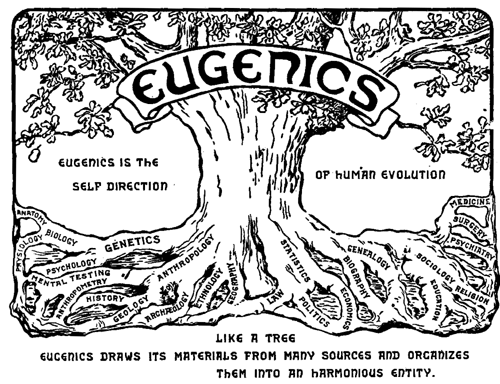
Wiki: Eugenics in the United States


Eugenics, the set of beliefs and practices which aims at improving the genetic quality of the human population[1][2] played a significant role in the history and culture of the United States prior to its involvement in World War II.[3]

Eugenics was practised in the United States many years before eugenics programs in Nazi Germany[4] and U.S. programs provided much of the inspiration for the latter.[5][6][7] Stefan Kühl has documented the consensus between Nazi race policies and those of eugenicists in other countries, including the United States, and points out that eugenicists understood Nazi policies and measures as the realization of their goals and demands.[5]

During the Progressive Era of the late 19th and early 20th century, eugenics was considered[by whom?] a method of preserving and improving the dominant groups in the population; it is now generally associated with racist and nativist elements[citation needed] (as the movement was to some extent a reaction to a change in emigration from Europe) rather than scientific genetics...

https://en.wikipedia.org/wiki/Eugenics_in_the_United_States

https://en.wikipedia.org/wiki/Carnegie_Institution_for_Science

20151110

The CIA and Nazi War Criminals

Washington D.C., February 4, 2005 - Today the National Security Archive posted the CIA's secret documentary history of the U.S government's relationship with General Reinhard Gehlen, the German army's intelligence chief for the Eastern Front during World War II. At the end of the war, Gehlen established a close relationship with the U.S. and successfully maintained his intelligence network (it ultimately became the West German BND) even though he employed numerous former Nazis and known war criminals. The use of Gehlen's group, according to the CIA history, Forging an Intelligence Partnership: CIA and the Origins of the BND, 1945-49, was a "double edged sword" that "boosted the Warsaw Pact's propaganda efforts" and "suffered devastating penetrations by the KGB." [See Volume 1: Introduction, p. xxix]

The declassified "SECRET RelGER" two-volume history was compiled by CIA historian Kevin Ruffner and presented in 1999 by CIA Deputy Director for Operations Jack Downing to the German intelligence service (Bundesnachrichtendienst) in remembrance of "the new and close ties" formed during post-war Germany to mark the fiftieth year of CIA-West German cooperation. This history was declassified in 2002 as a result of the work of The Nazi War Crimes and Japanese Imperial Government Records Interagency Working Group (IWG) and contains 97 key documents from various agencies.

This posting comes in the wake of public grievances lodged by members of the IWG that the CIA has not fully complied with the mandate of the Nazi War Crimes Disclosure Act and is continuing to withhold hundreds of thousands of pages of documentation related to their work. (Note 1) In interviews with the New York Times, three public members of the IWG said:

"I think that the CIA has defied the law, and in so doing has also trivialized the Holocaust, thumbed its nose at the survivors of the Holocaust and also at the Americans who gave their lives in the effort to defeat the Nazis in World War II." - Former congresswoman Elizabeth Holtzman

"I can only say that the posture the CIA has taken differs from all the other agencies that have been involved, and that's not a position we can accept." - Washington lawyer Richard Ben-Veniste

"Too much has been secret for too long. The CIA has not complied with the statute." - Former federal prosecutor Thomas H. Baer

The IWG was established in January 11, 1999 and has overseen the declassification of about eight million pages of documents from multiple government agencies. Its mandate expires at the end of March 2005.

The documentation unearthed by the IWG reveals extensive relationships between former Nazi war criminals and American intelligence organizations, including the CIA. For example, current records show that at least five associates of the notorious Nazi Adolf Eichmann worked for the CIA, 23 other Nazis were approached by the CIA for recruitment, and at least 100 officers within the Gehlen organization were former SD or Gestapo officers. (Note 2)

The IWG enlisted the help of key academic scholars to consult during the declassification process, and these historians released their own interpretation of the declassified material last May (2004) in a publication called US Intelligence and the Nazis. The introduction to this book emphasizes the dilemma of using former Nazis as assets:

"The notion that they [CIA, Army Counterintelligence Corp, Gehlen organization] employed only a few bad apples will not stand up to the new documentation. Some American intelligence officials could not or did not want to see how many German intelligence officials, SS officers, police, or non-German collaborators with the Nazis were compromised or incriminated by their past service… Hindsight allows us to see that American use of actual or alleged war criminals was a blunder in several respects…there was no compelling reason to begin the postwar era with the assistance of some of those associated with the worst crimes of the war. Lack of sufficient attention to history-and, on a personal level, to character and morality-established a bad precedent, especially for new intelligence agencies. It also brought into intelligence organizations men and women previously incapable of distinguishing between their political/ideological beliefs and reality. As a result, such individuals could not and did not deliver good intelligence. Finally, because their new, professed 'democratic convictions' were at best insecure and their pasts could be used against them (some could be blackmailed), these recruits represented a potential security problem." (Note 3)

The Gehlen organization profiled in the newly posted CIA history represents one of the most telling examples of these pitfalls. Timothy Naftali, a University of Virginia professor and consulting historian to the IWG who focused heavily on the declassified CIA material, highlighted the problems posed by our relationship with Gehlen: "Reinhard Gehlen was able to use U.S. funds to create a large intelligence bureaucracy that not only undermined the Western critique of the Soviet Union by protecting and promoting war criminals but also was arguably the least effective and secure in the North Atlantic Treaty Organization. As many in U.S. intelligence in the late 1940s had feared would happen, the Gehlen Organization proved to be the back door by which the Soviets penetrated the Western alliance." (Note 4)

The documents annexed in the CIA history posted today by the Archive echo the observations of Professor Naftali. While placing much of the blame on the Army Counterintelligence Corps' initial approach to Gehlen, this history emphasizes the CIA's own reluctance to adopt responsibility for Gehlen's organization, yet the documents show the CIA ultimately embracing Gehlen.

Some of the highlights from this secret CIA documentary history include:

A May 1, 1952 report detailing how Gehlen and his network were initially approached by U.S. army intelligence. (Document 6)

Two evaluations of the Gehlen operation from October 16 and 17, 1946, advising against the transfer of Gehlen's organization to CIG hands and questioning the value of the operation as a whole. (Documents 21 and 22)

A March 19, 1948 memorandum from Richard Helms, noting Army pressure for the CIA to assume sponsorship of the Gehlen organization, and continued concern over the security problems inherent in the operation. (Document 59)

A December 17, 1948 report outlining the problems with the Gehlen organization, but ultimately recommending CIA assumption of the project. (Document 72)

In answer to the question "Can we learn from history?", the IWG's consulting historians noted "The real question is not whether we will make use of our past to deal with the present, but rather how well we will do so. To do it well, we need these documents." (Note 5)

"This secret CIA history is full of documents we never would have seen under the Freedom of Information Act, because Congress in 1984 gave the CIA an exemption for its 'operational' files, on the grounds that such files were too sensitive ever to be released," commented Thomas Blanton, director of the National Security Archive. "The Nazi War Crimes Disclosure Act has proven this assumption false. Release of these files has done no damage to national security, has provided information of enormous public interest and historical importance, and however belatedly, has brought a measure of accountability to government operations at variance with mainstream American values."...

http://nsarchive.gwu.edu/NSAEBB/NSAEBB146/

20151109

The Nazi roots of the Senate’s ‘Torture Report’ on the CIA


Supreme Court Justice Arthur Goldberg once stated that “The Dulles brothers were traitors.” Some historians believe that Allen Dulles became head of the newly formed CIA in large part to cover up his treasonous behavior and that of his Nazi clients.

In 1953 Dulles was involved, along with Frank Wisner, in Operation Ajax, the covert operation that led to the removal of duly elected Mohammad Mossadeq, prime minister of Iran, and his replacement with Mohammad Reza Pahlavi, Shah of Iran. Manufactured rumors of a Soviet takeover of the country had surfaced due to the nationalization of the Anglo-Iranian Oil Company.

Through Operation Paperclip, Werner von Braun along with a cadre of other Nazi rocket scientists the US military imported into the country illegally and against specific Truman orders, these blemished individuals with highly undesirable back-grounds were installed at Huntsville, Alabama at the end of WWII.

Within the same period, elements of the US government also, covertly, absorbed a network of Nazi spies headed by Nazi General Reinhard Gehlen. “The Gehlen Org” (as it came to be called) worked within the US government to promote Nazi aims and to protect and resettle Nazis from Europe. In fact, the CIA was built around the Gehlen Org...

http://themillenniumreport.com/2014/12/the-nazi-roots-of-the-senates-torture-report-on-the-cia/


20140429

Mengele’s Skull

It was an unusual coincidence, one that presented a difficult choice. Mossad agent Rafi Eitan described the missed opportunity to an interviewer fromDer Spiegel almost fifty years later:

In the spring of 1960, as we were planning the arrest of Adolf Eichmann, we learned that [Josef] Mengele was also in Buenos Aires. Our people checked out the address and it proved to be correct. … There were just 11 of us and we had our hands full dealing with Eichmann. After we had brought Eichmann to the house where we kept him until we flew him out, my boss at the Mossad, Isser Harel, called. He wanted us to arrest Mengele as well, but Mengele had left his home in the meantime. Harel said we should wait until he returned and then bring both him and Eichmann to Israel in the same plane. I refused because I didn’t want to endanger the success of the Eichmann operation. … When our agents returned to Argentina, Mengele had moved out of his apartment and gone underground.1

So Eichmann went to Jerusalem, and Mengele remained in South America. The first was executed after facing survivors, witnesses, and judges in an Israeli court in 1961 and the second, who died in hiding in Brazil, ended up as a skeleton on the examination table for forensic experts in 1985. Each of these forums exemplifies, and perhaps even inaugurated, different forms and sensibilities within the ethics and epistemology of war crime investigations and human rights...

http://www.cabinetmagazine.org/issues/43/keenan_weizman.php

20120406

FOCUS: IBM at Auschwitz, New Documents

Newly-released documents expose more explicitly the details of IBM's pivotal role in the Holocaust - all six phases: identification, expulsion from society, confiscation, ghettoization, deportation, and even extermination. Moreover, the documents portray with crystal clarity the personal involvement and micro-management of IBM president Thomas J. Watson in the company's co-planning and co-organizing of Hitler's campaign to destroy the Jews.

IBM's twelve-year alliance with the Third Reich was first revealed in my book IBM and the Holocaust, published simultaneously in 40 countries in February 2001. It was based on some 20,000 documents drawn from archives in seven countries. IBM never denied any of the information in the book; and despite thousands of media and communal requests, as well as published articles, the company has remained silent.

The new "expanded edition" contains 32 pages of never-before-published internal IBM correspondence, State Department and Justice Department memos, and concentration camp documents that graphically chronicle IBM's actions and what they knew during the 12-year Hitler regime. On the anniversary of the release of the original book, the new edition was released on February 26, 2012 at a special live global streaming event at Yeshiva University's Furst Hall, sponsored by the American Association of Jewish Lawyers and Jurists together with a coalition of other groups...

http://readersupportednews.org/news-section2/328-121/10198-