Able Danger was a classified military planning effort led by the U.S. Special Operations Command (SOCOM) and the Defense Intelligence Agency (DIA). It was created as a result of a directive from the Joint Chiefs of Staff in early October 1999 by Chairman of the Joint Chiefs of Staff Hugh Shelton, to develop an information operations campaign plan against transnational terrorism.
According to statements by Lt. Col. Anthony Shaffer and those of four others, Able Danger had identified 2 of 3 Al Qaeda cells active in the 9/11 attacks; the 'Brooklyn cell' linked to "Blind Sheik" Omar Abdel-Rahman, including September 11 attacks leader Mohamed Atta, and three of the 9/11 plot's other 19 hijackers.
In December 2006, a sixteen-month investigation by the US Senate Intelligence Committee concluded "Able Danger did not identify Mohamed Atta or any other 9/11 hijacker at any time prior to September 11, 2001," and dismissed other assertions that have fueled 9/11 conspiracy theories. The Senate Judiciary Committee first attempted to investigate the matter for the Senate in September, 2005. The Pentagon "ordered five key witnesses not to testify", according to Senate Judiciary Committee Chairman Arlen Specter. "That looks to me as if it may be obstruction of the committee's activities," Specter, R-Pennsylvania, said at the start of his committee's hearing into the unit.[1]
Attorney Mark Zaid, representing Lt. Colonel Anthony Shaffer and the other four Able Danger employees at the Senate Judiciary Committee hearing in September 2005, pointed out to the Committee that his clients had been forbidden by the Pentagon to testify to the Committee. He also discussed the Defense Intelligence Agency's decision to suspend Lt. Colonel Shaffer's security clearance shortly after it became known that he had provided information to the 9/11 Commission on Able Danger. "Based on years of experience I can say categorically that the basis for the revocation was questionable at best."[2] [3]
An investigation by the Defense Department Inspector General's office (IG) in September 2006 concluded that "the evidence did not support assertions that Able Danger identified the September 11, 2001, terrorists nearly a year before the attack, that Able Danger team members were prohibited from sharing information with law enforcement authorities, or that DoD officials acted against LTC Shaffer for his disclosures regarding Able Danger." However, some of the people questioned by the IG claimed their statements to the IG were distorted by investigators in the final IG's report, and the report omitted essential information that they had provided. Lt. Col Tony Shaffer has claimed that the DOD retaliated against him for speaking out publicly about the IG report's distortions.[4]
The Senate panel of investigators said there was no evidence DoD lawyers stopped analysts from sharing findings with the FBI before the attacks. Analysts had created charts that included pictures of then-known Al Qaeda operatives, but none including Atta. A follow-up chart made after the attacks did show Atta. The Senate Committee said its findings were consistent with those of the DoD inspector general, released in September 2006. [5] [6]..
https://en.wikipedia.org/wiki/Able_Danger
Showing posts with label Senate Intelligence Committee. Show all posts
20160219
20160217
The CIA’s ludicrous spying charade: Here’s what you need to know about John Brennan’s angry Senate tirade
“Do not say that we spied on Senate computers or files,” CIA Director John Brennan said testily in a Senate Intelligence Committee Threat Assessment hearing on Tuesday, leaning forward and shaking his head with almost every word. “We did not do that. We were fulfilling our responsibilities.”
Brennan was objecting to Sen. Ron Wyden’s characterization as “spying” of a controversial CIA search of files relating to an investigation of the agency’s torture program. In order to understand the nuances of this distinction, a little backstory is necessary.
In 2009, the CIA had set up an offsite server that contained files relevant to its infamous torture program, to be used by the Department of Justice as well as Intelligence Committee (SSCI) staffers. The server had a dedicated portion for SSCI staffers that CIA officials weren’t supposed to access. In 2013, during a period when CIA and SSCI were arguing about the veracity of some conclusions made in the draft torture report, SSCI staffers found a document, which the CIA now claims shouldn’t have been accessible to SSCI staffers, proving that the agency itself actually agreed with the report’s conclusions in an internal investigation conducted all the way back in 2009.
In early 2014, CIA investigators tried to find out how the staffers had obtained the damning document. (They obtained it, as Vice reported last year, by using a search tool provided by a CIA contractor, and as such any error in question belonged to the CIA.) In doing so, CIA investigators violated a promise not to access any of the server files dedicated to Senate staffers.
Brennan’s insistence that the spy agency had not spied on the committee that oversees its actions took place amid a testy six-minute exchange during which Wyden attempted to get Brennan to agree that CIA would never again spy on the committee....
http://www.salon.com/2016/02/11/the_cias_ludicrous_spying_charade_heres_what_you_need_to_know_about_john_brennans_angry_senate_tirade/
Brennan was objecting to Sen. Ron Wyden’s characterization as “spying” of a controversial CIA search of files relating to an investigation of the agency’s torture program. In order to understand the nuances of this distinction, a little backstory is necessary.
In 2009, the CIA had set up an offsite server that contained files relevant to its infamous torture program, to be used by the Department of Justice as well as Intelligence Committee (SSCI) staffers. The server had a dedicated portion for SSCI staffers that CIA officials weren’t supposed to access. In 2013, during a period when CIA and SSCI were arguing about the veracity of some conclusions made in the draft torture report, SSCI staffers found a document, which the CIA now claims shouldn’t have been accessible to SSCI staffers, proving that the agency itself actually agreed with the report’s conclusions in an internal investigation conducted all the way back in 2009.
In early 2014, CIA investigators tried to find out how the staffers had obtained the damning document. (They obtained it, as Vice reported last year, by using a search tool provided by a CIA contractor, and as such any error in question belonged to the CIA.) In doing so, CIA investigators violated a promise not to access any of the server files dedicated to Senate staffers.
Brennan’s insistence that the spy agency had not spied on the committee that oversees its actions took place amid a testy six-minute exchange during which Wyden attempted to get Brennan to agree that CIA would never again spy on the committee....
http://www.salon.com/2016/02/11/the_cias_ludicrous_spying_charade_heres_what_you_need_to_know_about_john_brennans_angry_senate_tirade/
20151214
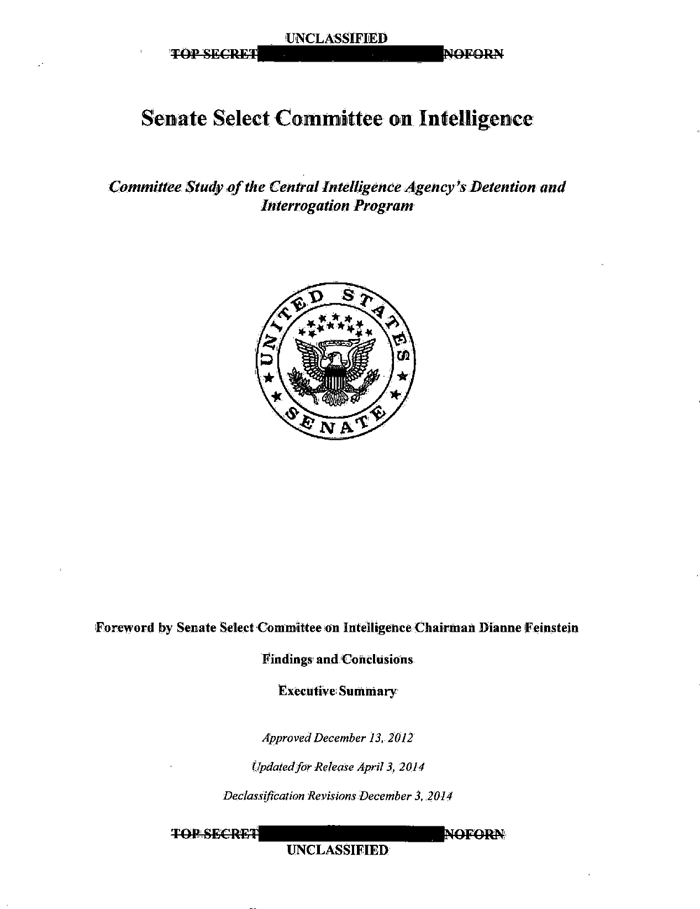
Government Suspected Of Wanting CIA Torture Report To Remain Secret
A Senate panel released a redacted synopsis of the 7,000 page report. Copies of the full classified report sent to federal agencies have gone unread. Some fear the report may never be made public.
DAVID GREENE, HOST:
Let's remember a year ago today, the Senate released what's become known as the Torture Report. We learned about the CIA's detention and harsh interrogation of suspected terrorists. But we did not learn everything - far from it, in fact. That report was only a summary of a much larger study that runs nearly 7,000 pages. That full report remains secret, and as NPR's David Welna discovered, the officials who have it might not have even read it.
DAVID WELNA, BYLINE: As chairwoman at the time of the Senate Intelligence Committee California Democrat Dianne Feinstein released last year's scathing synopsis of the CIA's recent interrogation activities. Today Feinstein says to really grasp what the CIA did, you have to read the committee's full report.
DIANNE FEINSTEIN: This is where all of the documentation rests, chapter and verse.
WELNA: Which is why Feinstein sent copies of the full classified Senate report to the CIA and to the Justice, State and Defense Departments. She included a letter urging officials to read it and learn from it. Feinstein now suspects those documents were not even opened, much less read.
FEINSTEIN: My general belief is that they don't want these facts out there anywhere.
WELNA: They being?
20140731
CIA apologizes for spying on Senate committee
The episode was the subject of an unusual, public dispute between the panel and the spy agency over access to classified information.
The CIA had accused the committee staffers of getting access to internal agency documents and of improperly handling classified material.
The Justice Department looked into it at the request of the CIA and decided there wasn't enough evidence of a crime to warrant further investigation...
20140714
DOJ won't probe CIA-Senate spy charges
The Department of Justice has decided not to pursue accusations that the CIA spied on the Senate Intelligence Committee, nor will it investigate charges that committee staffers took classified documents from a secure CIA facility.
"The department carefully reviewed the matters referred to us and did not find sufficient evidence to warrant a criminal investigation," Justice Department spokesman Peter Carr confirmed to The Hill.
Sen. Dianne Feinstein (D-Calif.), the Intelligence Committee’s chairwoman, took to the Senate floor in March and blasted the CIA, saying it had spied on her staffers conducting an investigation into the agency's rendition, detention and interrogation program during the Bush era.
The CIA, in turn, alleged that the staffers had taken unauthorized documents while conducting their investigation...
http://thehill.com/policy/defense/211853-doj-declines-to-investigate-cia-senate-spat
"The department carefully reviewed the matters referred to us and did not find sufficient evidence to warrant a criminal investigation," Justice Department spokesman Peter Carr confirmed to The Hill.
Sen. Dianne Feinstein (D-Calif.), the Intelligence Committee’s chairwoman, took to the Senate floor in March and blasted the CIA, saying it had spied on her staffers conducting an investigation into the agency's rendition, detention and interrogation program during the Bush era.
The CIA, in turn, alleged that the staffers had taken unauthorized documents while conducting their investigation...
http://thehill.com/policy/defense/211853-doj-declines-to-investigate-cia-senate-spat
20130618
A Candid Look at the Senate Intelligence Committee
Much of the continuing controversy over intelligence surveillance policy revolves around whether the sweeping collection of U.S. telephone data by intelligence agencies violates constitutional norms. But it is also an occasion to assess the quality of intelligence oversight, and to review the performance of oversight mechanisms in representing the public and defending its interests.
So it was disappointing to read that the Senate Select Committee on Intelligence has blocked its former general counsel, Vicki Divoll, from speaking to Talking Points Memo (TPM) on the record about how the Committee functions.
“TPM was reporting a story based on interviews with members of Congress and current and former aides about the successes and pitfalls of intelligence oversight on Capitol Hill,” wrote Brian Beutler of TPM DC...
http://blogs.fas.org/secrecy/2013/06/ssci-candid/
http://en.wikipedia.org/wiki/Senate_Intelligence_Committee
So it was disappointing to read that the Senate Select Committee on Intelligence has blocked its former general counsel, Vicki Divoll, from speaking to Talking Points Memo (TPM) on the record about how the Committee functions.
“TPM was reporting a story based on interviews with members of Congress and current and former aides about the successes and pitfalls of intelligence oversight on Capitol Hill,” wrote Brian Beutler of TPM DC...
http://blogs.fas.org/secrecy/2013/06/ssci-candid/
http://en.wikipedia.org/wiki/Senate_Intelligence_Committee
Subscribe to:
Posts (Atom)