Showing posts with label propaganda. Show all posts

20170124

How Media Fuels Our Fear of Terrorism


A very large portion of the news we consume is about terrorism in America and Europe. That coverage has consequences on how people live their lives.

In the wake of the San Bernardino terrorist attacks, one women (who did not yet have kids) told the New York Times she planned to home school her future children for fear of mass shootings. Another man recounted that he now watches movies at home instead of in public theaters. Another stated she now steers clear of crowded public areas.

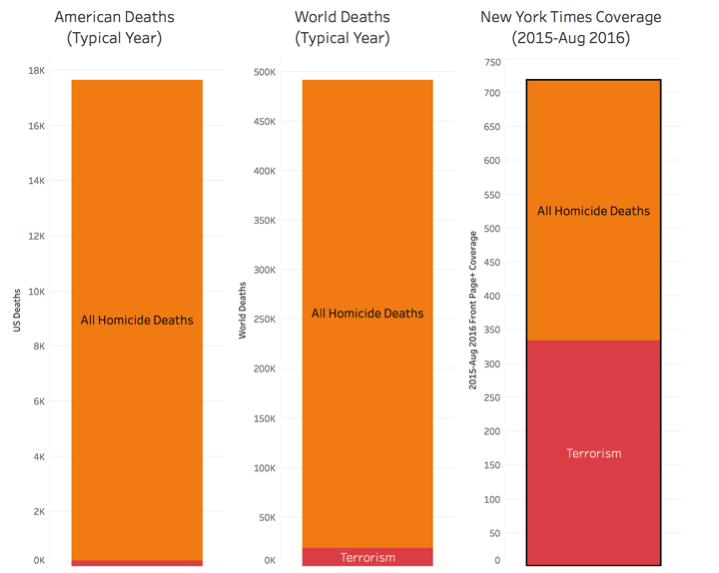
We hear about terrorists attacks in the media and then adjust our lives based on how we process that information. But is the amount of media coverage dedicated to terrorism in the West in anyway commensurate with the actual risk of terrorism we face?

In this article, let’s see how an American newspaper ( The New York Times ) covers terrorism, and show that this selective coverage can give us a distorted sense of the world using actual data. The aim of this analysis is to show how news media — especially social media — cover/distributes a non-representative set of events based on what is relevant/engaging to their audience. Readers and viewers then use this selective data to infer what the entire reality is.

Media is data for human decisions, and selective media is selective data. Selective data can lead to bad inferences and bad decisions, as was the case with the explosion of the Space Shuttle Challenger . Selective facts can actually be worse than no facts or fake news, as it can give us a false sense of confidence...

https://priceonomics.com/our-fixation-on-terrorism/

20170119

How the Chinese Government Fabricates Social Media Posts for Strategic Distraction, not Engaged Argument

The Chinese government has long been suspected of hiring as many as 2,000,000 people to surreptitiously insert huge numbers of pseudonymous and other deceptive writings into the stream of real social media posts, as if they were the genuine opinions of ordinary people. Many academics, and most journalists and activists, claim that these so-called "50c party" posts vociferously argue for the government's side in political and policy debates. As we show, this is also true of the vast majority of posts openly accused on social media of being 50c. Yet, almost no systematic empirical evidence exists for this claim, or, more importantly, for the Chinese regime's strategic objective in pursuing this activity. In the first large scale empirical analysis of this operation, we show how to identify the secretive authors of these posts, the posts written by them, and their content. We estimate that the government fabricates and posts about 448 million social media comments a year. In contrast to prior claims, we show that the Chinese regime's strategy is to avoid arguing with skeptics of the party and the government, and to not even discuss controversial issues. We infer that the goal of this massive secretive operation is instead to regularly distract the public and change the subject, as most of the these posts involve cheerleading for China, the revolutionary history of the Communist Party, or other symbols of the regime. We discuss how these results fit with what is known about the Chinese censorship program, and suggest how they may change our broader theoretical understanding of "common knowledge" and information control in authoritarian regimes...

http://gking.harvard.edu/50c

20170108

Commentary: Reading news in the age of Trump? Think like a spy.

President-elect Donald Trump is clearly antagonistic toward the mainstream media. That attitude is unlikely to change after Inauguration Day. His disdain for journalists and reluctance to release details about his finances and business ventures may force journalists to rely increasingly on anonymous sources, a strategy that reputable news organizations have long frowned upon.

So in the age of Trump, how should a reader approach coverage that relies primarily on anonymous sources?

Read the news like a spy.

By not naming a source, a journalist asks you to trust them. Did they talk to an intern or a policymaker? Every source has an agenda; if we as readers don't know the source we have a hard time parsing out and then evaluating that motivation. Remember the way the press covereddecisions that led to the 2003 Iraq War via articles based on unnamed sources, all with tall tales of Weapons of Mass Destruction?

Anonymous sources certainly have their place. During the Watergate scandal, Washington Postreporters Bob Woodward and Carl Bernstein used a contact named Deep Throat to verify details about U.S. President Richard Nixon’s involvement in the break-in of the Democratic National Committee’s headquarters, theft of top-secret documents and bugging of phones. Legitimate sources need to be protected from retaliation in return for informing the public, especially where national security whistle-blowing is concerned.

Many readers feel they have only two options: take the reporter’s word for it, or not. The result is a steady flow of insider stories that get blasted through aggregated media, which simply repeat others’ work. They then abandon the story as online roadkill for us to Tweet about. We tend to either label what we read as bogus, or scream at people who label what we believe as bogus.

The unique circumstances of Trump’s business background mean legitimate anonymous sources will likely have to play a significant role in reporting over the next four years. At the same time, the echo-like nature of the web, coupled with partisan outlets and equally partisan readers, opens the door to more unscrupulous or mistaken use of anonymous sources.

So how can readers exercise intelligent skepticism?

One way is to apply some of the same tests intelligence officers use to help them evaluate their own sources. Since an article’s unnamed sources are fully unknown to you as the reader, not every test applies, but thinking backwards from the information in front of you to who could be the source is a good start on forming a sense of how credible what you are being told might be...

http://www.reuters.com/article/us-media-trump-commentary-idUSKBN14O17D

20161110

School for Assassins (US Information Agency)


Description: This Cold War-era animated film depicts the tragedy that unfolds when a young Communist revolutionary trained in Cuba returns to his home country in Latin America.

20161019

PENTAGON VIDEO WARNS OF “UNAVOIDABLE” DYSTOPIAN FUTURE FOR WORLD’S BIGGEST CITIES

THE YEAR IS 2030. Forget about the flying cars, robot maids, and moving sidewalks we were promised. They’re not happening. But that doesn’t mean the future is a total unknown.

According to a startling Pentagon video obtained by The Intercept, the future of global cities will be an amalgam of the settings of “Escape from New York” and “Robocop” — with dashes of the “Warriors” and “Divergent” thrown in. It will be a world of Robert Kaplan-esque urban hellscapes — brutal and anarchic supercities filled with gangs of youth-gone-wild, a restive underclass, criminal syndicates, and bands of malicious hackers.

At least that’s the scenario outlined in “Megacities: Urban Future, the Emerging Complexity,” a five-minute video that has been used at the Pentagon’s Joint Special Operations University. All that stands between the coming chaos and the good people of Lagos and Dhaka (or maybe even New York City) is the U.S. Army, according to the video, which The Intercept obtained via the Freedom of Information Act.


“Megacities: Urban Future, the Emerging Complexity,” a video created by the Army and used at the Pentagon’s Joint Special Operations University.

The video is nothing if not an instant dystopian classic: melancholy music, an ominous voiceover, and cascading images of sprawling slums and urban conflict. “Megacities are complex systems where people and structures are compressed together in ways that defy both our understanding of city planning and military doctrine,” says a disembodied voice. “These are the future breeding grounds, incubators, and launching pads for adversaries and hybrid threats.”

https://theintercept.com/2016/10/13/pentagon-video-warns-of-unavoidable-dystopian-future-for-worlds-biggest-cities/

20161004

Bell Pottinger Scandal - Half a Billion $ Spent on Fake ISIS Propaganda ...

Bell Pottinger in the spotlight for creating propaganda videos for US military in Iraq


The work included creating short news segments made to look like Arabic news networks and fake insurgent videos, The Sunday Times, which worked with the Bureau on the investigation, and other news outlets reported over the weekend.

The scale of Bell Pottinger’s operation in Iraq was significant; costing, on average, more than a hundred million dollars per year, with the agency at one point employing almost 300 British and Iraqi staff.

Bell Pottinger made about £15m a year in fees from the work, agency founder Lord Bell told The Sunday Times, with the bulk of the money going on costs such as production and distribution.

The agency’s work started in Iraq in March 2004 when it was tasked with "promotion of democratic elections", but the Bureau said it has identified transactions worth $540m (£420m) between the Pentagon and Bell Pottinger relating to contracts issued from May 2007 to December 2011, with a contract worth a similar annual rate ($120m, £93m) reportedly in force in 2006 too.

Quoted widely in the media, former Bell Pottinger employee Martin Wells said his work consisted of three types of products: TV ads portraying al Qaeda in a negative light; news items made to look as if they had been "created by Arabic TV" and with the origins sometimes hidden; and the production of fake al Qaeda propaganda films.

The latter would be put on CDs and dropped into areas that were raided. The CDs had a code embedded in them that gave the location of where they had been played...

http://www.prweek.com/article/1410858/bell-pottinger-spotlight-creating-propaganda-videos-us-military-iraq

Bell Pottinger secretly filmed boasting of political access and doing PR for despotic regimes

20160929

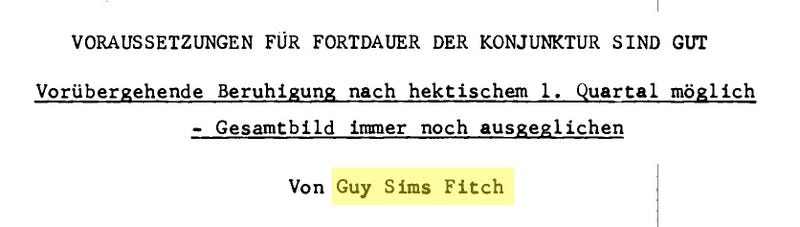
Meet Guy Sims Fitch, a Fake Writer Invented by the US Government


Guy Sims Fitch had a lot to say about the world economy in the 1950s and 60s. He wrote articles in newspapers around the globe as an authoritative voice on economic issues during the Cold War. Fitch was a big believer in private American investment and advocated for it as a liberating force internationally. But no matter what you thought of Guy Sims Fitch’s ideas, he had one big problem. He didn’t exist.

Guy Sims Fitch was created by the United States Information Agency (USIA), America’s official news distribution service for the rest of the world. Today, people find the term “propaganda” to be incredibly loaded and even negative. But employees of the USIA used the term freely and proudly in the 1950s and 60s, believing that they were fighting a noble and just cause against the Soviet Union and the spread of Communism. And Guy Sims Fitch was just one tool in the diverse toolbox of the USIA propaganda machine.

“I don’t mind being called a propagandist, so long as that propaganda is based on the truth,” said Edward R. Murrow in 1962. Murrow took a job as head of the USIA after a long and celebrated career as a journalist, and did quite a few things during his tenure that would make modern journalists who romanticize “the good old days” blush.

But even when USIA peddled its own version of the truth, the propaganda agency wasn’t always using the most, let’s say, truthful of methods. Their use of Guy Sims Fitch—a fake person whose opinions would be printed in countries like Brazil, Germany, and Australia, among others—served the cause of America’s version of the truth against Communism during the Cold War, even if Fitch’s very existence was a lie.

I recently filed a Freedom of Information Act request with the CIA to get more information about Guy Sims Fitch, this fictional character that journalists and editors of the USIA would use to promote American economic interests abroad. The twist? The CIA wants to make sure that the privacy rights of this fictional character aren’t violated. Or, perhaps, that the privacy rights of the people who wrote under that name aren’t violated. The short version? They’re toying with me.

Under the Freedom of Information Act, federal agencies are required to take into consideration the privacy rights of living individuals. Dead people don’t have privacy rights under US law, which is why you’ll see agencies like the FBI release their files on notable individuals after a famous person dies. (And the not so famous, if you ask for it.) But Guy Sims Fitch can never die, because he was never born...

http://paleofuture.gizmodo.com/meet-guy-sims-fitch-a-fake-writer-invented-by-the-us-g-1787060769

20160902

The Dumbed-Down New York Times

Exclusive: A New York Times columnist writes Americans are so “dumbed-down” that they don’t know that Russia “invaded” Ukraine two years ago, but that “invasion” was mostly in the minds of Times editors and other propagandists, says Robert Parry.

By Robert Parry

In a column mocking the political ignorance of the “dumbed-down” American people and lamenting the death of “objective fact,” New York Times columnist Timothy Egan shows why so many Americans have lost faith in the supposedly just-the-facts-ma’am mainstream media.

Egan states as flat fact, “If more than 16 percent of Americans could locate Ukraine on a map, it would have been a Really Big Deal when Trump said that Russia was not going to invade it — two years after they had, in fact, invaded it.”

But it is not a “fact” that Russia “invaded” Ukraine – and it’s especially not the case if you also don’t state as flat fact that the United States has invaded Syria, Libya and many other countries where the U.S. government has launched bombing raids or dispatched “special forces.” Yet, the Times doesn’t describe those military operations as “invasions.”

Nor does the newspaper of record condemn the U.S. government for violating international law, although in every instance in which U.S. forces cross into another country’s sovereign territory without permission from that government or the United Nations Security Council, that is technically an act of illegal aggression.

In other words, the Times applies a conscious double standard when reporting on the actions of the United States or one of its allies (note how Turkey’s recent invasion of Syria was just an “intervention”) as compared to how the Times deals with actions by U.S. adversaries, such as Russia...

https://consortiumnews.com/2016/08/27/the-dumbed-down-new-york-times/

20160626

Former Shin Bet head ‘bursts myth’ on cyber hackers who attack Israel

In his first big speech since stepping down as head of the Shin Bet (Israel Security Agency) last month, Yoram Cohen on Tuesday said he wanted to “burst the myth of retribution,” explaining that Israel always eventually learns who to hold responsible for trying to cyber-hack it.

Conventionally, most government and private sector officials say that one of the puzzles of cyber warfare is identifying who initiated a cyber attack.

Cohen’s statements, made at Tel Aviv University’s International Cybersecurity Conference, indicated that the Shin Bet’s abilities to decipher who cyber-attacks Israel are more advanced than has been previously known.

He also gave the agency credit for blocking all major cyber attacks the country has faced during his tenure (May 2011 to May 2016).

The former Shin Bet director explained that a major challenge in the field is that one small oversight could help Israeli adversaries inflict substantial harm.

At the same time, he said that Israeli intelligence had been empowered, realizing that the same was true for cyber-attacking adversaries – meaning Israel has many opportunities to inflict substantial cyber attacks from their mistakes.

Cohen pointed to three main cyber threats: computer network attacks, computer exploitation attacks and social media influence attacks.

Splitting them up, he said that while the first two are well-understood, the public is less familiar with the last one.

He explained that terrorist and jihad groups have started to launch sophisticated social media campaigns to try to mislead and frame the way that a target-country’s general public views developing events – since so much of an average person’s understanding of current affairs now depends on social media.

Latching on to a similar idea, Maj.- Gen. Herzi (Herzl) Halevi, IDF chief of military intelligence, who also spoke at the conference, described the dilemma concerning confronting these campaigns on social media.

He said that one of the questions asked is whether Israel should “plant” ideas of its own on social media to influence its adversaries in the country’s favor...

http://www.jpost.com/Israel-News/Former-Shin-Bet-head-bursts-myth-on-cyber-hackers-who-attack-Israel-457355

20160504

Govt-backed counter-extremist ‘propaganda’ program operating without oversight - report

Counter-narratives on extremism are being peddled by a secret government propaganda program in the absence of oversight under the guise of “grassroots Muslim voices,” an investigation by a UK advocacy group suggests.

A covert propaganda program run by the Home Office has been developing a labyrinth of “authentic” Muslim voices to create counter-narratives geared towards combatting extremist ideologies commonly seen among British millennials through community groups and NGOs.

A report carried out by UK nonprofit group CAGE says this stealth government program has been in operation since 2011.

Officials Secret Act

The study, which was published Tuesday, warns the secret nature of the project and the misinformation it spreads are a poor reflection on a government that claims to uphold transparency.

CAGE suggests public relations firm Breakthrough Media is tasked with spinning these counter-narratives and is likely protected under Britain’s Official Secrets Act (OSA). The advocacy group says the use of this legislation to cloak a government propaganda project in secrecy is a grievous abuse of government power....

https://www.rt.com/uk/341707-cage-propaganda-prevent-terrorism/

20160502

Selling Serco: documentary-maker Molly Dineen on why she shot a corporate promo


How do we make our people feel less like shit?” This was one of the most pressing questions for Rupert Soames when he took control of the crisis-ridden outsourcing firm Serco.

The £1.05bn organisation – which runs prisons, air-traffic control hubs, train lines and government defence contracts globally – was in the midst of a “full-blown corporate crisis, and as a company it was widely reviled”, says Soames, who became chief executive in May 2014. Staff morale was extremely low. “We seek to make the world a better place, and then we see all of these headlines: ‘evil’, ‘grasping’, ‘ripping off the taxpayer’,” he adds, suggesting that it was “a bit like if you were a member of a congregation and discovered that your priest had been doing crack cocaine”.

His crisis PR solution was to bring in Bafta award-winning documentary- maker Molly Dineen (described by the Guardian’s Mark Lawson as “the leading film-maker of her generation”), to make an hour-long film about the company – following frontline staff across the world, including trainee prison wardens, employment coaches, hospital porters, tugboat captains and asylum support officers at work.

Unfortunately, the only way to see her new film is to join Serco’s 100,000-strong workforce, because the exercise was purely designed to boost staff members’ self-esteem and will not be broadcast more widely – but a small screening was held for staff and investors last week. The film clearly does an excellent job of showcasing the handful of Serco employees who appear as humane and thoughtful people; it made the audience laugh and was unexpectedly moving. Less clear is why such a respected, independent film-maker took Serco’s commission...

http://www.theguardian.com/film/2016/apr/25/molly-dineen-serco-corporate-documentary-interview-rupert-soames