Showing posts with label rendition. Show all posts

20160809

Inside the CIA’s Penal Colonies

In June 2006, President George W. Bush told Central Intelligence Agency (CIA) director Michael Hayden that he was worried. The subject of Bush’s concern was a picture of a CIA detainee chained to the ceiling, clothed in a diaper. This came almost five years into the agency’s detention and interrogation program, four years since it began waterboarding prisoners, three years after the revelations of Abu Ghraib, two years after a top-secret report had condemned the agency’s “inhumane and undocumented techniques,” and a year after the Washington Post reported the existence of the CIA’s “covert prison system” — but now President Bush was concerned.

The public knows this because the CIA recently released fifty previously classified documents — 821 pages in all. Among them is a two-page memorandum from June 7, 2006, consisting of nothing but redactions, save one sentence in which Hayden passed along the president’s concern.

Three months later, Bush gave a major speech in which he admitted to the existence of the CIA’s detention and interrogation program, run through an archipelago of gulag-like secret prisons strung around the world. After the speech the program began to slowly wind down: once its existence was officially acknowledged, it could no longer function.

The fifty newly released documents ought to be read in full. They are in turns fascinating, infuriating, baffling, illuminating, and elliptical. They describe the day-to-day banality and terror inside the CIA’s black sites during those first five years — from their authorization less than one week after 9/11 to Bush’s public acknowledgment in September 2006.

The documents report field agents’ protests against the violence and the cruelty hidden behind euphemisms like “detention” and “interrogation”; they lay out the bureaucratic logic and headquarter cowardice prevalent inside the national security state; and they tell us, in their own way, that there is much more that remains unknown.

A Dark, Cold Day
Consider what we know about the plights of Gul Rahman and Khaled el-Masri, two CIA detainees whose ordeals can finally be reconstructed.

The report on the CIA’s internal investigation into the death of Gul Rahman makes for some of the grimmest reading in the collection. The contours of Rahman’s demise could have been pieced together from accounts already in the public record, but the report’s rendering of his final days captures the realities of detainee life like nothing else.

The report redacts the prison’s location, but this owes more to the agency’s stubbornness than its secrecy: we already know that Rahman died at a CIA compound near Kabul, Afghanistan known as the Salt Pit. “The facility is hot in the summer and cold in the winter,” states the report. It was the winter cold that killed Rahman.

In October 2002, the CIA captured Rahman in Islamabad. By November, he was on site, and the CIA was attempting to break him with “48 hours of sleep deprivation, auditory overload, total darkness, isolation, a cold shower, and rough treatment.”

In his first two days, his captors repeatedly pushed and shoved him while he was hooded; one person later described witnessing “a rough takedown,” which CIA officers had “thoroughly planned and rehearsed.” Later, when Rahman’s corpse was inspected, he had “surface abrasions” all over: “on his shoulders, pelvis, arms, legs, and face.” But all superficial, no severe wounds: an expert working-over.

While alive, Rahman refused to cooperate, even denying his identity. His obstinacy impressed his interrogators so much that they concluded that he had clearly received “a sophisticated level of resistance training.” They cited other evidence too: the fact that Rahman “claimed inability to think due to conditions” — in particular, the cold — and that he “[c]omplained about poor treatment” and “about the violation of his human rights.”

Although it was already cold outside and the prison had no central heating or insulation, his captors gave him a cold shower. Actually, according to one person interviewed, it was because it was cold that Rahman “was deliberately given a cold shower as a deprivation technique.” One witness remembered how Rahman began to show signs of hypothermia. Guards gave him a blanket, then later took it away.

In his cell, Rahman was kept “nude, with the exception of a diaper for most of his incarceration.” At some point, he was given a sweatshirt, and his diaper was taken off. (The report notes, “There is uncertainty as to when Rahman’s diaper had been removed.”) At the end of his life, he was restrained in a sitting position on a bare concrete floor, wearing nothing but a sweatshirt and shackled so that he could not stand up.

On his final day alive, at 4 AM, guards found him “sitting in his cell, alive, and shaking.” They continued their rounds. At 8 AM, guards again found him “alive, sitting on the floor, and shaking.” They continued their rounds. One guard later explained that nothing seemed amiss, “because all of the prisoners shake.”

Two hours later, Rahman was dead. Seeing that he had stopped shaking, guards entered his cell and examined him, finding blood in his nose and mouth.

They performed CPR. Blood flowed from his mouth and mucous from his nose after each chest compression. A doctor found “no evidence that the prisoner had been abused and no evidence of a cause of death.” An autopsy ruled the cause of death “undetermined,” though someone noted that “it was his clinical impression that Rahman died of hypothermia.”

During his last night, the temperature had been below freezing; Rahman was dehydrated; he died chained to a concrete floor, half naked, unable to move around to warm himself.

In the CIA’s report, the only individual found responsible is Gul Rahman himself: he had thrown his last meal — a plate of rice — across the floor, thus depriving his body of a “source of fuel to keep him warm.” Further, it had, after all, been Rahman’s violent behavior that “resulted in his restraint,” which “brought him” into sustained contact with the cold floor. With that, the report ends...

https://www.jacobinmag.com/2016/07/cia-torture-bush-cheney-waterboarding-interrogation/

20160613

Wiki: Stephen R. Kappes


Stephen R. Kappes (born August 22, 1951) was the Deputy Director of the Central Intelligence Agency (DDCIA), until his resignation on April 14, 2010.[1][2] He had served in the CIA since 1981, with a two-year hiatus. A career clandestine operations professional, Kappes was well known for his supervisory role in the extraordinary rendition program, a non-judicial system of rendering persons suspected of terrorism to secret locations where most of them were interrogated.[3][4]Kappes was also known for his role in persuading Libyan leader Muammar al-Gaddafi to abandon his nuclear weapons program in 2003.[5] In 2009, Kappes was convicted in absentia by an Italian court for his headquarters-based role in the rendition and torture of an Egyptian citizen who was kidnapped from Italian soil by the CIA...

Dramatic departure in 2004[edit]
It had been widely reported in the press that Kappes quit the Agency rather than carry out a request by Goss to reassign Michael Sulick, his then deputy.[8] It is also reported that this incident occurred because the chief of staff admonished the then assistant Deputy Director for Counterintelligence, Mary Margaret Graham – who later worked for the Director of National Intelligence (DNI) John Negroponte – about leaking personnel information.[8] According to some news reports, Sulick had just engaged in a shouting match with Goss’s chief of staff.

For a brief period in between his senior appointments, Kappes worked in the private security industry. In April 2005, ArmorGroup, a British security firm, named him vice president in charge of global strategy, and named him Chief Operating Officer (COO) in November 2005....

Convicted of kidnapping, extraordinary rendition and torture[edit]
On November 4, 2009, in a landmark ruling, Italian judge Oscar Magi convicted 22 American CIA operatives of kidnapping Muslim cleric Osama Moustafa Hassan Nasr, known as Abu Omar, from the streets of Milan in 2003. Most of the top CIA officers had left the agency, with the exception of Kappes, who at the time was the assistant director of the CIA's clandestine branch.[12]
Role in hiding detainee death[edit]

Per official reports, Kappes was responsible for the alteration of records regarding the death of a detainee at the 'Salt Pit', a secret CIA interrogation operation in Afghanistan. A detainee froze to death, after having been showered with water, and left outside overnight. Kappes made certain that the death was retained 'off the books'. Two former officials who read the internal inspector general report made clear that the base chief was coached directly by Kappes on how to report the death as an accident. According to two former officials who read a CIA inspector general's report on the incident, Kappes coached the base chief—whose identity is being withheld at the request of the CIA—on how to respond to the agency's investigators. They would report it as an accident.[13]
Sudden retirement, no explanation[edit]

On April 14, 2010, CIA Director Leon E. Panetta reported that Kappes will be retiring in May.[14] The odd timing of the retirement, and lack of Presidential thanks for his years of service, led many to comment that this was a departure in disgrace.[2]...

https://en.wikipedia.org/wiki/Stephen_Kappes

20160425

Portugal Clears the Way for Extradition of Ex-C.I.A. Agent to Italy

ROME — A former undercover C.I.A. agent will be handed over to Italy, where she was convicted of taking part in the 2003 kidnapping of an Egyptian cleric in one of the renditions ordered by the George W. Bush administration, after appellate courts in Portugal, where she lives, turned down her appeal this week.

In January, a Portuguese court ruled that the former agent, Sabrina De Sousa, should be handed over to Italy, but the order was stayed pending appeal. On Friday, her Italian lawyer, Dario Bolognesi, said in an interview that the appeal had been denied, and that Ms. De Sousa would be extradited after May 4.

News that Portugal’s Constitutional Court had turned down her appeal this week was also reported on Friday by The Washington Post and by the Portuguese newspapers Diário de Notícias and Expresso. Her Portuguese lawyer, Manuel de Magalhães e Silva, did not respond to requests for comment.

Ms. De Sousa, who holds dual American and Portuguese citizenship, has denied any wrongdoing or involvement in the kidnapping, which took place while she was working undercover for the C.I.A. as a diplomat in Milan. She resigned from the agency in 2009 and avoided trial by leaving Europe, but was convicted in absentia that year. Despite the risk of arrest, she returned to Portugal last year to be closer to her family.

Last October, the Portuguese authorities briefly detained her and confiscated her passport so that she could not leave the country, though she was freed pending the court proceedings...

20160408

CIA torture techniques in Libya included prolonged diapering and insects


Wired News did a report detailing some of the alleged Central Intelligence Agency (CIA) torture techniques used in Libya (see article: U.S. Used This Torture Box to Interrogate Gadhafi’s Enemies http://www.wired.com/dangerroom/2012/09/helping-gadhafi-torture/all/ ).

The article alleges that the CIA engaged in all sorts of horrific abuses including “Prolonged diapering” which was permissible under the “enhanced interrogation” technique mentioned by former CIA Director George Tenet in 2003-era CIA documents declassified in 2009 (see article: The 

Other approved torture techniques described included “the attention grasp, walling, the facial hold, the facial slap (insult slap), the abdominal slap, cramped confinement, wall standing, stress positions, sleep deprivation beyond 72 hours … the use of harmless insects, the water board.” In 2002, Bush administration officials considered a CIA request to place al-Qaida member Abu Zubaydah inside a “confinement box.”

Detainees reported that they were “restrained in painful stress positions for long periods of time,” “beaten and slammed into walls,” “denied food,” “denied sleep by continuous, deafeningly loud Western music” and “subjected to different forms of water torture including waterboarding.

Waterboarding is a form of torture in which water is poured over the face of an immobilized captive, thus causing the individual to experience the sensation of drowning. Waterboarding can cause extreme pain, dry drowning, damage to lungs, brain damage from oxygen deprivation, other physical injuries including broken bones due to struggling against restraints, lasting psychological damage and death...

http://www.examiner.com/article/cia-torture-techniques-libya-included-prolonged-diapering-and-insects

20150202

HOW GUANTÁNAMO DIARY ESCAPED THE BLACK HOLE AND GOT PAST THE CENSORS (MOSTLY)

The book, in which Guantanamo detainee Mohamedou Ould Slahi tells of his odyssey through overseas prisons and his torture and abuse by the US and its counterterrorism allies, is pockmarked with redactions left by military censors.

The diary was finally published last week, more than nine years after Slahi wrote it, and it jumped onto bestseller lists. But the details of how his lawyers fought for its release are still under seal – highlighting the secrecy that still surrounds everything to do with the U.S. military prison and the 122 men who remain there.

“The starting point is that everything that Mohamedou says, like anything that any Guantanamo detainee says, is considered classified and has to be cleared by the government,” said Hina Shamsi, the director of the National Security Project at the American Civil Liberties Union, who was involved in the negotiations for the manuscript’s release.

Slahi, a 44-year-old Mauritanian educated in Germany, was rendered by the CIA to prison in Jordan in late 2001, then held by the U.S. in Afghanistan and Guantanamo. The government claimed that Slahi had been an al Qaeda recruiter. He admits that he went to Afghanistan in 1990 to fight against the communist government; his brother-in-law was an adviser to Osama Bin Laden; and he’d met one of the 9/11 plotters in Germany. But Slahi maintains that he’d had nothing to do with al Qaeda since 1992, and the U.S. has never charged him with a crime...

https://firstlook.org/theintercept/2015/01/31/guantanamo-diary-escaped-black-hole-got-past-censors-mostly/

20141220

MEET ALFREDA BIKOWSKY, THE SENIOR OFFICER AT THE CENTER OF THE CIA’S TORTURE SCANDALS

NBC News yesterday called her a “key apologist” for the CIA’s torture program. A follow-up New Yorker article dubbed her “The Unidentified Queen of Torture” and in part “the model for the lead character in ‘Zero Dark Thirty.’” Yet in both articles she was anonymous.

The person described by both NBC and The New Yorker is senior CIA officer Alfreda Frances Bikowsky. Multiple news outlets have reported that as the result of a long string of significant errors and malfeasance, her competence and integrity are doubted — even by some within the agency.

The Intercept is naming Bikowsky over CIA objections because of her key role in misleading Congress about the agency’s use of torture, and her active participation in the torture program (including playing a direct part in the torture of at least one innocent detainee). Moreover, Bikowsky has already been publicly identified by news organizations as the CIA officer responsible for many of these acts...

https://firstlook.org/theintercept/2014/12/19/senior-cia-officer-center-torture-scandals-alfreda-bikowsky/

20140914

CIA Plane in Big Aussie-American Heroin Bust


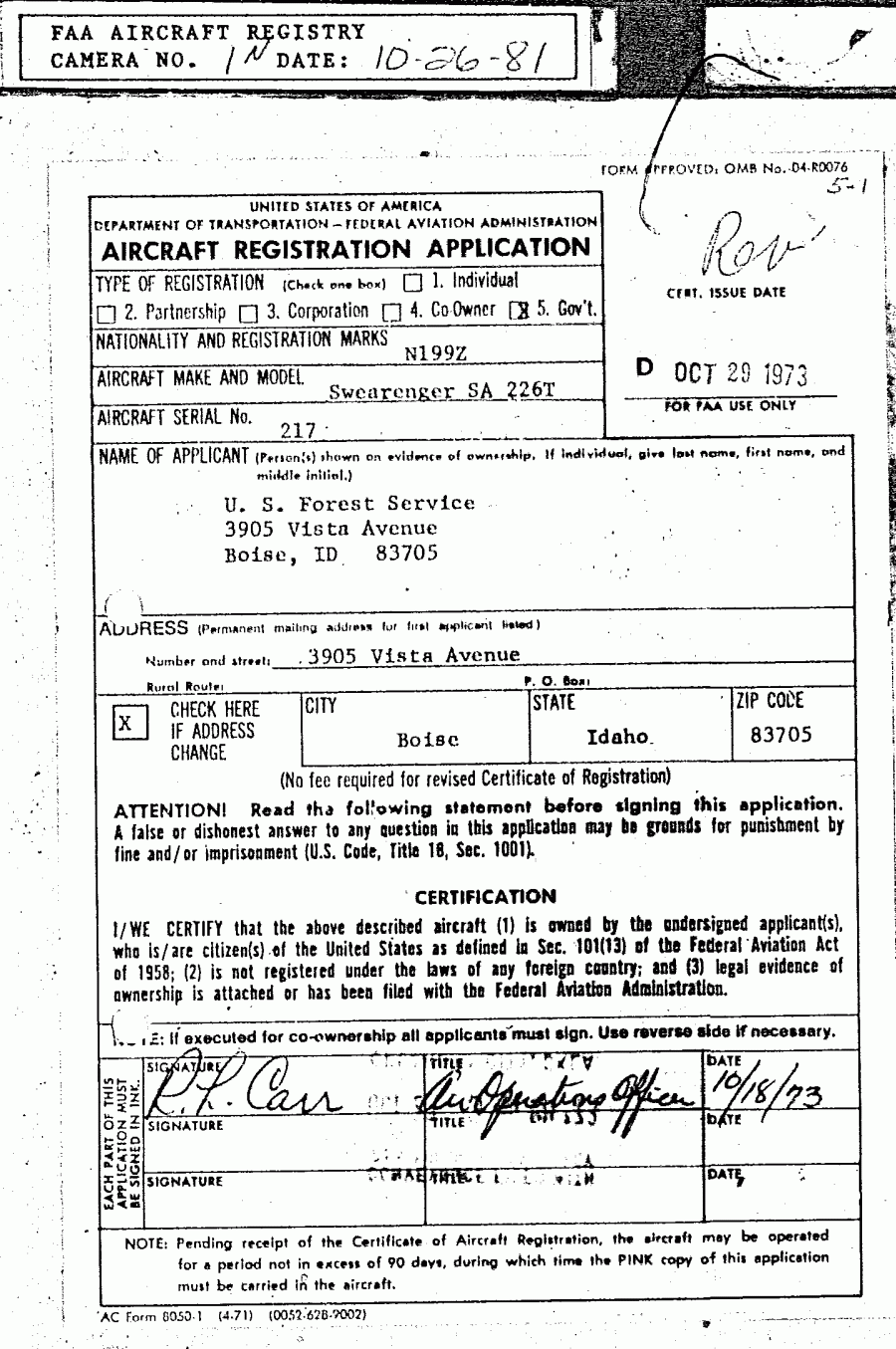
“Newly-obtained FAA registration records reveal that the American “mystery plane” busted this July with 35 kilos of heroin at an airport outside Sydney, Australia was a CIA plane. 

At least, it had been when it rolled off the assembly line 40 years earlier, courtesy a CIA deal with the U.S. Forest Service. And the CIA never sells off its planes.

The American-registered ‘mystery plane’ in Australia was a Merlin III twin–engine turbo-prop ( tail number N224HR).

FAA registration records show it was commissioned in the early 70’s by the U.S. Forest Service from aircraft manufacturer Swearingen in San Antonio, part of an operation to “sheep-dip” CIA planes through the U.S. Forest Service.

“Sheep-dip” is spook-speak for concealing the source or true ownership of something, or, at the very least, hiding it from Congress. When the plane was ordered, the CIA was merely anticipating Congressional calls for reining in the CIA, through (tellingly) forcing the Agency to divest its proprietary airlines.

By the time the plane was delivered two years later, the calls had grown much louder. In another two years, they’d become successful. More on this in a moment...

http://www.madcowprod.com/2014/09/12/mystery-aircraft-busted-in-australia-was-cia-plane/

20140724

Poland 'helped in CIA rendition', European Court rules

Poland broke the European human rights convention in helping the CIA to render two terror suspects, the European Court of Human Rights has ruled.

The judges said Poland had co-operated with the secret illegal transfers in 2002-2003, allowing two suspects to be interrogated on its territory.

It is the first such case concerning a CIA "black site" prison in Poland.

Abu Zubaydah, a Palestinian, was arrested in Pakistan and Abd al-Rahim al-Nashiri, a Saudi, in Dubai.

Polish officials called the ruling "embarrassing for Poland", but also "premature" because Poland's investigation into the prison allegations was still going on.

The court held that "the treatment to which the applicants had been subjected by the CIA during their detention in Poland had amounted to torture".

http://www.bbc.com/news/world-europe-28460628

20140126

The hidden history of the CIA’s prison in Poland


On a cold day in early 2003, two senior CIA officers arrived at the U.S. Embassy in Warsaw to pick up a pair of large cardboard boxes. Inside were bundles of cash totaling $15 million that had been flown from Germany via diplomatic pouch.

The men put the boxes in a van and weaved through the Polish capital until coming to the headquarters of Polish intelligence. They were met by Col. ­Andrzej Derlatka, deputy chief of the intelligence service, and two of his associates.

The Americans and Poles then sealed an agreement that over the previous weeks had allowed the CIA the use of a secret prison — a remote villa in the Polish lake district — to interrogate al-Qaeda suspects. The Polish intelligence service received the money, and the CIA had a solid location for its newest covert operation, according to former agency officials who spoke on the condition of anonymity to discuss the interrogation program, including previously unreported details about the creation of the CIA’s “black sites,” or secret prisons...

20130728

Ex-officer: CIA inflated threat of radical cleric to allow 2003 abduction, shield higher-ups


WASHINGTON — A former CIA officer has broken the U.S. silence around the 2003 abduction of a radical Islamist cleric in Italy, charging that the agency inflated the threat the preacher posed and that the United States then allowed Italy to prosecute her and other Americans to shield President George W. Bush and other U.S. officials from responsibility for approving the operation.

Confirming for the first time that she worked undercover for the CIA in Milan when the operation took place, Sabrina De Sousa provided new details about the “extraordinary rendition” that led to the only criminal prosecution stemming from the secret Bush administration rendition and detention program launched after the Sept. 11, 2001, attacks.

The cleric, Osama Mustapha Hassan Nasr, was snatched from a Milan street by a team of CIA operatives and flown to Egypt, where he was held for the better part of four years without charges and allegedly tortured. An Egyptian court in 2007 ruled that his imprisonment was “unfounded” and ordered him released...


20130719

Kidnap case ex-CIA agent Robert Lady 'en route to US'


An ex-CIA station chief held in Panama after being convicted in Italy over the kidnap of a terror suspect is '"en route" to the US, officials say.

Former Milan station chief Robert Lady had been released and had boarded a US-bound flight, said American officials.

Lady was sentenced to nine years in jail for his involvement in the 2003 abduction of the man - an Egyptian cleric - in Milan.

The cleric, known as Abu Omar, was allegedly flown to Egypt and tortured...

http://www.bbc.co.uk/news/world-us-canada-23382876

http://cryptome.org/lady-writes.htm

http://cryptome.info/lady-eyeball.htm

20130403

Symbols of Bush-era Lawlessness Flourish Under Obama


"During the George W. Bush years, two of the most controversial elements of what was then called the Global War on Terror were the CIA's rendition, detention and interrogation (RDI) program and the creation of the prison camps at Guantanamo Bay. The RDI program included waterboarding and other forms of torture, as well as so-called black site prisons where detainees were held incommunicado after being abducted by the CIA, and sometimes tortured by members of the host country's security forces.

Guantanamo Bay and the RDI program are both back in the news now, each for their own unsavory reasons, and their reemergence should be a reminder of how fully the Obama administration has embraced the logic underpinning the Bush regime's response to 9/11. The Pentagon is now requesting nearly $200 million for Guantanamo Bay infrastructure upgrades, including $49 million for a new unit for "special" prisoners – likely the so-called high-value detainees currently housed at Camp 7, which include self-proclaimed 9/11 mastermind Khalid Sheikh Mohammed. The Pentagon's reasoning is that neither the president nor Congress have any plans to close the prison anytime soon, so these repairs are necessary..."

20121214

CIA 'tortured and sodomised' terror suspect, human rights court rules | Law | The Guardian

CIA agents tortured a German citizen, sodomising, shackling, and beating him, as Macedonian state police looked on, the European court of human rights said in a historic judgment released on Thursday.

In a unanimous ruling, it also found Macedonia guilty of torturing, abusing, and secretly imprisoning Khaled el-Masri, a German of Lebanese origin allegedly linked to terrorist organisations.

Masri was seized in Macedonia in December 2003 and handed over to a CIA "rendition team" at Skopje airport and secretly flown to Afghanistan.

It is the first time the court has described CIA treatment meted out to terror suspects as torture.

"The grand chamber of the European court of human rights unanimously found that Mr el-Masri was subjected to forced disappearance, unlawful detention, extraordinary rendition outside any judicial process, and inhuman and degrading treatment," said James Goldston, executive director of the Open Society Just

20120118

RENDITION: Thousands of "Suspects" have "Disappeared": Shedding Light on North Carolina's "Rendition" Connection

The 10th anniversary of the 9/11 attacks was a searing reminder of the pain felt by those who lost loved ones on that day and in wars in Iraq and Afghanistan. New York City opened a stunning memorial, which allowed all of us to remember and grieve.

A very different panorama greets the families who last week marked a related anniversary - the opening of the Guantánamo Detention Camp on Jan. 11, 2002, and the beginning of the Bush administration's embrace of what Vice President Dick Cheney termed "the dark side."

In 10 years, thousands of suspects have been detained or even "disappeared," secretly taken on American orders to be interrogated and sometimes tortured all over the world. Some were no doubt guilty. But many were not. All were treated without regard for due process, making a mockery of our commitment to human rights. On this 10th anniversary, the victims of "extraordinary rendition" and torture and their families are largely alone and forgotten.

North Carolina played a crucial role in this abuse. Aero Contractors, the CIA-affiliated aviation company headquartered at the Johnston County Airport in Smithfield, transported dozens of men to overseas jails. In places like Uzbekistan, Romania and Egypt, North Carolina-based pilots and crews delivered prisoners to jails where they were held incommunicado and savagely tortured. Sometimes, the torturers were U.S. officials; other times, Americans had others do the dirty work.

Much of the information obtained was questionable at best and often wrong, making America less - not more - safe.

Extraordinary rendition is a clear violation of international law and U.S. treaty obligations. Many of its victims have since been released, with no charges filed and no

20120102

How Congress is Signing its own Arrest Warrants in the NDAA Citizen Arrest bill

I never thought I would have to write this: but—incredibly—Congress has now passed the National Defense Appropriations Act, with Amendment 1031, which allows for the military detention of American citizens. The amendment is so loosely worded that any American citizen could be held without due process. The language of this bill can be read to assure Americans that they can challenge their detention — but most people do not realize what this means: at Guantanamo and in other military prisons, one’s lawyer’s calls are monitored, witnesses for one’s defense are not allowed to testify, and one can be forced into nudity and isolation. Incredibly, ninety-three Senators voted to support this bill and now most of Congress: a roster of names that will live in infamy in the history of our nation, and never be expunged from the dark column of the history books.

They may have supported this bill because—although it’s hard to believe—they think the military will only arrest active members of Al Qaida; or maybe, less naively, they believe that ‘at most’, low-level dissenting figures, activists, or troublesome protesters might be subjected to military arrest. But they are forgetting something critical: history shows that those who signed this bill will soon be subject to arrest themselves.

Our leaders appear to be supporting this bill thinking that they will always be what they are now, in the fading light of a once-great democracy — those civilian leaders who safely and securely sit in freedom and DIRECT the military. In inhabiting this bubble, which their own actions are about to destroy, they are cocooned by an arrogance of power, placing their own security in jeopardy by their own hands, and ignoring history and its inevitable laws. The moment this bill becomes law, though Congress is accustomed, in a weak democracy, to being the ones who direct and control the military, the power roles will reverse: Congress will no longer be directing and in charge of the military: rather, the military will be directing and in charge of individual Congressional leaders, as well as in charge of everyone else — as any Parliamentarian in any society who handed this power over to the military can attest.

Perhaps Congress assumes that it will always only be ‘they’ who are targeted for arrest and military detention: but sadly, Parliamentary leaders are the first to face pressure, threats, arrest and even violence when the military obtains to power to make civilian arrests and hold civilians in military facilities without due process. There is no exception to this rule. Just as I traveled the country four years ago warning against the introduction of torture and secret prisons – and confidently offering a hundred thousand dollar reward to anyone who could name a nation that allowed torture of the ‘other’ that did not eventually turn this abuse on its own citizens — (confident because I knew there was no such place) — so today I warn that one cannot name a nation that gave the military the power to make civilian arrests and hold citizens in military detention, that did not almost at once turn that power almost against members of that nation’s own political ruling class. This makes sense — the obverse sense of a democracy, in which power protects you; political power endangers you in a militarized police state: the more powerful a political leader is, the more can be gained in a militarized police state by pressuring, threatening or even arresting him or her.

20110905

Council of Europe demands truth on CIA 'black sites'

Paris (CNN) -- The human rights commissioner for the Council of Europe urged countries that have hosted secret CIA prisons to come clean Monday, as the 10th anniversary of 9/11 approaches.

Thomas Hammarberg said Poland, Romania and Lithuania were among at least seven countries that hosted "black sites" for "enhanced interrogation" during the "war on terror."

"Darkness still enshrouds those who authorized and ran the black sites on European territories," he said. "The full truth must now be established and guarantees given that such forms of co-operation will never be repeated."

CIA officials have acknowledged the rendition program, but refused to discuss details and denied violating any laws. Efforts to challenge the agency and get details about it in U.S. courts have been turned aside.