20160217
U.S. Hacked Into Iran’s Critical Civilian Infrastructure For Massive Cyberattack, New Film Claims
The targets of the U.S. hacking operations, covered by the code name “NITRO ZEUS,” include power plants, transport infrastructure, and air defenses, the film will state, with agents entering these protected systems nightly to make sure the attacks were still deployable.
The film, Zero Days, by Oscar-winning director Alex Gibney, which is set to premiere at the Berlin film festival on Wednesday, will claim that the U.S.-Israel “Stuxnet” worm — which destroyed around 1 in 5 of the centrifuges used in Iran’s nuclear program — was just a small part of a much larger set of offensive capabilities developed against the nation.
Citing at least five confidential U.S. military or intelligence sources with direct knowledge of the programs, the film claims:
• U.S. hackers working from the Remote Operations Center (ROC) in Fort Meade, Maryland, have penetrated huge swaths of Iran’s critical infrastructure, and were ready to launch disabling attacks alongside any military operation;...
http://www.buzzfeed.com/jamesball/us-hacked-into-irans-critical-civilian-infrastructure-for-ma
20140624
Police Story: Hacking Team’s Government Surveillance Malware
In Part 1, we analyze a newly discovered Android implant that we attribute to Hacking Team and highlight the political subtext of the bait content and attack context.
In Part 2, we expose the functionality and architecture of Hacking Team’s Remote Control System (RCS) and operator tradecraft in never-before published detail.
Introduction
This report analyzes Hacking Team’s Android implant, and uses new documents to illustrate how their Remote Control System (RCS) interception product works. This work builds on our previous research into the technologies and companies behind “lawful interception” malware. This technology is marketed as filling a gap between passive interception (such as network monitoring) and physical searches. In essence, it is malware sold to governments. Unlike phone monitoring and physical searches, however, most countries have few legal guidelines and oversight for the use of this new power. In light of the absence of guidelines and oversight, together with its clandestine nature, this technology is uniquely vulnerable to misuse. By analysing the tools, and their proliferation at the hands of companies like Hacking Team and Gamma Group, we hope to support efforts to ensure that these tools are used in an accountable way, and not to violate basic principles of human rights and rule of law.
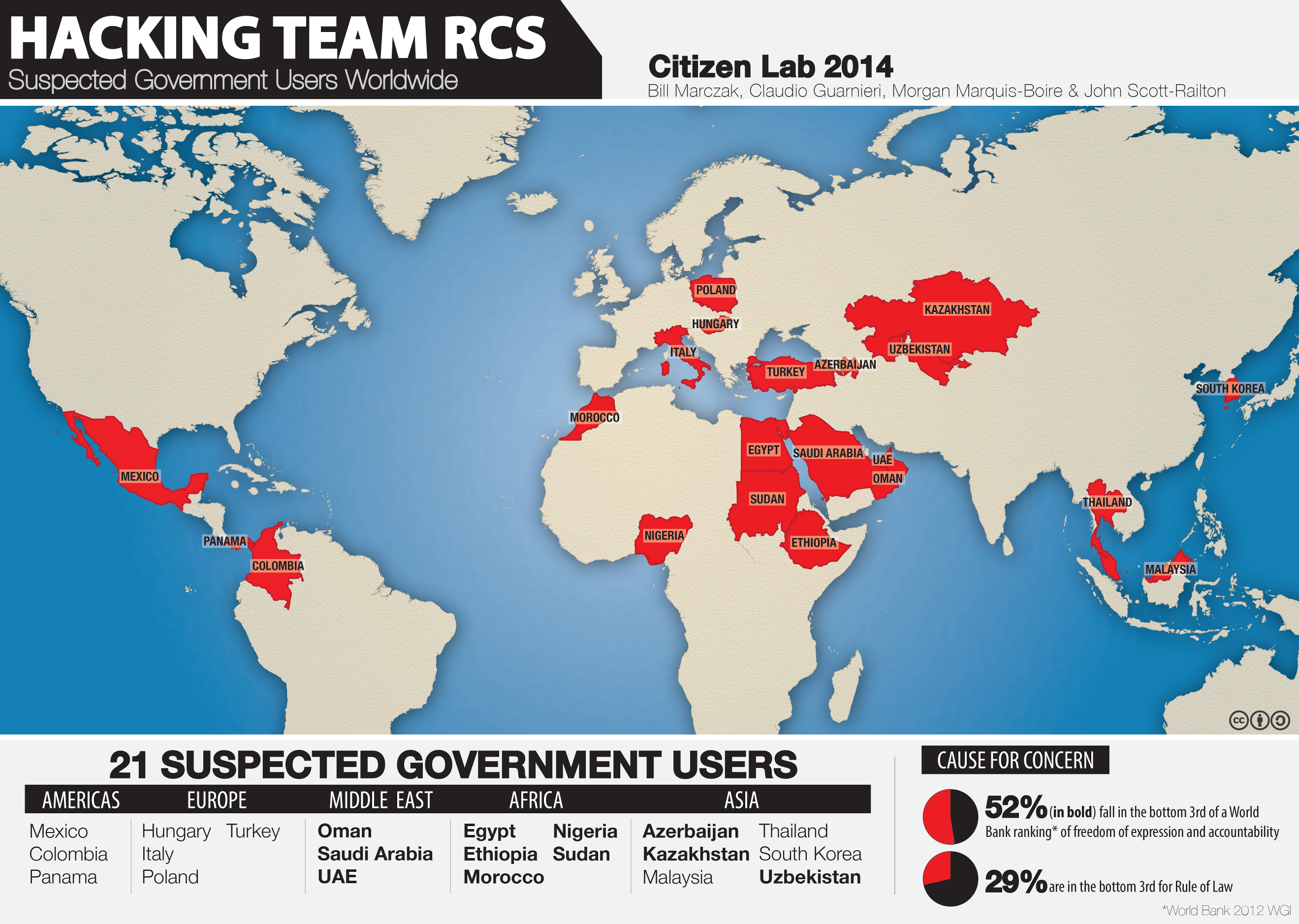
In a report published earlier this year, we presented the results of a global scanning effort, and identified 21 countries with deployments of Hacking Team’s Remote Control System monitoring solution. In addition, alongside other researchers, we have uncovered a range of cases where “lawful interception” software has been used against political targets by repressive regimes. Political and civil society targets have included Mamfakinch in Morocco, human rights activist Ahmed Mansoor in the UAE, and ESAT, a US-based news service focusing on Ethiopia. In all of these cases, a tool marketed for “law enforcement” was used against political, rather than security threats. In still other cases, like Malaysia [PDF], we have found bait documents and seeding suggestive of political targeting...
https://citizenlab.org/2014/06/backdoor-hacking-teams-tradecraft-android-implant/
20131207
FBI’s search for ‘Mo,’ suspect in bomb threats, highlights use of malware for surveillance
Mo remained elusive for months, communicating via e-mail, video chat and an Internet-based phone service without revealing his true identity or location, court documents show. So with no house to search or telephone to tap, investigators turned to a new kind of surveillance tool delivered over the Internet.
The FBI’s elite hacker team designed a piece of malicious software that was to be delivered secretly when Mo signed on to his Yahoo e-mail account, from any computer anywhere in the world, according to the documents. The goal of the software was to gather a range of information — Web sites he had visited and indicators of the location of the computer — that would allow investigators to find Mo and tie him to the bomb threats....
http://www.washingtonpost.com/business/technology/2013/12/06/352ba174-5397-11e3-9e2c-e1d01116fd98_story.html
20130913
FBI Admits It Controlled Tor Servers Behind Mass Malware Attack
Freedom Hosting’s operator, Eric Eoin Marques, had rented the servers from an unnamed commercial hosting provider in France, and paid for them from a bank account in Las Vegas. It’s not clear how the FBI took over the servers in late July, but the bureau was temporarily thwarted when Marques somehow regained access and changed the passwords, briefly locking out the FBI until it gained back control.
The new details emerged in local press reports from a Thursday bail hearing in Dublin, Ireland, where Marques, 28, is fighting extradition to America on charges that Freedom Hosting facilitated child pornography on a massive scale. He was denied bail today for the second time since his arrest in July...
http://www.wired.com/threatlevel/2013/09/freedom-hosting-fbi/
20130102
Ubuntu Spyware: What to do? — Free Software Foundation — working together for free software
Skip to content, sitemap or skip to search.
- Info
Ubuntu Spyware: What to do?
Posted by Richard Stallman at Dec 07, 2012 01:55 AM | PermalinkOne of the major advantages of free software is that the community protects users from malicious software. Now Ubuntu GNU/Linux has become a counterexample. What should we do?Proprietary software is associated with malicious treatment of the user: surveillance code, digital handcuffs (DRM or Digital Restrictions Management) to restrict users, and back doors that can do nasty things under remote control. Programs that do any of these things are malware and should be treated as such. Widely used examples include Windows, the iThings, and the Amazon "Kindle" product for virtual book burning, which do all three; Macintosh and the Playstation III which impose DRM; most portable phones, which do spying and have back doors; Adobe Flash Player, which does spying and enforces DRM; and plenty of apps for iThings and Android, which are guilty of one or more of these nasty practices.
Free software gives users a chance to protect themselves from malicious software behaviors. Even better, usually the community protects everyone, and most users don't have to move a muscle. Here's how.
Once in a while, users who know programming find that a free program has malicious code. Generally the next thing they do is release a corrected version of the program; with the four freedoms that define free software (see http://www.gnu.org/philosophy/free-sw.html), they are free to do this. This is called a "fork" of the program. Soon the community switches to the corrected fork, and the malicious version is rejected. The prospect of ignominious rejection is not very tempting; thus, most of the time, even those who are not stopped by their consciences and social pressure refrain from putting malfeatures in free software.
But not always. Ubuntu, a widely used and influential GNU/Linux distribution, has installed surveillance code. When the user searches her own local files for a string using the Ubuntu desktop, Ubuntu sends that string to one of Canonical's servers. (Canonical is the company that develops Ubuntu.)
This is just like the first surveillance practice I learned about in Windows. My late friend Fravia told me that when he searched for a string in the files of his Windows system, it sent a packet to some server, which was detected by his firewall. Given that first example I paid attention and learned about the propensity of "reputable" proprietary software to be malware. Perhaps it is no coincidence that Ubuntu sends the same information.
Ubuntu uses the information about searches to show the user ads to buy various things from Amazon. Amazon commits many wrongs (see http://stallman.org/amazon.html); by promoting Amazon, Canonical contributes to them. However, the ads are not the core of the problem. The main issue is the spying. Canonical says it does not tell Amazon who searched for what. However, it is just as bad for Canonical to collect your personal information as it would have been for Amazon to collect it.
People will certainly make a modified version of Ubuntu without this surveillance. In fact, several GNU/Linux distros are modified versions of Ubuntu. When those update to the latest Ubuntu as a base, I expect they will remove this. Canonical surely expects that too.
Most free software developers would abandon such a plan given the prospect of a mass switch to someone else's corrected version. But Canonical has not abandoned the Ubuntu spyware. Perhaps Canonical figures that the name "Ubuntu" has so much momentum and influence that it can avoid the usual consequences and get away with surveillance.
Canonical says this feature searches the Internet in other ways. Depending on the details, that might or might not make the problem bigger, but not smaller.
Ubuntu allows users to switch the surveillance off. Clearly Canonical thinks that many Ubuntu users will leave this setting in the default state (on). And many may do so, because it doesn't occur to them to try to do anything about it. Thus, the existence of that switch does not make the surveillance feature ok.
Even if it were disabled by default, the feature would still be dangerous: "opt in, once and for all" for a risky practice, where the risk varies depending on details, invites carelessness. To protect users' privacy, systems should make prudence easy: when a local search program has a network search feature, it should be up to the user to choose network search explicitly each time. This is easy: all it takes is to have separate buttons for network searches and local searches, as earlier versions of Ubuntu did. A network search feature should also inform the user clearly and concretely about who will get what personal information of hers, if and when she uses the feature.
If a sufficient part of our community's opinion leaders view this issue in personal terms only, if they switch the surveillance off for themselves and continue to promote Ubuntu, Canonical might get away with it. That would be a great loss to the free software community.
We who present free software as a defense against malware do not say it is a perfect defense. No perfect defense is known. We don't say the community will deter malware without fail. Thus, strictly speaking, the Ubuntu spyware example doesn't mean we have to eat our words.
But there's more at stake here than whether some of us have to eat some words. What's at stake is whether our community can effectively use the argument based on proprietary spyware. If we can only say, "free software won't spy on you, unless it's Ubuntu," that's much less powerful than saying, "free software won't spy on you."
It behooves us to give Canonical whatever rebuff is needed to make it stop this. Any excuse Canonical offers is inadequate; even if it used all the money it gets from Amazon to develop free software, that can hardly overcome what free software will lose if it ceases to offer an effective way to avoid abuse of the users.
If you ever recommend or redistribute GNU/Linux, please remove Ubuntu from the distros you recommend or redistribute. If its practice of installing and recommending nonfree software didn't convince you to stop, let this convince you. In your install fests, in your Software Freedom Day events, in your FLISOL events, don't install or recommend Ubuntu. Instead, tell people that Ubuntu is shunned for spying.
While you're at it, you can also tell them that Ubuntu contains nonfree programs and suggests other nonfree programs. (See http://www.gnu.org/distros/common-distros.html.) That will counteract the other form of negative influence that Ubuntu exerts in the free software community: legitimizing nonfree software.
Reference
Privacy in Ubuntu 12.10: Amazon Ads and Data Leaks by Micah Lee at the Electronic Frontier Foundation.
Copyright 2012 Richard Stallman
Released under the Creative Commons Attribution Noderivatives 3.0 license
Comments (0)
- Upcoming Events
"A Free Digital Society"
Jan 17, 2013 04:15 PM - 06:30 PM — Ann Arbor, MIFOSDEM '13
Feb 02, 2013 - Feb 03, 2013 — Brussels, Belgium- Previous events…
- Upcoming events…
Sign up
The FSF is a charity with a worldwide mission to advance software freedom — learn about our history and work.
Free Software Foundation The Free Software Foundation (FSF) is a nonprofit with a worldwide mission to promote computer user freedom and to defend the rights of all free software users. -->Copyright © 2004-2012 Free Software Foundation, Inc.
This work is licensed under a Creative Commons Attribution-No Derivative Works 3.0 license (or later version) — Why this license?.
The FSF also has sister organizations in France, Latin America, Europe and India.
20120618
20120422
Google Chrome behind the scenes
Subject: [Fed-Talk] Google Chrome behind the scenes
Date: April 17, 2012 8:20:59 PM PDT
To: fed-talk@lists.apple.com Talk <fed-talk@lists.apple.com> "If you've ever wondered how Google keeps Chrome up-to-date behind the scenes, I took some time deconstructing its activities and writing it up. In many ways it acts very similarly to malware used in Advanced Persistent Threats (APTs), so I gave the article a purposely provocative title. Actually... the whole article is a little provocative. I guess I was feeling a little punchy after too many long hours.If you want to jump straight to the hairy graphic, here it is:
http://www.netsq.com/Documents_html/GoogleAPT/Todd"
20120402
Richard Clarke on Who Was Behind the Stuxnet Attack | Smithsonian Magazine
20110619
20110604
List of cyber-weapons developed by Pentagon to streamline computer warfare
"The Pentagon has developed a list of cyber-weapons and -tools, including viruses that can sabotage an adversary’s critical networks, to streamline how the United States engages in computer warfare.
The classified list of capabilities has been in use for several months and has been approved by other agencies, including the CIA, said military officials who spoke on the condition of anonymity to describe a sensitive program. The list forms part of the Pentagon’s set of approved weapons or “fires” that can be employed against an enemy..." http://www.washingtonpost.com/national/list-of-cyber-weapons-developed-by-pen...20110406
20110307
Computer expert says US behind Stuxnet worm
Computer expert says US behind Stuxnet wormBy Glenn Chapman (AFP) – 3 days ago
LONG BEACH, California — A German computer security expert said Thursday he believes the United States and Israel's Mossad unleashed the malicious Stuxnet worm on Iran's nuclear program.
"My opinion is that the Mossad is involved," Ralph Langner said while discussing his in-depth Stuxnet analysis at a prestigious TED conference in the Southern California city of Long Beach.
"But, the leading source is not Israel... There is only one leading source, and that is the United States."
There has been widespread speculation Israel was behind the Stuxnet worm that has attacked computers in Iran, and Tehran has blamed the Jewish state and the United States for the killing of two nuclear scientists in November and January.
"The idea behind Stuxnet computer worm is really quite simple," Langner said. "We don't want Iran to get the bomb."
The malicious code was crafted to stealthily take control of valves and rotors at an Iranian nuclear plant, according to Langner.
"It was engineered by people who obviously had inside information," he explained. "They probably also knew the shoe size of the operator."
Stuxnet targets computer control systems made by German industrial giant Siemens and commonly used to manage water supplies, oil rigs, power plants and other critical infrastructure.
"The idea here is to circumvent digital data systems, so the human operator could not get there fast enough," Langner said.
"When digital safety systems are compromised, really bad things can happen -- your plant can blow up.
Most Stuxnet infections have been discovered in Iran, giving rise to speculation it was intended to sabotage nuclear facilities there. The worm was crafted to recognize the system it was to attack.
The New York Times reported in January that US and Israeli intelligence services collaborated to develop the computer worm to sabotage Iran's efforts to make a nuclear bomb.
Russia called on NATO in January to launch an investigation into the computer worm that targeted a Russian-built Iranian nuclear power plant, saying the incident could have triggered a new Chernobyl.
Russia's envoy to NATO in January said Stuxnet caused centrifuges producing enriched uranium at the Bushehr plant to spin out of control, which could have sparked a new "Chernobyl tragedy," the 1986 nuclear meltdown in Ukraine.
"The operators saw on their screens that the centrifuges were working normally when in fact they were out of control," Dmitry Rogozin told reporters after meeting with ambassadors from the 28-nation Western alliance.
Russia is helping Iran build a nuclear power plant in the southern city of Bushehr for civilian use.
Langner said the Stuxnet code was designed to trick human operators by showing them recorded readings indicating machinery is running normally while behind the scenes they are heading for destruction.
"It's definitely hard-core sabotage," Langner said of Stuxnet. "It's like in the movies where during a heist the security camera is running pre-recorded video showing nothing is wrong."
Iran's envoy to the International Atomic Energy Agency has denied that the Stuxnet attack effected the country's nuclear program, including Bushehr.
A terrifying aspect of Stuxnet, according to Langner, is that it is a generic attack that would work well in factories, power plants, or other operations plentiful in the United States.
"It's a cyber weapon of mass destruction," Langner said. "We'd better start preparing right now."
Copyright © 2011 AFP. All rights reserved. More »