Showing posts with label Iraq. Show all posts

20170211

Wiki: Adnan Khashoggi


Adnan Khashoggi (Arabic: عدنان خاشقجي‎‎; born 25 July 1935) is a Saudi Arabian businessman. At a peak net worth of up to 10 billion USD in the early 1980s, he was considered one of the richest men in the world.[1][2]

Khashoggi was born in Mecca, the son of Muhammad Khashoggi, who was King Abdul Aziz Al Saud's personal doctor.[3] His family is of Turkish origin. Adnan Khashoggi's sister Samira Khashoggi Fayed married Mohammed Al-Fayed and was the mother of Dodi Fayed.[4] Another sister, Soheir Khashoggi, is a well-known Arab writer (Mirage, Nadia's Song, Mosaic).[5]

Khashoggi was educated at Victoria College in Alexandria, Egypt,[3] and the Americanuniversities California State University, Chico, Ohio State, and Stanford. Khashoggi left his studies in order to seek his fortune in business...

Khashoggi headed a company called Triad Holding Company, which among other things built the Triad Center in Salt Lake City, Utah, which later went bankrupt. He was famed as an arms dealer, brokering deals between US firms and the Saudi government, most actively in the 1960s and 1970s....

Among his overseas clients were defense contractorsLockheed Corporation (now Lockheed Martin Corporation), Raytheon, Grumman Aircraft Engineering Corporation and Northrop Corporation (which have now merged into Northrop Grumman)....

A shrewd businessman, he established companies in Switzerland and Liechtenstein to handle his commissions as well as developing contacts with notables such as CIAofficers James H. Critchfield and Kim Roosevelt and US businessman Bebe Rebozo, a close associate of former US President Richard Nixon. His yacht, the Nabila, was the largest in the world at the time and was used in the James Bond film Never Say Never Again. After Khashoggi ran into financial problems he sold the yacht to the Sultan of Brunei, who in turn sold it to Donald Trump for $29 million, who sold it for $20 million[7]to Prince Al-Waleed bin Talal as part of a deal to keep his Taj Mahal casino out of bankruptcy.[8]...

Iran–Contra affair[edit source]
He was implicated in the Iran–Contra affair as a key middleman in the arms-for-hostages exchange along with Iranian arms dealer Manucher Ghorbanifar and, in a complex series of events, was found to have borrowed money for these arms purchases from the now-bankrupt financial institution the Bank of Credit and Commerce International (BCCI) with Saudi and US backing...

Imelda Marcos affair[edit source]
In 1988, Khashoggi was arrested in Switzerland, accused of concealing funds, and held for three months. Khashoggi stopped fighting extradition when the US prosecutors reduced the charges to obstruction of justice and mail fraud and dropped the more serious charges of racketeering and conspiracy. In 1990, a United States federal jury in Manhattan acquitted Khashoggi and Imelda Marcos, widow of the exiled Philippine President Ferdinand Marcos, of racketeering and fraud.[9][10]...

Genesis Intermedia[edit source]
Khashoggi, along with Ramy El-Batrawi, was the principal financier behind Genesis Intermedia, Inc. (formerly NASDAQ: GENI), a publicly traded Internet company based in the US. In 2006, El-Batrawi and Kashoggi were sued by the SEC for securities fraud.[11] The case was settled in 2008; both men did not admit or deny the allegations;.[12]...

Seymour Hersh report[edit source]
In January 2003, Seymour Hersh reported in The New Yorker magazine that former US Assistant Secretary of Defense Richard Perle had a meeting with Khashoggi in Marseille in order to use him as a conduit between Trireme Partners, a private venture capital company of which he was one of three principals, and the Saudi government. At the time, Perle was chair of the Defense Policy Board, a Defense Department advisory group, which provided him with access to classified information and a position to influence defense policy. An advocate of the overthrow of Iraqi dictator Saddam Hussein, Perle had served as an adviser to 2000 Republican US Presidential nominee George W. Bush.

Khashoggi told Hersh that Perle talked to him about the economic costs regarding a proposed invasion of Iraq. "'If there is no war,' he told me, 'why is there a need for security? If there is a war, of course, billions of dollars will have to be spent.'"[13]...

2011 money laundering case[edit source]
Khashoggi was implicated in a money laundering case involving the use of an Indian citizen. In 2011, Hasan Ali Khan, owner of a Pune stud farm, was arrested by India's Enforcement Directorate and charged. Khan and Kolkata businessman Kashinath Tapuriah were charged under the Prevention of Money Laundering Act. Allegedly, in 2003, Khan helped launder US$300 million of money through the Zurich branch of Swiss bank UBS.[14][15]

Khan and Tapuriah admitted to knowing Kashoggi, and Khan described him as a friend. Introduced to UBS by Khashoggi in 1982, Khan held funds in American accounts through UBS Geneva.[16] One of Khan's accounts was eventually blocked.[17]...

20161004

Bell Pottinger in the spotlight for creating propaganda videos for US military in Iraq


The work included creating short news segments made to look like Arabic news networks and fake insurgent videos, The Sunday Times, which worked with the Bureau on the investigation, and other news outlets reported over the weekend.

The scale of Bell Pottinger’s operation in Iraq was significant; costing, on average, more than a hundred million dollars per year, with the agency at one point employing almost 300 British and Iraqi staff.

Bell Pottinger made about £15m a year in fees from the work, agency founder Lord Bell told The Sunday Times, with the bulk of the money going on costs such as production and distribution.

The agency’s work started in Iraq in March 2004 when it was tasked with "promotion of democratic elections", but the Bureau said it has identified transactions worth $540m (£420m) between the Pentagon and Bell Pottinger relating to contracts issued from May 2007 to December 2011, with a contract worth a similar annual rate ($120m, £93m) reportedly in force in 2006 too.

Quoted widely in the media, former Bell Pottinger employee Martin Wells said his work consisted of three types of products: TV ads portraying al Qaeda in a negative light; news items made to look as if they had been "created by Arabic TV" and with the origins sometimes hidden; and the production of fake al Qaeda propaganda films.

The latter would be put on CDs and dropped into areas that were raided. The CDs had a code embedded in them that gave the location of where they had been played...

http://www.prweek.com/article/1410858/bell-pottinger-spotlight-creating-propaganda-videos-us-military-iraq

20160910

The Pentagon has shipped more than a million small arms to Iraq and Afghanistan’s defense forces


The Pentagon has spent billions of dollars since 2001 funneling roughly more than a million assault rifles, pistols, shotguns, and machine guns into Iraq and Afghanistan, helping to fuel lasting conflict there, according to a new report by a London-based nonprofit research and advocacy group Action on Armed Violence.

At least 949,582 of these small arms were given to security forces in Iraq, and at least 503,328 small arms were given to local forces in Afghanistan, the group said. They called this an “under-estimate” based on the information they were able to acquire.

If the figures are correct, the US exports amounted to more than one small arm for each member of Afghanistan’s security forces, which totaled roughly 355,000 soldiers, police, and airmen in February 2015, according to a NATO operational update on the force. The number of armaments sent to Iraq also vastly exceeded the current size of that country’s active military and paramilitaries - 209,000, according to the International Institute for Strategic Studies’ 2016 Military Balance report.

Until now, the Pentagon hasn’t published such a tally of its own, so the group’s researchers spent a year scouring multiple databases to arrive at its estimate: a general Pentagon contract list, a government-wide contracting list, and multiple government reports on military spending. They finally calculated that the overall value of the contractually-agreed small arms shipments, just to those two countries, was roughly $2.16 billion.

U.S. intelligence reports and eyewitnesses have previously said that a significant fraction of the U.S.-financed arms were either lost or stolen, and that many wound up in the hands of forces opposed to US interests, including terrorist groups such as the Islamic State, or ISIS...

https://www.publicintegrity.org/2016/08/26/20146/pentagon-has-shipped-more-million-small-arms-iraq-and-afghanistan-s-defense-forces

20160530

After Iraq War, Monsanto, Cargill & Dow Chemical Took Over Iraqi Agriculture


BAGHDAD — In the aftermath of the Iraq War, Iraq’s seed and agriculture industry was destroyed by U.S. corporations, with the aid of the U.S. government.

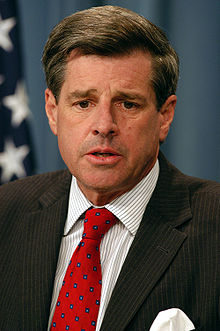
In May 2003, after the war officially ended, U.S. diplomat Paul Bremer became the head of the occupational authority, essentially controlling Iraq’s government. He issued 100 orders that set the strategy for rebuilding efforts, including Order 81, “Patent, Industrial Design, Undisclosed Information, Integrated Circuits and Plant Variety Law.”

Dr. Dahlia Wasfi, a physician and environmental activist, explained the devastating impact of this order in a 2008 speech.

“Before 2003 they had a well functioning, centrally-controlled seed industry that had developed over the years a rich seed variety for almost variation of wheat in the world today,” she said.

Wasfi said Iraqi farmers achieved this by following ancient traditions of saving, replanting and sharing seeds from previous harvests. Historians agree that agriculture as we know it, including many of these seed-saving techniques, originated in ancient times, around 5,000 B.C.E., in the region of the Middle East that includes modern-day Iraq.

But by 2005, Iraq was providing for only 4 percent of its seed needs, Wasfi said, explaining that under Order 81, “Iraqi farmers are not allowed to save seeds, they are not allowed to share seeds, no sharing, and they are not allowed to replant harvested seeds.”

She also pointed to years of U.S.-driven war and sanctions as other key factors in the collapse of the native seed industry...

http://www.mintpressnews.com/iraq-war-monsanto-cargill-dow-chemical-took-iraqi-agriculture/216614/

20160516

THE SECRET NSA DIARY OF AN ABU GHRAIB INTERROGATOR

AFTER WORKING AS an interrogator for a U.S. military contractor in Iraq, Eric Fair took a job as an analyst for the National Security Agency. When he went to the NSA, Fair was reckoning with the torture of Iraqi prisoners, torture he had witnessed and in which he had participated.

Fair would go on to write a memoir detailing his experiences in Iraq; the book, Consequence, was published last month to strong notices, including not one but two positive reviews in the New York Times. But Fair actually wrote about his time as an interrogator more than a decade earlier in an internal NSA publication.

One of the publication’s editors asked him to contribute a piece about “how my experience as an interrogator influences my work at the NSA,” as he put it in Consequence. Fair submitted an article in which “I question the efficacy of certain intelligence-gathering techniques and wonder whether, for the sake of morality, it might be best to sacrifice some level of tactical knowledge.”

“I was asked rewrite this section. I cut it completely. Instead, I wrote about how my experience in the interrogation booths had familiarized me with the overall intelligence cycle.”

Fair’s article for the NSA publication is among the files provided by former agency contractor Edward Snowden. It appeared in SIDtoday, a newsletter for the NSA’s Signals Intelligence Directorate, or SID, and is being released by The Intercept...

https://theintercept.com/2016/05/11/the-secret-nsa-diary-of-an-abu-ghraib-interrogator/

20160314

Where did ISIS come from? The story starts here.

AS SOON AS I ARRIVE AT HIS HOME, a well-kept but slightly dated fieldstone Colonial in Chevy Chase, Maryland, he ushers me down a staircase into the basement, past one bookcase packed with white binders and another stacked with board games. We end up in a dimly lit corner where a desk, a couch, and a treadmill all jockey for space. “This is basically my office,” L. Paul Bremer tells me, adding almost apologetically, “and our exercise area.”

For a man who once commanded the world’s attention, working out of a palace and wielding expansive powers over 25 million people while serving as America’s viceroy in postwar Iraq, these quarters seem modest. But the reminders of a more influential time are all around. Each of those white binders is labeled “CPA Archives,” as in the Coalition Provisional Authority that President George W. Bush appointed Bremer to run one month after US troops had cruised into Baghdad. (At one point during his reign, Bremer is said to have waved off a British general’s concerns about the legality of a certain security measure with the quip “I am the law.”) Along the white-paneled walls hang framed photos of Bremer with the biggest stars in the firmament of Republican administrations over the last half century: Nixon, Ford, Reagan, Bushes 41 and 43, as well as Kissinger, Haig, Rumsfeld, and Cheney.

When George W. appointed Bremer in May 2003, after the exhilaration around the toppling of Saddam Hussein’s statue had been quickly followed by a descent into looting and lawlessness, most people were caught off guard. That included the Bush administration’s first postwar point man in Iraq, retired Lieutenant General Jay Garner, who had just arrived in Baghdad when he learned he was about to be replaced. Although Bremer was a former ambassador, he spoke no Arabic, had no experience with postwar reconstruction or with running a large organization, had never served in the military or the Arab world, and had never even visited Iraq. Those shortcomings did not hinder his candidacy. Perversely, as I would learn from Bremer, they enhanced it.

Bremer’s Iraq tour turned out to be relatively brief, just 14 months, yet it continues to resonate to this day. That’s particularly true around a couple of enormously consequential decisions that he announced during just his first two weeks in Baghdad. In those decisions, critics argue, one can find the roots of the lethal insurgency that upended Iraq, as well as the scourge of ISIS that followed and now threatens to draw American troops back onto Iraqi soil for the third time in as many decades. In the end, though, how much should Bremer be held responsible for the continuing mess of the Middle East?

It’s been more than five years since US combat troops left Iraq. It took about that long after Vietnam for the nation to begin wrestling honestly with the forces that had led us into that mistaken war. It’s time we start doing the same with Iraq. And the case of L. Paul Bremer — at once well intentioned, infuriating, and tragic — is the ideal place to anchor this kind of reexamination...

https://www.bostonglobe.com/magazine/2016/03/10/where-did-isis-come-from-the-story-starts-here/eOHwJQgnZPNj8SE91Vw5hK/story.html

20160115

Remembering the Iran-Iraq War

Thirty five years ago today, Iraq’s President Saddam Hussein made a dangerous gamble that did not pay off: with Iran vulnerable after the Islamic Revolution of 1979, Hussein attacked the oil-rich province of Khuzistan, inhabited mostly by Arabs. Since its independence in 1932, Iraq was critical of the Pahlavi monarchy for fashioning Iran as a Persian nation, and had disputed Iran’s right to a province so heavily populated by Arabs. Hussein’s early successes on the warfront compelled Ayatollah Khomeini, Iran’s new leader, to deploy an enormous number of recently, and often poorly, trained soldiers to the front. By 1982, Khomeini had forced Hussein’s hand. Retreating to the internationally recognized borders, Iraq’s President offered Khomeini peace. An emboldened Khomeini went on the offensive. The war reached a fever pitch in 1986 when Iran overtook Iraq’s al-Faw Peninsula. Western governments, until then satisfied with funding both sides, stepped in to resolve the conflict, which finally ended in 1988.

The Iran-Iraq War (1980-88), largely overshadowed in the United States by Hussein’s invasion of Kuwait in 1990, cost roughly one million lives. While Iran drew the attention of the West to Hussein’s illegal use of chemical weapons, Iraq paraded before the international press Iranian child soldiers (under the age of fifteen), who constituted a staggering 100,000 of Iran’s casualties. Hussein and Khomeini, both egregious violators of human rights, caused Iranians and Iraqis tremendous trauma.

A few scholars in the West, most notably Dina Khoury, Amatzia Baram, and Hamid Dabashi, have seriously contended with the effects of the devastating total war. Most historians have instead emphasized the political revolutions that shaped the two nations. For Iraqi studies, much ink has been spilt on Abd al-Karim Qasim’s Republican Revolution of 1958 and the Bathist coup led by Hasan al-Bakr and Saddam Hussein in 1968. Iran too has had its important political upheavals, including the CIA-backed 1953 coup that ousted democratically elected Prime Minister Mohammad Mossadegh as well as the 1979 Islamic Revolution that finally resulted in the end of monarchy, and the rise of a fundamentalist Shi‘i government, in Iran. Other scholars and commentators are concerned with the pressing questions of today’s Middle East. As Iraq now falls apart along ethnic and religious lines after over a decade of US intervention and Iran emerges from decades of painful sanctions, many rightfully preoccupy themselves with lamenting or celebrating present circumstances...

https://notevenpast.org/remembering-the-iran-iraq-war/

20130825

Exclusive: CIA Files Prove America Helped Saddam as He Gassed Iran


The U.S. government may be considering military action in response to chemical strikes near Damascus. But a generation ago, America's military and intelligence communities knew about and did nothing to stop a series of nerve gas attacks far more devastating than anything Syria has seen, Foreign Policy has learned.

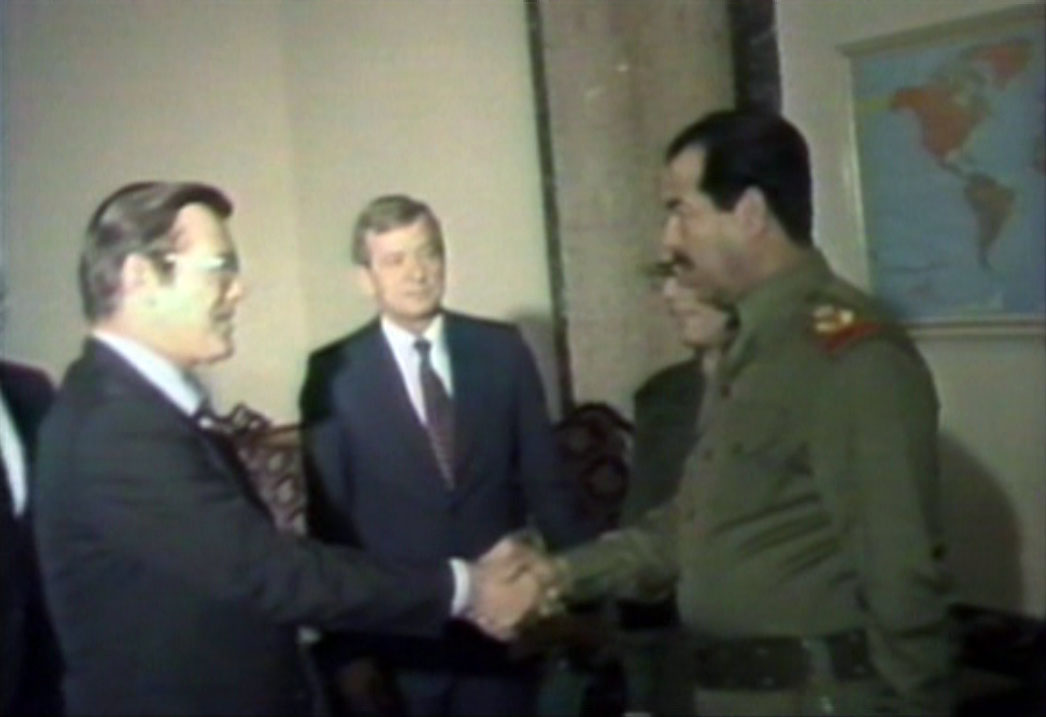
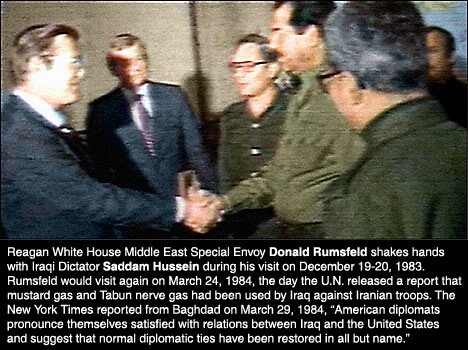
In 1988, during the waning days of Iraq's war with Iran, the United States learned through satellite imagery that Iran was about to gain a major strategic advantage by exploiting a hole in Iraqi defenses. U.S. intelligence officials conveyed the location of the Iranian troops to Iraq, fully aware that Hussein's military would attack with chemical weapons, including sarin, a lethal nerve agent.

The intelligence included imagery and maps about Iranian troop movements, as well as the locations of Iranian logistics facilities and details about Iranian air defenses. The Iraqis used mustard gas and sarin prior to four major offensives in early 1988 that relied on U.S. satellite imagery, maps, and other intelligence. These attacks helped to tilt the war in Iraq's favor and bring Iran to the negotiating table, and they ensured that the Reagan administration's long-standing policy of securing an Iraqi victory would succeed. But they were also the last in a series of chemical strikes stretching back several years that the Reagan administration knew about and didn't disclose...