

20160409
Wiki: John Poindexter

Iran–Contra affair[edit source | edit]
The Iran-Contra affair resulted from the discovery of the United States' involvement in sending money and weapons to Iran for the release of American hostages from Lebanon, and sending aid to the Contras. This involvement was in violation of the Boland Amendment which prevented the United States from directly or indirectly being involved with the Contras.[5] Evidence revealed that Poindexter was a leader in the organization of the transfer of the weapons to Iran and oversaw other people involved in the affair, such as Oliver North.
Poindexter and North communicated through a channel known as the "Private Blank Check" which Poindexter set up on a National Security Council (NSC) computer. Through this system, Poindexter and North were able to send messages back and forth without being intercepted by other NSC staff members. This system was not successful. Even though both Poindexter and North attempted to delete the messages, the White House Communications Agency was able to recover some of them, later used in trying Poindexter and North. On November 25, 1986, after the public disclosure of the Iran-Contra affair, Poindexter was forced to resign from his position as National Security Advisor,[6]
Poindexter was convicted on April 7, 1990, of five counts of lying to Congress and obstructing the Congressional committees investigating the Iran-Contra Affair, which were investigating the Reagan Administration's covert arms sales to Iran and the diversion of proceeds to insurgents fighting to overthrow the Sandinista government in Nicaragua. The convictions were reversed in 1991 on appeal[7] on the grounds that several witnesses against him had been influenced by his testimony before Congress, even though Congress had given him immunity for that testimony.[8]...
Recall to public service[edit source | edit]
Late in 2001, upon the recommendation of Science Applications International Corporation executive Brian Hicks, then Vice President Dick Cheney recommended Admiral Poindexter to head a separate anti-terrorist office and serve under US Secretary of Defense Donald Rumsfeld.
Information Awareness Office[edit source | edit]
From January 2002 to August 2003, Poindexter served as the Director of the DARPA Information Awareness Office (IAO). The mission of the IAO was to imagine, develop, apply, integrate, demonstrate and transition information technologies, components, and prototype closed-loop information systems. This aimed to counter asymmetric threats (most notably, terrorist threats) by achieving total information awareness and thus aiding preemption; national security warning; and, national security decision making.[12]...
https://en.wikipedia.org/wiki/John_Poindexter
20150418
Memex In Action: Watch DARPA Artificial Intelligence Search For Crime On The 'Dark Web'

It’s likely that in the coming weeks many other law enforcement agencies will avail themselves of the search tools, which will land on DARPA’s Open Catalog next Friday (though DARPA told FORBES the release could be pushed back to the following Monday). FORBES got an exclusive look at the front end of one of the search technologies created by one of the Memex team, a group of self-proclaimed hackers called Hyperion Gray.
According to Alejandro Caceres, who heads up the Hyperion Gray team, a handful of his firm’s tools will be available, including “advanced web crawling and scraping technologies, with a dose of Artificial Intelligence and machine learning, with the goal of being able to retrieve virtually any content on the Internet in an automated way”. Its solution to the problem of finding crime on the so-called “dark web” (a term anathema to Tor’s supporters), is called SourcePin. It is trying to overcome one of the main barriers to modern search: crawlers can’t click or scroll like humans do and so often don’t collect “dynamic” content that appears upon an action by a user.
“Our approach to solving this problem is to build a system that sees the web more like a human user with a browser, and therefore actually behaves like a human user by using a browser to crawl the web, to the point of being able to scroll down a page, or even hover over an object on the page to reveal more content…. we are teaching the system how to act like a human and handle virtually any web page scenario. Eventually our system will be like an army of robot interns that can find stuff for you on the web, while you do important things like watch cat videos,” says Caceres...
http://www.forbes.com/sites/thomasbrewster/2015/04/10/darpa-memex-search-going-open-source-check-it-out/
20140208
IBM developing Self-Destructing Microchips for US Defense

The agency of the United States Department of Defense which is responsible for funding the development of many technologies, Defense Advanced Research Projects Agency (DARPA) hashanded over a contract to IBM for creating a microchip that will self-destruct remotely.
The project announced a year back, known as Vanishing Programmable Resources (VAPR), which is dedicated to developing a CMOS microchip that self-destructs when it receives a certain frequency of radio signal from military command, in order to fully destroy it and preventing it from being used by the enemy...
20120510
DARPA Space Enabled Effects for Military Engagements (SeeMe) - YouTube
20120421
DARPA Doubling Down on Spy Technologies
Declining budgets mean that DARPA has had narrow down its wish list, and agency leaders have determined global ISR to be one of the most important study areas, Urban said April 17 at the National Defense Industrial Association’s annual science and engineering technology conference. U.S. drones in Iraq and Afghanistan have been relatively unchallenged, but the next conflict may require ISR operations in contested airspace. So DARPA is looking into sensors that would be powerful enough to fly in friendly airspace and peer into countries where access is denied. In addition to persistence, DARPA is focusing on higher resolution imagery and wider view sensors... http://www.nationaldefensemagazine.org/blog/Lists/Posts/Post.aspx?List=7c996c.../blog/Lists/Posts
20120321
Facebook Is a CIA/NSA Information Gathering Tool - YouTube
This is old but unfortunately still relevant.
20111225
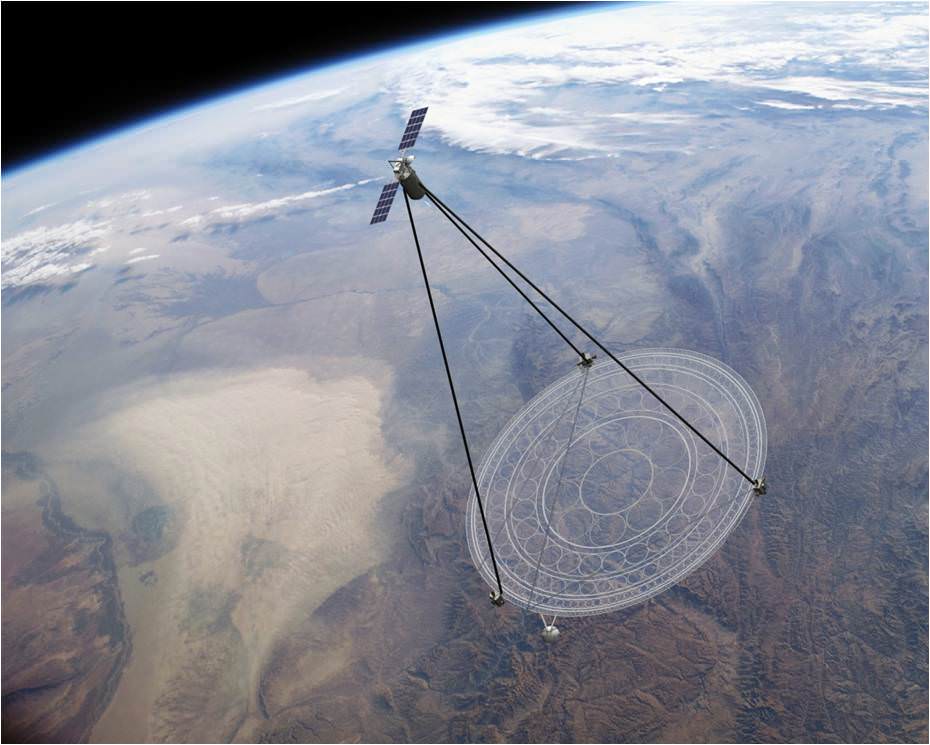
DARPA’s New Spy Satellite Could Provide Real-Time Video From Anywhere on Earth

Artist concept of the Membrane Optical Imager for Real-Time Exploitation (MOIRE). Credit: DARPA
“It sees you when you’re sleeping and knows when you’re awake” could be the theme song for a new spy satellite being developed by DARPA. The Defense Advanced Research Projects Agency’s latest proof-of-concept project is called the Membrane Optical Imager for Real-Time Exploitation (MOIRE), and would provide real-time images and video of any place on Earth at any time — a capability that, so far, only exists in the realm of movies and science fiction. The details of this huge eye-in-the-sky look like something right out of science fiction, as well, and it would be interesting to determine if it could have applications for astronomy as well.

20110724


20110626

20110604
One Brain, Hundreds of Eyes: Darpa Plots Manhunt Master Controller
Thought military tracking technology couldn’t get any creepier? Hold onto your tinfoil hats and hide behind the nearest curtain because the next generation of manhunting gear just took another step closer to reality.
The Pentagon’s bleeding-edge research shop, Darpa, announced this week that it awarded a $14 million contract to defense contractor SAIC to build Insight, its system-of-systems effort to mashup snooping sensors that’ll find human prey on the battlefield.
Darpa has developed loads of sensors and spying gear: everything from the 1.8-gigapixel Argus camera to the Vehicle and Dismount Exploitation Radar (given the wonderful acronym, “Vader”) that pinpoints humans, cars and trucks from a distance. But getting all these systems to mesh together so that your average grunt can form a picture clear enough to track a high value terrorist or insurgent in real time is tricky, to say the least. It’s a classic problem in intelligence work: too much information and too much trouble connecting the dots. The result is “information overload” in general, and “information underload” on specific targets.
And that’s the problem that Darpa wants Insight to solve. It’s supposed to help users sift through the heaps of information collected by the U.S. military’s numerous sensor platforms to find just the right information, on just the right targets using the most appropriate combination of spying gear.
Darpa wants Insight to integrate data from a dizzying array of sources. It’s hungry for info from ground moving target indicators, infrared video, multispectral imagery, human tipsters, audio intercepts, even text chats and social media, among others. The idea, though, isn’t to configure the program for a fixed set of inputs, but allow it to be flexible enough to “plug and play” with different sensors as needs dictate.
But Insight isn’t just supposed to be a warehouse for all the data soaked up by the military’s eyes and ears. It’s supposed to make sense of it, too. In a notice to researchers, Darpa states that the system needs to be able to perform “threat network detection/estimation,” “anomaly detection” and ”behavioral (pattern-of-life) modeling including cultural, social, and insurgency dynamics.” In other words, Insight needs to get a feel for the rhythm of life in the areas it’s looking at, understand what kinds of threats its users are interested in and be able to automatically pick them out of the heaps of data and background noise.
Just so Insight isn’t running off its own smarts alone, Darpa’s planning a number of tools to aid the human-software collaboration, including “visualization, hypothesis manipulation, and on-line learning” as well as other “algorithms and data processing technologies.”
So how will Insight be used on the battlefield? Think high value targets, for one. Darpa says its spy system needs to be able to track so-called “high value individuals” (.pdf) and insurgents, even over the long term, across a range of settings from rural to urban. Insight’s also supposed to be capable enough to think one step ahead of the threats it tracks and anticipate their next move, like sniffing out a possible ambush.
On the ground, it would play out like this. An analyst adds to a watch list the name of a particularly important insurgent. A sensor picks up someone who might be him driving past a checkpoint in Iraq. Insight automatically recognizes that he’ll soon drive out of range of the current sensor and switches over to a new snooping device closer by to pick him up down the road. It follows him as he picks up associates and drives to a meeting, keeping a constant watch on him as it shifts from sensor data to communications intercepts to the real-time reports of spies on the ground, ultimately verifying his identity.
A system this complex, you can’t just dump in Iraq or Afghanistan. So Darpa is looking to set up an “incubator” — a sort of virtual world, where all these sensors and sensor-integrators can be tested out first. The pixelized place will pit the system against a battery of simulated sensor data and information collected from real world threats to see how it performs at tracking threats. Once it’s finished in the virtual world, it moves to meatspace testing at the Army’s National Training Center in Ft. Irwin, California. Only then would it go to an honest-to-God war zone.
Photo: Flickr/US Army
See Also:
- Beyond Surveillance: Darpa Wants a Thinking Camera
- UK Crossing Guards Join the Surveillance State
- New Army Camera Promises Super-Wide Surveillance
- All-Seeing Blimp Could Be Afghanistan’s Biggest Brain
- Navy Seeks Unblinking Eye for Battlefield Surveillance
- With Drones and Satellites, U.S. Zeroed in on bin Laden


