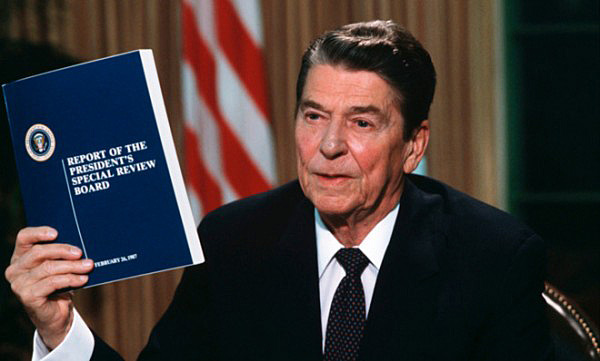
Washington, D.C., November 25, 2016 – Exactly thirty years ago, President Ronald Reagan announced to the nation – after weeks of denials – that members of his White House staff had engaged in a web of covert intrigue linking illicit U.S. support for a guerrilla war in Central America with an illegal and politically explosive arms-for-hostages bargain with the Islamic Republic of Iran. The revelation quickly led to a new phrase – “Iran-Contra” – which became synonymous with political hubris, government incompetence, and dishonesty in the public sphere.
Over the years, the National Security Archive has published major document collections, books, and web postings about Iran-Contra that expand on all of these areas of inquiry (see links in left column). Today, the Archive posts a selection of materials that spotlight the last of the elements above – deceitfulness – whose relevance has sadly become more pronounced after a bruising political season marked by examples and allegations of widespread public contempt for facts, evidence and the truth.
Today’s focus also follows Oxford Dictionaries’ selection earlier this month of the term “post-truth” as its Word of the Year, a choice it traced indirectly to the Reagan-era scandal: “Post-truth seems to have been first used in this meaning in a 1992 essay by the late Serbian-American playwright Steve Tesich in The Nation magazine. Reflecting on the Iran-Contra scandal and the Persian Gulf War, Tesich lamented that ‘we, as a free people, have freely decided that we want to live in some post-truth world.’” (See The Nation, January 6/13, 1992)
The historical record, including thousands of documents and hundreds of hours of testimony that are not possible to reproduce here, bears out the connection between the attitudes evident during the mid-1980s and what Americans have been witnessing in 2016.
The Iran-Contra affair inundated national news coverage starting a few weeks before the November 1986 press conference (as stories about the Contra and Iran operations leaked out) and lasting through Summer 1987. A galvanized media that had faced criticisms for its lax treatment of Reagan seemed eager to make up for it now that it finally had a story of Watergate proportions. Picking up on aspects of secret administration policy that only a few intrepid reporters had noticed before, TV and print outlets uncovered sometimes shocking new information about the lengths to which the Reagan administration had gone to press the Contra war in and around Nicaragua without authorization from Congress.
Similar disclosures came out about National Security Council staff-supervised contacts with Iranian intermediaries and Israeli counterparts, along with covert missile shipments from U.S. military stocks to Iran. Various committees in Congress hastily held hearings that produced more discoveries along the same lines.
Eventually, a joint congressional select committee was convened and an independent counsel appointed by the courts, both of which uncovered volumes of invaluable documentary evidence of what had transpired, including:
After being explicitly prohibited from aiding the Contras with military or intelligence support, the president and his top advisers had agreed to solicit financial and other material backing from a slew of foreign governments (Document 01), from Saudi Arabia, to China, to the Sultanate of Brunei, to apartheid South Africa. No effort was ever intended to notify Congress, which had constitutional authority over funding for those activities
When the approaches to foreign governments seemed not to be enough, National Security Council staffer Oliver North, the main foot soldier of the affair, with authorization from at least one of his superiors, National Security Adviser John Poindexter, diverted revenues from the illicit Iran missile sales to the Contras – the activity that garnered the most attention in the scandal
Reagan had authorized direct talks with Iran to bargain for American hostages being held by Hezbollah in Lebanon, in direct contradiction of his own black-letter policy, and disregarding statutory requirements to justify his decision in writing and notify Congress (Document 02)
When Reagan’s senior aides told him the Iran deals were illegal, he told them flatly that he was willing to face “charges of illegality” (Document 03)
After the covert Contra support operation was exposed with the shooting down of a U.S.-backed supply plane (in October 1986), State Department and CIA officials testified falsely to Congress about U.S. ignorance of the program. Their testimony eventually produced guilty pleas to criminal charges of misleading Congress.
After the Iran deals were leaked to a Lebanese news magazine, the White House recognized it would be much harder to hide their role in this instance. The president, vice president and other top aides rallied around to protect the president and the covert policy by explicitly promoting a cover story that departed in significant ways from the truth (Document 08)
Vice President George H. W. Bush was substantially aware of, and even participated in aspects of, the illicit operations even though he denied it vociferously at the time. Confirmation eventually came in the form of dictated notes which he had refused for years to turn over to the independent counsel (Document 06), as well as in the form of other documents about proscribed quid pro quo deals with the Honduran government.
Secretary of State George P. Shultz, while standing out as one of the few officials (along with Defense Secretary Caspar W. Weinberger) to directly speak against the Iran deals to the president, also knew more than he admitted to Congress and the independent counsel – as did Weinberger. Some of the notes of his debriefings to State Department aides, handwritten by Charles Hill, are among the most explicit records available about the atmosphere of deceit – and self-deception – within the White House and the administration (Document 07)...
http://nsarchive.gwu.edu/NSAEBB/NSAEBB567-Iran-Contra-Reagan-Oliver-North-and-Post-Truth-30-years-later/
Showing posts with label Ronald Reagan. Show all posts
20161014
“HIGH OFFICIALS CANNOT BE TRIED FOR THEIR CRIMES”
A letter written by the U.S. Office of the Independent Counsel before its dissolution is shedding new light on who helped cover up aspects of Iran-Contra and how senior officials are granted effective immunity. The letter, which was provided by someone who had been associated with the Independent Counsel’s investigation during the Iran-Contra aftermath, was written by Lawrence Walsh and addressed to President Bush. The three page letter was a diplomatic plea for justice. While much of the document dealt with Walsh’s attempts to investigate and prosecute Iran-Contra, it also reveals that the National Security Agency helped coverup aspects of it and forced charges against Oliver North to be dropped.
The first paragraph is simple; yet powerful in its statement of fact and its plea for intervention from the White House. “…We face the likelihood that former high officials cannot be tried for crimes related to their conduct in public office. The intelligence agencies, the Attorney General, and my office have been trying to deal with this problem without exposing intelligence secrets, and protecting government deniability of publicly known facts. It seems clear that if we continue to withhold this information we lose a much more important national value – the rule of law.” [Emphasis added] These sentiments and problems continue to be ones that challenge the United States, and much of the world, due to the increasing tension between secrecy and transparency.
The increased ability for people to hack or leak information is responsible for much of this tension, and has highlighted it in an unusual way. WikiLeaks has released and made available a lot of information, all of which has been confirmed so far, yet the release of the information doesn’t negate the government’s need for secrecy. The information is still classified, and some inside the government and military have faced concern about their security clearances due to reading publicly available documents on WikiLeaks or the New York Times. Some have even faced arrest for reading the Snowden documents. The problem that Walsh and his office faced, however, was more complex and wicked than this, and it had managed to worsen since Reagan’s administration.
Under the Reagan administration, Walsh enjoyed some level of cooperation. He worked closely with Ambassador Abshire and A.B. Culvahouse, who were competent liaisons. While Walsh didn’t always get the outcome he desired, the process was relatively unhampered. According to Walsh’s letter, however, not only was this relationship absent under the Bush administration – they were interfering with the efforts to prosecute former CIA Station Chief Joseph Fernandez (AKA Tomás Castillo, Thomas Castillo)...
https://glomardisclosure.com/2016/10/13/high-officials-cannot-be-tried-for-their-crimes/
The first paragraph is simple; yet powerful in its statement of fact and its plea for intervention from the White House. “…We face the likelihood that former high officials cannot be tried for crimes related to their conduct in public office. The intelligence agencies, the Attorney General, and my office have been trying to deal with this problem without exposing intelligence secrets, and protecting government deniability of publicly known facts. It seems clear that if we continue to withhold this information we lose a much more important national value – the rule of law.” [Emphasis added] These sentiments and problems continue to be ones that challenge the United States, and much of the world, due to the increasing tension between secrecy and transparency.
The increased ability for people to hack or leak information is responsible for much of this tension, and has highlighted it in an unusual way. WikiLeaks has released and made available a lot of information, all of which has been confirmed so far, yet the release of the information doesn’t negate the government’s need for secrecy. The information is still classified, and some inside the government and military have faced concern about their security clearances due to reading publicly available documents on WikiLeaks or the New York Times. Some have even faced arrest for reading the Snowden documents. The problem that Walsh and his office faced, however, was more complex and wicked than this, and it had managed to worsen since Reagan’s administration.
Under the Reagan administration, Walsh enjoyed some level of cooperation. He worked closely with Ambassador Abshire and A.B. Culvahouse, who were competent liaisons. While Walsh didn’t always get the outcome he desired, the process was relatively unhampered. According to Walsh’s letter, however, not only was this relationship absent under the Bush administration – they were interfering with the efforts to prosecute former CIA Station Chief Joseph Fernandez (AKA Tomás Castillo, Thomas Castillo)...
https://glomardisclosure.com/2016/10/13/high-officials-cannot-be-tried-for-their-crimes/
20160601
The Warning in Gary Webb’s Death
From the Archive: Modern U.S. history is more complete because journalist Gary Webb had the courage to revive the dark story of the Reagan administration’s protection of Nicaraguan Contra cocaine traffickers in the 1980s. But Webb ultimately paid a terrible price, as Robert Parry reports.
By Robert Parry (Originally published Dec. 9, 2011)
Every year since investigative journalist Gary Webb took his own life in 2004, I have marked the anniversary of that sad event by recalling the debt that American history owes to Webb for his brave reporting, which revived the Contra-cocaine scandal in 1996 and forced important admissions out of the Central Intelligence Agency two years later.
But Webb’s suicide on the evening of Dec. 9, 2004, was also a tragic end for one man whose livelihood and reputation were destroyed by a phalanx of major newspapers the New York Times, the Washington Post and the Los Angeles Times serving as protectors of a corrupt power structure rather than as sources of honest information.
In the 1980s, the CIA’s analytical division was already showing signs of politicization, especially regarding President Ronald Reagan’s beloved Contras and their war against Nicaragua’s Sandinista government and the U.S. press corps was already bending to the propaganda pressures of a right-wing Republican administration.
Looking back at CIA cables from the early-to-mid-1980s, you can already see the bias dripping from the analytical reports. Any drug accusation against the leftist Sandinistas was accepted without skepticism and usually with strong exaggeration, while the opposite occurred with evidence of Contra cocaine smuggling; then there was endless quibbling and smearing of sources.
So, to put these reports in anything close to an accurate focus, you would need special lenses to correct for all the politicized distortions. Yet, the U.S. news media, which itself was under intense pressure not to appear “liberal,” worsened the Reagan administration’s fun-house reflection of reality and attacked any dissident journalist who wouldn’t go along.
Thus, Americans heard a lot about how the evil Sandinistas were trying to “poison” America’s youth with cocaine, although there was not a single interception of a drug shipment from Nicaragua during the Sandinista reign, except for one planeload of cocaine that the United States flew into and out of Nicaraguan in a clumsy “sting” operation.
On the other hand, substantial evidence of Contra-related cocaine shipments out of Costa Rica and Honduras was kept from the American people with Reagan’s Justice Department and CIA intervening to head off investigations and thus prevent embarrassing disclosures. The chief role of the big newspapers in this upside-down world was to heap ridicule on anyone who told the truth.
Every year since investigative journalist Gary Webb took his own life in 2004, I have marked the anniversary of that sad event by recalling the debt that American history owes to Webb for his brave reporting, which revived the Contra-cocaine scandal in 1996 and forced important admissions out of the Central Intelligence Agency two years later.
But Webb’s suicide on the evening of Dec. 9, 2004, was also a tragic end for one man whose livelihood and reputation were destroyed by a phalanx of major newspapers the New York Times, the Washington Post and the Los Angeles Times serving as protectors of a corrupt power structure rather than as sources of honest information.
In the 1980s, the CIA’s analytical division was already showing signs of politicization, especially regarding President Ronald Reagan’s beloved Contras and their war against Nicaragua’s Sandinista government and the U.S. press corps was already bending to the propaganda pressures of a right-wing Republican administration.
Looking back at CIA cables from the early-to-mid-1980s, you can already see the bias dripping from the analytical reports. Any drug accusation against the leftist Sandinistas was accepted without skepticism and usually with strong exaggeration, while the opposite occurred with evidence of Contra cocaine smuggling; then there was endless quibbling and smearing of sources.
So, to put these reports in anything close to an accurate focus, you would need special lenses to correct for all the politicized distortions. Yet, the U.S. news media, which itself was under intense pressure not to appear “liberal,” worsened the Reagan administration’s fun-house reflection of reality and attacked any dissident journalist who wouldn’t go along.
Thus, Americans heard a lot about how the evil Sandinistas were trying to “poison” America’s youth with cocaine, although there was not a single interception of a drug shipment from Nicaragua during the Sandinista reign, except for one planeload of cocaine that the United States flew into and out of Nicaraguan in a clumsy “sting” operation.
On the other hand, substantial evidence of Contra-related cocaine shipments out of Costa Rica and Honduras was kept from the American people with Reagan’s Justice Department and CIA intervening to head off investigations and thus prevent embarrassing disclosures. The chief role of the big newspapers in this upside-down world was to heap ridicule on anyone who told the truth.
20160526
20160407
Spies and shadowy allies lurk in secret, thanks to firm’s bag of tricks
“Happy birthday to you, happy birthday to you....”
Azima, an Iranian-born American charter airline executive, had long donated to both Democratic and Republican administrations. He visited the Clinton White House 10 times between October 1995 and December 1996, including private afternoon coffees with the president. Years later, as Hillary Clinton stood for election to the Senate in December 1999, Azima hosted her and 40 guests for a private dinner that raised $2,500 a head.
Azima’s Democratic fundraising activities provided an interesting twist in the career of a man who has found himself in a media storm of one of America’s major political scandals, the Iran-Contra affair, during the Republican Reagan Administration.
Adnan Khashoggi arrives to the opening night ceremony and premiere of the film "Blindness" during the 61st International film festival in Cannes, southern France, on May 14, 2008.
In the mid-1980s, senior Reagan administration officials secretly arranged to sell weapons to Iran to help free seven American hostages then use the sale proceeds to fund right-wing Nicaraguan rebels known as the Contras. On a mission to Tehran in 1985, one of Azima’s Boeing 707 cargo planes delivered 23 tons of military equipment, The New York Times reported. Azima has always claimed to know nothing about the flight or even if it happened.
“I’ve had nothing to do with Iran-Contra,” Azima told the International Consortium of Investigative Journalists (ICIJ). “I was investigated by every known agency in the U.S. and they decided there was absolutely nothing there,” said Azima. “It was a wild goose chase. The law enforcement and regulators fell for it.”..
http://www.newsobserver.com/news/nation-world/world/article70044452.html
20160403
Wiki: Elliott Abrams
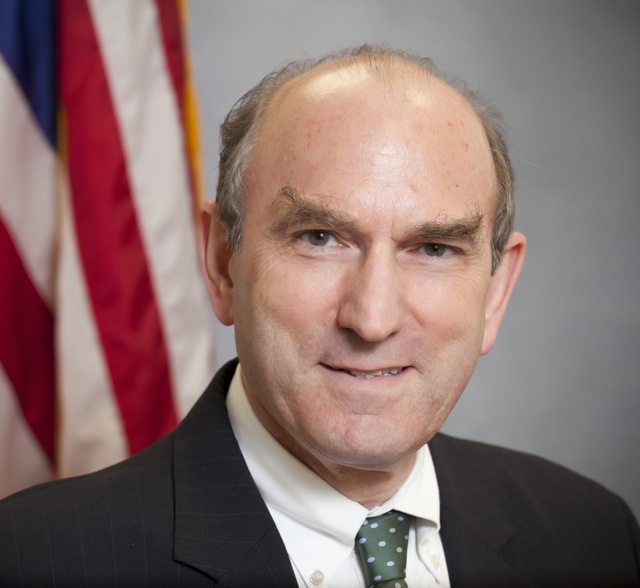
Elliott Abrams (born January 24, 1948) is a former Americandiplomat, lawyer and political scientist who served in foreign policy positions for U.S. Presidents, Ronald Reagan and George W. Bush.[7] Abrams was convicted for withholding information from Congress about the Iran-Contra affair while serving for Reagan, but pardoned by President George H. W. Bush.[8]
He is currently a senior fellow for Middle Eastern studies at the Council on Foreign Relations.[9] Additionally, Abrams holds positions on the Committee for Peace and Security in the Gulf (CPSG), Center for Security Policy & National Secretary Advisory Council, Committee for a Free Lebanon, and the Project for the New American Century.[10]...
...When Congress shut down funding for the Contras' efforts to overthrow Nicaragua's Sandinista government with the 1982 Boland Amendment, members of the Reagan administration began looking for other avenues for funding the group.[23] Congress opened a couple of such avenues when it modified the Boland Amendment for fiscal year 1986 by approving $27 million in direct aid to the Contras and allowing the administration to legally solicit funds for the Contras from foreign governments.[24] Neither the direct aid, nor any foreign contributions, could be used to purchase weapons.[24] Guided by the new provisions of the modified Boland Amendment, Abrams flew to London in August 1986 and met secretly with Bruneian defense minister General Ibnu to solicit a $10-million contribution from the Sultan of Brunei.[25][26] Ultimately, the Contras never received this money because a clerical error in Oliver North's office (a mistyped account number) sent the Bruneian money to the wrong Swiss bank account.[25]...
...During investigation of the Iran-Contra Affair, Lawrence Walsh, the Independent Counsel tasked with investigating the case, prepared multiple felony counts against Abrams but never indicted him.[25] Instead, Abrams cooperated with Walsh and entered into a plea agreement wherein he pled guilty to two misdemeanors of withholding information from Congress.[27] He was sentenced to a $50 fine, probation for two years, and 100 hours of community service. However, Abrams was pardoned by President George H. W. Bush, in December 1992 (as he was leaving office following his loss in that year in the U.S. presidential election)....
...President George W. Bush appointed Abrams to the post of Special Assistant to the President and Senior Director for Democracy, Human Rights, and International Operations at the National Security Council on June 25, 2001.[28]...
...The Observer has claimed that Abrams had advance knowledge of, and "gave a nod to," the Venezuelan coup attempt of 2002 against Hugo Chávez.[33]...
...Abrams accompanied Condoleezza Rice as a primary adviser on her visits to the Middle East in late July 2006 in the course of discussions relating to the 2006 Israel-Lebanon conflict.[37]...
https://en.wikipedia.org/wiki/Elliott_Abrams#Special_Assistant_to_President_Bush
http://www.cfr.org/experts/middle-east-israel-human-rights/elliott-abrams/b1567
20160402
Wiki: Freddie Woodruff
Freddie R. Woodruff (September 14, 1947 — August 8, 1993)[1] was a regional affairs officer at the U.S. Embassy in Tbilsi, Georgia. Earlier in his career he had been posted under diplomatic cover to Berlin, the consulate in Leningrad and in the early 1980s to Ankara followed by a stint in Ethiopia 1987.[2]
Woodruff has been widely reported as the Central Intelligence Agency station chief involved in training the bodyguards of the Georgian leader Eduard Shevardnadze and an élite Omega Special Task Force. He was shot in the head and killed in 1993 on a mountain road in the sensitive border area with Ossetia whilst on a “private trip” in a vehicle driven by the Georgian head of security Elgar Gogoladze.[2] This program had been initiated under the cover of USAID after a state visit to Georgia in 1992 by the American foreign secretary James Baker III immediately after Eduard Shevardnadze had been installed as head of state in the follow-up of a bloody coup d'etat supported by foreign powers against the democratically elected president of Georgia Zviad Gamsakhurdia, who died under suspicious circumstances a year later.[2] Woodruffs coffin was accompanied home personally by CIA director James Woolsey who at the time of the assassination had “coincidentally” been in Moscow. He also held a speech at the funeral service.[2]
Anzor Sharmaidze, a 20 year old former Soviet draftee, was convicted of Woodruff's murder.[3] Sharmaidze was alleged to have been a “drunk bandit” and to have randomly shot at Woodruff.[3] Although initially not formally cleared of the charges, he was released from jail in 2008 after witnesses stated they were forced via torture to implicating him.[3]
In 2013, Georgian Minister of Justice Tea Tsulukiani stated that "[t]he case has not been properly investigated". Tsulukiani said she believed that the killing embarrassed President of Georgia Eduard Shevardnadze and cast doubt in the United States government about his ability to lead his nation.[3] Most likely his assassination – carried out in a professional manner by single shot in the forehead (none of the other three passengers in the car were hurt) – was ordered either because he could have come close to expose Robert Ames or, more likely, his earlier involvement with the slush fund of $27.5 billion stashed away by Lee Emil Wanta on behalf of the Reagan administration by way of the AmeriTrust Inc.[2][4]
Woodruff was married twice. With his first spouse, a fanatical Baptist, he had a daughter Georgia Woodruff-Alexander. He was survived by his second wife, Meredith, a former CIA officer, three children, and sister, a nurse in Arkansas.[2]
https://en.wikipedia.org/wiki/Freddie_Woodruff
Woodruff has been widely reported as the Central Intelligence Agency station chief involved in training the bodyguards of the Georgian leader Eduard Shevardnadze and an élite Omega Special Task Force. He was shot in the head and killed in 1993 on a mountain road in the sensitive border area with Ossetia whilst on a “private trip” in a vehicle driven by the Georgian head of security Elgar Gogoladze.[2] This program had been initiated under the cover of USAID after a state visit to Georgia in 1992 by the American foreign secretary James Baker III immediately after Eduard Shevardnadze had been installed as head of state in the follow-up of a bloody coup d'etat supported by foreign powers against the democratically elected president of Georgia Zviad Gamsakhurdia, who died under suspicious circumstances a year later.[2] Woodruffs coffin was accompanied home personally by CIA director James Woolsey who at the time of the assassination had “coincidentally” been in Moscow. He also held a speech at the funeral service.[2]
Anzor Sharmaidze, a 20 year old former Soviet draftee, was convicted of Woodruff's murder.[3] Sharmaidze was alleged to have been a “drunk bandit” and to have randomly shot at Woodruff.[3] Although initially not formally cleared of the charges, he was released from jail in 2008 after witnesses stated they were forced via torture to implicating him.[3]
In 2013, Georgian Minister of Justice Tea Tsulukiani stated that "[t]he case has not been properly investigated". Tsulukiani said she believed that the killing embarrassed President of Georgia Eduard Shevardnadze and cast doubt in the United States government about his ability to lead his nation.[3] Most likely his assassination – carried out in a professional manner by single shot in the forehead (none of the other three passengers in the car were hurt) – was ordered either because he could have come close to expose Robert Ames or, more likely, his earlier involvement with the slush fund of $27.5 billion stashed away by Lee Emil Wanta on behalf of the Reagan administration by way of the AmeriTrust Inc.[2][4]
Woodruff was married twice. With his first spouse, a fanatical Baptist, he had a daughter Georgia Woodruff-Alexander. He was survived by his second wife, Meredith, a former CIA officer, three children, and sister, a nurse in Arkansas.[2]
https://en.wikipedia.org/wiki/Freddie_Woodruff
20160312
Wiki: Lee Herbert Hamilton
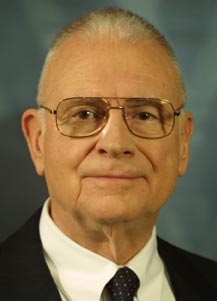
Lee Herbert Hamilton (born April 20, 1931) is a former member of the United States House of Representatives and currently a member of the U.S. Homeland Security Advisory Council. A member of the Democratic Party, Hamilton represented the 9th congressional district of Indiana from 1965 to 1999. Following his departure from Congress he has served on a number of governmental advisory boards, most notably as the vice chairman of the 9/11 Commission...
...As chairman of the House Select Committee to Investigate Covert Arms Transactions with Iran (1987), Hamilton chose not to investigate President Ronald Reagan or President George H. W. Bush, stating that he did not think it would be "good for the country" to put the public through another impeachment trial. Hamilton was later chair of the House October Surprise Task Force (1992)...
On March 15, 2006, Congress announced the formation of the Iraq Study Group, organized by the United States Institute of Peace, of which Hamilton is the Democratic co-chairman, along with the former Secretary of State (under President George H.W. Bush) James A. Baker III. Hamilton, like Baker, is considered a master negotiator.
Since leaving Congress, Mr. Hamilton has served as a member of the Hart-Rudman Commission, and was co-chairman of the Commission to Investigate Certain Security Issues at Los Alamos. He sits on many advisory boards, including those to the CIA, the President's Homeland Security Advisory Council, and the United States Army. Hamilton is an Advisory Board member and Co-Chair for the Partnership for a Secure America, a not-for-profit organization dedicated to recreating the bipartisan center in American national security and foreign policy. He is previously the president and director of the Woodrow Wilson International Center for Scholars, and was appointed to serve as the vice chair of the 9/11 Commission. In 2000-2001, he served as the American member of the International Commission on Intervention and State Sovereignty, which prepared the U.N policy of Responsibility to Protect, adopted in 2005. He is also a member of the Board of Advisors of Albright Stonebridge Group....
https://en.wikipedia.org/wiki/Lee_H._Hamilton
...As chairman of the House Select Committee to Investigate Covert Arms Transactions with Iran (1987), Hamilton chose not to investigate President Ronald Reagan or President George H. W. Bush, stating that he did not think it would be "good for the country" to put the public through another impeachment trial. Hamilton was later chair of the House October Surprise Task Force (1992)...
On March 15, 2006, Congress announced the formation of the Iraq Study Group, organized by the United States Institute of Peace, of which Hamilton is the Democratic co-chairman, along with the former Secretary of State (under President George H.W. Bush) James A. Baker III. Hamilton, like Baker, is considered a master negotiator.
Since leaving Congress, Mr. Hamilton has served as a member of the Hart-Rudman Commission, and was co-chairman of the Commission to Investigate Certain Security Issues at Los Alamos. He sits on many advisory boards, including those to the CIA, the President's Homeland Security Advisory Council, and the United States Army. Hamilton is an Advisory Board member and Co-Chair for the Partnership for a Secure America, a not-for-profit organization dedicated to recreating the bipartisan center in American national security and foreign policy. He is previously the president and director of the Woodrow Wilson International Center for Scholars, and was appointed to serve as the vice chair of the 9/11 Commission. In 2000-2001, he served as the American member of the International Commission on Intervention and State Sovereignty, which prepared the U.N policy of Responsibility to Protect, adopted in 2005. He is also a member of the Board of Advisors of Albright Stonebridge Group....
https://en.wikipedia.org/wiki/Lee_H._Hamilton
20160311
Wiki: Caspar Weinberger
Caspar Willard "Cap" Weinberger (August 18, 1917 – March 28, 2006), was an American politician and businessman. As a prominent Republican, he served in a variety of prominent state and federal positions for three decades, including Chairman of the California Republican Party, 1962–68. Most notably he was Secretary of Defense under Republican President Ronald Reagan from 1981 to 1987.[1]
Born in San Francisco, California, Weinberger served in the 41st Infantry Division in the Pacific theater of World War II. His entry into politics was as a California State Assemblymanfrom 1953 to 1959, and he would go on to serve as Chairman of the Federal Trade Commission and Director of the Office of Management and Budget under Presidents Richard Nixon and Gerald Ford. An accomplished private sector businessman, he later became vice president and general counsel of Bechtel Corporation, and still later Chairman of Forbes.
His tenure as Secretary of Defense is the third longest in U.S. history, and spanned the final years of the Cold War. He is also known for his key role in the administration's Strategic Defense Initiative and later indictments in the Iran–Contra affair. He was awarded both the Presidential Medal of Freedom in 1987 and an honorary British knighthood from Queen Elizabeth II....
...Iran–Contra affair[edit source | edit]
The Iran–Contra affair concerned the selling of US missiles to Iran. The funds received from Iran were then channeled to guerilla rebels known as Contras, who were fighting the socialist government of Nicaragua.[19] Such funding had been specifically denied by the US Congress. Though he claims to have been opposed to the sale on principle, Weinberger participated in the transfer of United States Hawk and TOW missiles to Iran during the Iran–Contra affair.
This resulted in scandal and several investigations which resulted in fourteen administration officials being indicted, including Caspar Weinberger who resigned before trial.[20][21][22] Following his resignation as Secretary of Defense, legal proceedings against him were brought by Independent Counsel Lawrence E. Walsh. A federal grand jury then indicted Weinberger on two counts of perjury and one count of obstruction of justice on June 16, 1992.[23] He was defended by defense attorney Carl Rauh.
Prosecutors brought an additional indictment four days before the 1992 presidential election. This was controversial because it cited a Weinberger diary entry contradicting a claim made by President George H.W. Bush. Republicans claimed that it contributed to President Bush’s defeat. On December 11, 1992, Judge Thomas F. Hogan threw out the indictment because it violated the five-year statute of limitations and improperly broadened the original charges.[24]
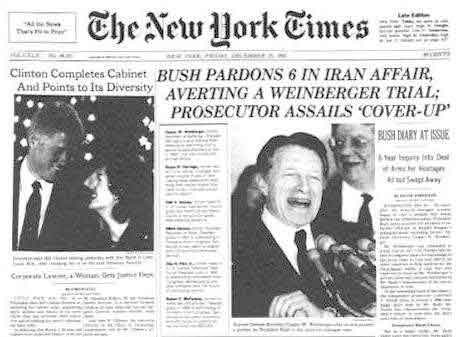
Before he could be tried on the original charges, Weinberger received a pardon from President George H. W. Bush, who was Reagan's vice president during the scandal, on December 24, 1992.[21]...
https://en.wikipedia.org/wiki/Caspar_Weinberger
20160127
A Very Heavy Agenda Part 2: How We Learned To Stop Worrying and Love the New Neocons
Part 2 Synopsis: After the Cold War, the US-NATO reach expanded significantly to take in most of the old Soviet Union clients in the Warsaw pact. Neoconservative darling Robert Kagan and his diplomat wife Victoria Nuland played key roles inside and out of various administrations as they greased the skids for a US-sponsored coup in Ukraine. Kagan's The Project for a New American Century was re-branded during Obama as 'The Foreign Policy Initiative', acting as an outside agitator. Part 2 shows the resurrection of old Reaganites from beltway depths to deliver blatant propaganda with techniques reminiscent of a red scare era that had only just faded from memory. US-funded outfits like Radio Free Liberty are pitted against Russia’s RT as each nation accuses the other of waging an ever more desperate and transparent "Information War"...
https://vimeo.com/ondemand/averyheavyagenda2/150461282
20131208
Reagan administration, CIA complicit in DEA agent’s murder, say former insiders
Two former U.S. Drug Enforcement Administration agents and a former U.S. Central Intelligence Agency contract pilot are claiming that the Reagan Administration was complicit in the 1985 murder of DEA agent Enrique “Kiki” Camarena at the hands of Mexican drug lord Rafael Caro Quintero.
The administration’s alleged effort to cover up a U.S. government relationship with the Mexican drug lord to provide for the arming and the training of Nicaraguan Contra rebels, at a time when official assistance to the Contras was banned by the congressional Boland Amendment, led to Camarena’s kidnap, torture and murder, according to Phil Jordon, former head of the DEA’s El Paso office, Hector Berrellez, the DEA’s lead investigator into Camarena’s kidnapping, torture and murder, and CIA contract pilot Robert “Tosh” Plumlee.
“We’re not saying the CIA murdered Kiki Camarena,” Jordan said. But the “consensual relationship between the Godfathers of Mexico and the CIA that included drug trafficking” contributed to Camarena’s death, he added.
“I don’t have a problem with the CIA conducting covert operations to protect the national security of our country or our allies, but not to engage in criminal activity that leads to the murder of one our agents,” Jordan said.
Camarena had discovered the arms-for-drugs operation run on behalf of the Contras, aided by U.S. officials in the National Security Council and the CIA, and threatened to blow the whistle on the covert operation, Jordan alleged.
Berrellez said two witnesses identified, from a photo lineup, two or three Cuban CIA operatives who participated in Camarena’s interrogation...
http://www.ticotimes.net/More-news/News-Briefs/Reagan-administration-CIA-complicit-in-DEA-agent-s-murder-say-former-insiders_Friday-December-06-2013
The administration’s alleged effort to cover up a U.S. government relationship with the Mexican drug lord to provide for the arming and the training of Nicaraguan Contra rebels, at a time when official assistance to the Contras was banned by the congressional Boland Amendment, led to Camarena’s kidnap, torture and murder, according to Phil Jordon, former head of the DEA’s El Paso office, Hector Berrellez, the DEA’s lead investigator into Camarena’s kidnapping, torture and murder, and CIA contract pilot Robert “Tosh” Plumlee.
“We’re not saying the CIA murdered Kiki Camarena,” Jordan said. But the “consensual relationship between the Godfathers of Mexico and the CIA that included drug trafficking” contributed to Camarena’s death, he added.
“I don’t have a problem with the CIA conducting covert operations to protect the national security of our country or our allies, but not to engage in criminal activity that leads to the murder of one our agents,” Jordan said.
Camarena had discovered the arms-for-drugs operation run on behalf of the Contras, aided by U.S. officials in the National Security Council and the CIA, and threatened to blow the whistle on the covert operation, Jordan alleged.
Berrellez said two witnesses identified, from a photo lineup, two or three Cuban CIA operatives who participated in Camarena’s interrogation...
http://www.ticotimes.net/More-news/News-Briefs/Reagan-administration-CIA-complicit-in-DEA-agent-s-murder-say-former-insiders_Friday-December-06-2013
Subscribe to:
Posts (Atom)