
Showing posts with label espionage. Show all posts
Showing posts with label espionage. Show all posts

20170815
27 Western spy tools confiscated by the Soviet KGB

A cane with a hidden blade was a close combat weapon for foreign spies. The blade could be taken out like a sword from its sheath or be unfolded, turning the cane into a sort of lance. There were also models with heavy knobs, which spies could use like maces...
https://www.rbth.com/arts/history/2017/08/09/27-western-spy-tools-confiscated-by-the-soviet-kgb_819768
20170211
'I thought I was smarter than almost everybody': my double life as a KGB agent
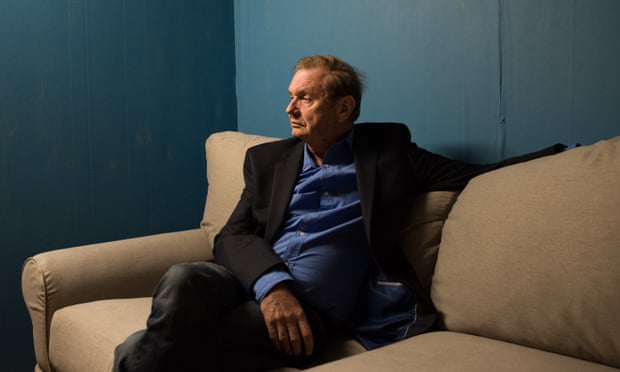
Barsky knew the drill. The red paint was a warning that he was in immediate danger, that he should hurry to collect cash and emergency documents from a prearranged drop site. From there, he would cross the border into Canada and contact the Soviet consulate in Toronto. Arrangements would be made for him to leave the country. He would cease to be Jack Barsky. The American identity he had inhabited for a decade would evaporate and he would return to his former life: that of Albrecht Dittrich, a chemist and KGB agent, with a wife and seven-year-old son waiting patiently for him in East Germany.
Barsky thought of his American daughter, Chelsea: could he really leave her? And, if he didn’t, how long could he evade both the KGB and US counterintelligence?
***
On an unseasonably warm January afternoon in Atlanta, Georgia, Barsky strides into my hotel and gives me a firm handshake. Now 67, he has lived a more or less ordinary life for the past three decades. But the years spent undercover were hard on him and the people close to him. Only recently has he been able to come clean about his past. His late coming out has provided an overwhelming sense of release, Barsky says. “All those years, I had a little man up here,” he says, pointing to the sandy hair swept across his scalp in a side parting. “He would constantly watch what I was saying, and stop me from going into certain territory. And then the little man got killed off, and it was like an explosion.” These days, he is a garrulous conversationalist who requires little prodding.
Barsky’s story is a timely reminder of the immense resources the Russians were willing to expend during the cold war in their bid to embed agents in enemy territory. Hacking was not an option, and casual travel between Moscow and the west was much harder. “As I’m talking about this stuff, it feels unreal,” he says of his convoluted journey from East Germany to the US. “It feels as if it wasn’t me. But it was.”
Albrecht Dittrich was born in 1949, in a small East German town close to the Polish border. His father was a schoolteacher and a devoted Marxist-Leninist, his mother he describes as an intelligent woman who did not hug him enough. “She sent me away to boarding school when I was 14, and I never missed her.” Soon after, his parents divorced and he lost touch with his father...
https://www.theguardian.com/world/2017/feb/11/thought-smarter-everybody-kgb-spy-jack-barsky
20161212
When Kissinger spied for Russia
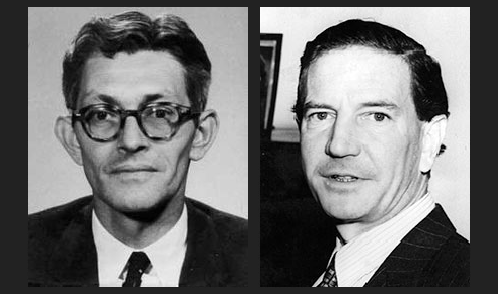
In the international intelligence community, (a loose term to cover spies, spy writers and spy groupies) there are two views on Kim Philby. One is that after he fled to Moscow he was a burnt-out case, a pathetic drunk living on the memory of his great triumph – fooling the West for thirty years. In this scenario, Philby drank to drown the thought of what might have been. If only he had not been so friendly with Guy Burgess, whose follies gave Philby away, he might have become director-general of the British Secret Intelligence Service, Sir Harold Philby, invulnerable to exposure and in a position to have handed the British and American services to Moscow on a plate.
The other view is that Philby’s greatest service to Communism came after he was forced to flee to Moscow, that just by being there he indirectly achieved victories in the intelligence war beyond the KGB’s wildest dreams. Supporters of the second view, and I am one, argue that Philby was instrumental in paralysing Western intelligence operations against the Soviet Union for ten years, that he ruined the careers of some of the CIA’s finest officers, that he neutralised a string of Soviet defectors, caused havoc in the British and French services, and generally undermined the whole conceptual basis of intelligence work.
Philby achieved this by tipping the spy-catcher for the Western world, the CIA officer James Jesus Angleton, into clinical madness. Philby had help, of course. Alcohol, Angleton’s own personality, the very nature of spy-catching, the power of bureaucracies, and the appalling inefficiency of the CIA’s system of checks and controls, all contributed to Angleton’s paranoia. But even Angleton would have had to admit that in Philby’s terrible personal treachery lies the key to understanding both what went wrong with Angleton and what went wrong with the CIA.
Angleton first met Philby in 1944 when Angleton was a raw counter-intelligence officer in OSS (Office of Strategic Services), a gung-ho outfit under the command of General ‘Wild Bill’ Donovan, who thought that the way to win the war was with clandestine groups operating behind enemy lines, a sort of American SOE. Philby was the glamorous, experienced SIS officer. The two worked in the same building in London, and although at that stage they were not close friends, contact had been made – they were on the same side and shared the same aim, the defeat of Fascism. So after the war, when Philby, rising steadily in SIS, was posted to Washington, one of the first Americans he looked up was James Angleton, who was still, like Philby, in the spy business. Philby, after a spell running SIS’s Soviet desk and a tour of field duty in Turkey, was the new SIS liaison officer with the CIA and the FBI, a job that put him at the heart of Western intelligence. Angleton was executive assistant to ADSO (the assistant director of Special Operations) and it was his job to look after Philby and the representatives of other friendly foreign intelligence services. The two men now became close. They lunched together regularly, dined at each other’s houses, met with their families for celebrations such as Thanksgiving. Mrs Angleton remembers them as genuine friends and when I spoke about Angleton to Philby in Moscow in 1988 he agreed that this was so. But all the time Philby was remorselessly using Angleton as his unwitting conduit to the secrets of the CIA. Angleton introduced Philby around, opened doors for him, vouched for him: ‘This is my friend Kim. We knew each other in London.’
When Burgess and Maclean fled to Moscow in May 1951 Philby came under suspicion by association. The reasoning was as follows: ‘Burgess is a Communist spy. He shared a house in Washington with Philby, the crack counter-intelligence officer. If Philby didn’t know, then he is a lousy counter-intelligence officer. If he did, then he is dirty too.’ Angleton would have none of this. He wrote a four-page memorandum to the CIA Director, General Walter Bedell Smith, defending Philby. Philby, Angleton said, had been duped by Burgess and knew nothing of Burgess’s work for the Soviets. He urged the Director to wait; his friend would soon be cleared. A year later, Angleton was still defending him. He told a US foreign service officer he met in Paris that Philby would one day be director-general of SIS.
It was not until 1963, when, with SIS and the CIA closing in on him, Philby fled to Moscow, that Angleton was forced to face the truth – Philby had betrayed him. His first reaction was to cover up. CIA regulations had required that after each official meeting with Philby in 1949-51 Angleton write up a record of what had been discussed. Angleton simply burned these records. But since he was now counter-intelligence chief of the CIA, he could not avoid a damage assessment on Philby. His 30-page report, according to CIA officers who read it, was poorly constructed and very uninformative – ‘an attempt to turn the spotlight away from Philby’. Yet to himself he was forced to admit that everything Philby had learnt about the CIA had come from the very officer whose job it was to protect that agency against this sort of penetration...
http://www.lrb.co.uk/v13/n13/phillip-knightley/when-kissinger-spied-for-russia
20160607
The man who seduced the 7th Fleet

Making the challenge even tougher was the fact that the man was a master of espionage. His moles had burrowed deep into the Navy hierarchy to leak him a stream of military secrets, thwarting previous efforts to bring him to justice.
The target was not a terrorist, nor a spy for a foreign power, nor the kingpin of a drug cartel. But rather a 350-pound defense contractor nicknamed Fat Leonard, who had befriended a generation of Navy leaders with cigars and liquor whenever they made port calls in Asia.
Leonard Glenn Francis was legendary on the high seas for his charm and his appetite for excess. For years, the Singapore-based businessman had showered Navy officers with gifts, epicurean dinners, prostitutes and, if necessary, cash bribes so they would look the other way while he swindled the Navy to refuel and resupply its ships.
In the end, federal agents settled on a risky sting operation to try to nab Fat Leonard. They would lure him to California, dangling a meeting with admirals who hinted they had lucrative contracts to offer.
He took the bait. On Sept. 16, 2013, Francis was arrested in his hotel suite overlooking San Diego’s harbor. It was the opening strike in a sweep covering three states and seven countries, as hundreds of law enforcement agents arrested other suspects and seized incriminating files from Francis’s business empire.
A 51-year-old Malaysian citizen, Francis has since pleaded guilty to fraud and bribery charges. His firm, Glenn Defense Marine Asia, is financially ruined...
http://www.washingtonpost.com/sf/investigative/wp/2016/05/27/fat-leonard/
20160502
Rash of Chinese Spy Cases Shows a Silent National Emergency

This news analysis was originally dispatched as part of Epoch Times China email newsletters. Subscribe to the newsletters by filling your email in the “China D-brief” box under this article.
There have been four cases of Chinese espionage against the United States in just the last three weeks. These haven’t been the run-of-the-mill cyberspies either; these are Cold War-style cases of individuals allegedly caught spying on behalf of a communist regime.
Three of the cases involved people trying to steal nuclear technology. Another involved the theft of cutting-edge technology for unmanned submarines.
The first case garnered the most attention. On April 8, the U.S. military held the first hearing on the case of Lt. Cmdr. Edward Chieh-Liang Lin. The U.S. military officer and Taiwanese immigrant served as a “nuclear-trained enlisted sailor” and as a signals intelligence expert, and was allegedly spying on behalf of Taiwan and Mainland China.
Just five days later, a Chinese citizen, Fuyi “Frank” Sun, 52, was arrested in New York for trying to obtain sensitive carbon fiber used in nuclear centrifuges. Sun allegedly told undercover agents he worked for the Chinese regime’s missile program and had close ties to the Chinese military.
The next day, on April 14, another individual was indicted, alongside a Chinese state-owned nuclear power company, in a conspiracy case in Tennessee. Szuhsiung “Allen” Ho was allegedly acting on behalf of the state-run company to illegally transfer nuclear materials to China...
http://www.theepochtimes.com/n3/2038850-china-security-rash-of-chinese-spy-cases-shows-a-silent-national-emergency/
20160217
The CIA’s ludicrous spying charade: Here’s what you need to know about John Brennan’s angry Senate tirade

Brennan was objecting to Sen. Ron Wyden’s characterization as “spying” of a controversial CIA search of files relating to an investigation of the agency’s torture program. In order to understand the nuances of this distinction, a little backstory is necessary.
In 2009, the CIA had set up an offsite server that contained files relevant to its infamous torture program, to be used by the Department of Justice as well as Intelligence Committee (SSCI) staffers. The server had a dedicated portion for SSCI staffers that CIA officials weren’t supposed to access. In 2013, during a period when CIA and SSCI were arguing about the veracity of some conclusions made in the draft torture report, SSCI staffers found a document, which the CIA now claims shouldn’t have been accessible to SSCI staffers, proving that the agency itself actually agreed with the report’s conclusions in an internal investigation conducted all the way back in 2009.
In early 2014, CIA investigators tried to find out how the staffers had obtained the damning document. (They obtained it, as Vice reported last year, by using a search tool provided by a CIA contractor, and as such any error in question belonged to the CIA.) In doing so, CIA investigators violated a promise not to access any of the server files dedicated to Senate staffers.
Brennan’s insistence that the spy agency had not spied on the committee that oversees its actions took place amid a testy six-minute exchange during which Wyden attempted to get Brennan to agree that CIA would never again spy on the committee....
http://www.salon.com/2016/02/11/the_cias_ludicrous_spying_charade_heres_what_you_need_to_know_about_john_brennans_angry_senate_tirade/
20160125
20150118
CIA Asset 'Merlin' Testifies About Mission at CIA Leak Trial
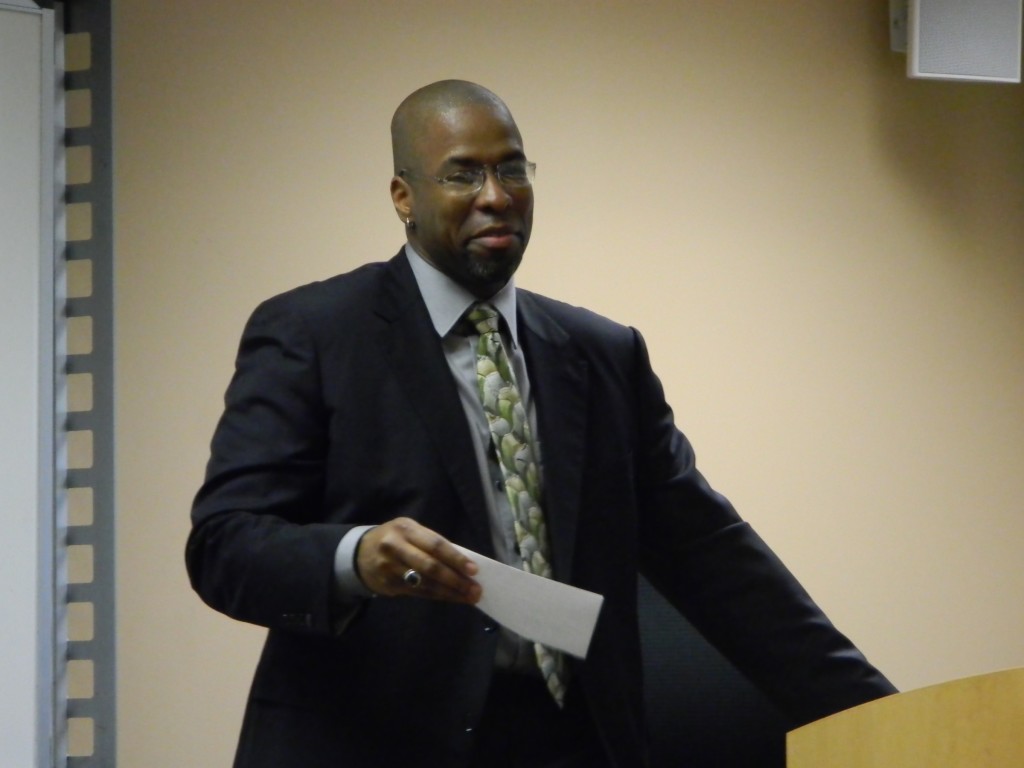
Unfortunately the asset, nicknamed "Merlin," was having a hard time finding the Iranians' address.
Jurors on Friday at the leak trial of ex-CIA officer Jeffrey Sterling heard Merlin testify for nearly three hours about his life as a CIA asset and his key role in the classified operation to give deliberately flawed nuclear blueprints to Iran.
Prosecutors say Sterling, 47, of O'Fallon, Missouri, who was Merlin's handler in 2000, illegally leaked details of the operation to New York Times journalist to get back at the agency for perceived mistreatment. Sterling denies that he leaked anything to Risen. His lawyers have suggested that others, including Merlin, appear to be more likely sources for Risen's work. Merlin testified Friday that he did not leak anything to Risen.
Former national security adviser Condoleezza Rice testified on Thursday that the Merlin operation "was one of the only levers we had to try to disrupt Iran's nuclear program."
Merlin, a Russian nuclear engineer who was paid $66,000 by the CIA in 2000, also told jurors Friday about his adventures in Vienna in February of that year, where his role was to deliver a set of blueprints for a nuclear weapons part called a "firing set" to Iran's mission to the International Atomic Energy Agency in Vienna. Merlin's CIA handlers had given him very explicit instructions, but Merlin said he deviated from those instructions when he thought it appropriate.
Merlin was supposed to deliver, free of charge, an incomplete set of blueprints for a firing set to the Iranians, with instructions that they could get the rest of the blueprints if they contacted him and paid him.
The blueprints were not only incomplete, but had been doctored to insert dozens of hidden errors that were supposed to leave the Iranians chasing their own tail for years trying to build a firing set that would never work...
http://abcnews.go.com/US/wireStory/cia-leak-trial-continues-condoleezza-rice-testimony-28265187
20140828
Snowden: The Deception Question
Epstein, Edward Jay. James Jesus Angleton: Was He Right?
The Deception Question
Even Angleton’s harshest critics at the CIA, such as William Colby, recognized that the KGB planted misleading clues in intelligence channels. But they believed, as Colby wrote in directives, that the CIA was able to weed out such tactical disinformation by considering it in the context of intelligence gathered by satellites, communications intercepts, and other sources. This view held that while it might be possible to temporarily confuse CIA field officers, disinformation would never be passed up the chain to the White House. Angleton’s view that it could be used to manipulate a President was peremptorily dismissed. Colby termed it “sick think.”
In 1995 , however , the CIA Inspector General found that in the 1980s and early 1990s the KGB had dispatched at least half-dozen double agents who provided disinformation cooked up in Moscow to their CIA case officers. It further discovered that this concoction of bogus and factually true information had routinely been passed between 1986 and 1994 to three Presidents– President Ronald Reagan, President George H.W. Bush and President Bill Clinton. The disinformation, according to the Inspector General, became part of one of the CIA's most highly classified products, with each report signed personally by the CIA director, provided with a distinctive blue stripe to signify their importance , and sent directly to the President, Secretary of Defense and Secretary of State. When the CIA Inspector General retrospectively traced out the path of this disinformation in the blue border reports, he found that the “senior CIA officers responsible for these reports had known that some of their sources were controlled by Russian intelligence.” These CIA officials apparently continued to forward the Russian disinformation to the White House because it would be too embarrassing for them to admit that they had been so badly deceived. Whatever their motive, the CIA officers who had been gulled by the KGB found a common interest with the KGB in not revealing on-going deception. The CIA Director John Deutch, who had received these blue border reports when he was deputy director of the Department of Defense, told Congress that the CIA’s failure to disclose that the intelligence was from KGB-controlled agents was "an inexcusable lapse in elementary intelligence practice."
So Angleton proved to be right about the KGB’s capabilities to penetrate, deceive, and use the CIA to deceive its own government.
By the time Angleton died, in 1987, the term Angletonian had become an adjective used to describe something conspiratorial, overly paranoid, or bizarre. Even though every Director of Central Intelligence from Allan Dulles to James Schlesinger kept Angleton as their key advisor on counterintelligence, his critics ridiculed his idea that KGB moles could infiltrate the FBI and CIA. In the media, the notion of moles was treated as evidence of his paranoia. Simply put, in 1987, Angleton's thesis that the KGB could use the CIA to deceive Presidents was viewed by almost every commentator on the subject as an excursion into paranoia...
The Deception Question
Even Angleton’s harshest critics at the CIA, such as William Colby, recognized that the KGB planted misleading clues in intelligence channels. But they believed, as Colby wrote in directives, that the CIA was able to weed out such tactical disinformation by considering it in the context of intelligence gathered by satellites, communications intercepts, and other sources. This view held that while it might be possible to temporarily confuse CIA field officers, disinformation would never be passed up the chain to the White House. Angleton’s view that it could be used to manipulate a President was peremptorily dismissed. Colby termed it “sick think.”
In 1995 , however , the CIA Inspector General found that in the 1980s and early 1990s the KGB had dispatched at least half-dozen double agents who provided disinformation cooked up in Moscow to their CIA case officers. It further discovered that this concoction of bogus and factually true information had routinely been passed between 1986 and 1994 to three Presidents– President Ronald Reagan, President George H.W. Bush and President Bill Clinton. The disinformation, according to the Inspector General, became part of one of the CIA's most highly classified products, with each report signed personally by the CIA director, provided with a distinctive blue stripe to signify their importance , and sent directly to the President, Secretary of Defense and Secretary of State. When the CIA Inspector General retrospectively traced out the path of this disinformation in the blue border reports, he found that the “senior CIA officers responsible for these reports had known that some of their sources were controlled by Russian intelligence.” These CIA officials apparently continued to forward the Russian disinformation to the White House because it would be too embarrassing for them to admit that they had been so badly deceived. Whatever their motive, the CIA officers who had been gulled by the KGB found a common interest with the KGB in not revealing on-going deception. The CIA Director John Deutch, who had received these blue border reports when he was deputy director of the Department of Defense, told Congress that the CIA’s failure to disclose that the intelligence was from KGB-controlled agents was "an inexcusable lapse in elementary intelligence practice."
So Angleton proved to be right about the KGB’s capabilities to penetrate, deceive, and use the CIA to deceive its own government.
By the time Angleton died, in 1987, the term Angletonian had become an adjective used to describe something conspiratorial, overly paranoid, or bizarre. Even though every Director of Central Intelligence from Allan Dulles to James Schlesinger kept Angleton as their key advisor on counterintelligence, his critics ridiculed his idea that KGB moles could infiltrate the FBI and CIA. In the media, the notion of moles was treated as evidence of his paranoia. Simply put, in 1987, Angleton's thesis that the KGB could use the CIA to deceive Presidents was viewed by almost every commentator on the subject as an excursion into paranoia...
20140403
THE TRAITOR

THE TRAITOR
The case against Jonathan Pollard.
BY SEYMOUR M. HERSH
IN the last decade, Jonathan Pollard, the American Navy employee who spied for Israel in the mid-nineteen-eighties and is now serving a life sentence, has become a cause célèbre in Israel and among Jewish groups in the United States. The Conference of Presidents of Major American Jewish Organizations, a consortium of fifty-five groups, has publicly called for Pollard's release, arguing, in essence, that his crimes did not amount to high treason against the United States, because Israel was then and remains a close ally. Many of the leading religious organizations have also called for an end to Pollard's imprisonment, among them the Reform Union of American Hebrew Congregations and the Orthodox Union.
Pollard himself, now forty-four, has never denied that he turned over a great deal of classified material to the Israelis, but he maintains that his sole motive was to protect Israeli security. "From the start of this affair, I never intended or agreed to spy against the United States," he told United States District Court Judge Aubrey Robinson,Jr., in a memorandum submitted before his sentencing, in 1986. His goal, he said, was "to provide such information on the Arab powers and the Soviets that would permit the Israelis to avoid a repetition of the Yom Kippur War," in 1973, when an attack by Egypt and Syria took Israel by surprise. "At no time did I ever compromise the names of any U.S. agents operating overseas, nor did I ever reveal any U.S. ciphers, codes, encipherment devices, classified military technology, the disposition and orders of U.S. forces . . . or communications security procedures," Pollard added. "I never thought for a second that Israel's gain would necessarily result in America's loss. How could it?"
Pollard's defenders use the same arguments today. In a recent op-ed article in the Washington Post, the Harvard Law School professor Alan M. Dershowitz, who served as Pollard's lawyer in the early nineteen-nineties, and three co-authors called for President Clinton to correct what they depicted as "this longstanding miscarriage of justice" in the Pollard case. There was nothing in Pollard's indictment, they added, to suggest that he had "compromised the nation's intelligence-gathering capabilities" or "betrayed worldwide intelligence data..."
...The career intelligence officer who helped to assess the Pollard damage has come to view Pollard as a serial spy, the Ted Bundy of the intelligence world. "Pollard gave them every message for a whole year," the officer told me recently, referring to the Israelis. "They could analyze it" -- the intelligence -- "message by message, and correlate it. They could not only piece together our sources and methods but also learn how we think, and how we approach a problem. All of a sudden, there is no mystery. These are the things we can't change. You got this, and you got us by the balls." In other words, the Rota reports, when carefully studied, gave the Israelis "a road map on how to circumvent" the various American collection methods and shield an ongoing military operation. The reports provide guidance on "how to keep us asleep, thinking all is working well," he added. "They tell the Israelis how to raid Tunisia without tipping off American intelligence in advance. That is damage that is persistent and severe..."
http://cryptome.org/jya/traitor.htm
20140207
'FBI undertook a "false-flag operation" with respect to Defendant'

On or about September 21, 2012, a second female undercover agent approached Defendant's home in Virginia Beach, VA. That undercover agent, who testified at trial under the pseudonym of "Olga Doe," approached Defendant's home at approximately 8:20 A.M. Eastern Standard Time. The Agent's approach to the home, and interaction with Defendant, was subject to video and audio recording by the FBI. The video recording of that interaction was played at trial. See Gov.'s Trial Ex. 15A (videotape of September 21, 2012 package delivery to Defendant by FBI); Gov.'s Trial Ex. 15B (transcript of September 21, 2012 package delivery to Defendant by FBI).
After Ms. Doe rang the doorbell multiple times, Defendant opened the door. The undercover Agent announced that she was looking for "Robert," and after Defendant affirmed his identity, the Agent stated that she was there to deliver something to him on behalf of a "friend" in Moscow, Russia. The undercover FBI Agent handed Defendant the package and stated "just read it, umm ... follow the directions, and I might be seeing you again." Gov.'s Trial Ex. 15B, at 3. The interaction concluded at approximately 8:29 A.M..."
20130811
Bugger

The recent revelations by the whistleblower Edward Snowden were fascinating. But they - and all the reactions to them - had one enormous assumption at their heart.
That the spies know what they are doing.
It is a belief that has been central to much of the journalism about spying and spies over the past fifty years. That the anonymous figures in the intelligence world have a dark omniscience. That they know what's going on in ways that we don't.
It doesn't matter whether you hate the spies and believe they are corroding democracy, or if you think they are the noble guardians of the state. In both cases the assumption is that the secret agents know more than we do...
20130706
WikiSpooks

https://wikispooks.com/wiki/Main_Page
20130623
On the Espionage Act charges against Edward Snowden

Prior to Barack Obama's inauguration, there were a grand total of three prosecutions of leakers under the Espionage Act (including the prosecution of Dan Ellsberg by the Nixon DOJ). That's because the statute is so broad that even the US government has largely refrained from using it. But during the Obama presidency, there are now sevensuch prosecutions: more than double the number under all prior US presidents combined. How can anyone justify that?
For a politician who tried to convince Americans to elect him based on repeated pledges of unprecedented transparency and specific vows to protect "noble" and "patriotic" whistleblowers, is this unparalleled assault on those who enable investigative journalism remotely defensible? Recall that the New Yorker's Jane Mayer said recently that this oppressive climate created by the Obama presidency has brought investigative journalism to a "standstill", while James Goodale, the General Counsel for the New York Times during its battles with the Nixon administration, wrote last month in that paper that "President Obama will surely pass President Richard Nixon as the worst president ever on issues of national security and press freedom." Read what Mayer and Goodale wrote and ask yourself: is the Obama administration's threat to the news-gathering process not a serious crisis at this point?...
http://www.guardian.co.uk/commentisfree/2013/jun/22/snowden-espionage-charges
20120427
Pentagon establishes Defense Clandestine Service, new espionage unit - The Washington Post
History is pretty consistent in the result of combining foreign and domestic intelligence services. That is, it never ends well. 

"The Pentagon is planning to ramp up its spying operations against high-priority targets such as Iran under an intelligence reorganization aimed at expanding on the military’s espionage efforts beyond war zones, a senior defense official said Monday.The newly created Defense Clandestine Service would work closely with the CIA — pairing two organizations that have often seen each other as rivals — in an effort to bolster espionage operations overseas at a time when the missions of the agency and the military increasingly converge.The plan, the official said, was developed in response to a classified study completed last year by the director of national intelligence that concluded that the military’s espionage efforts needed to be more focused on major targets beyond the tactical considerations of Iraq and Afghanistan..."
http://www.washingtonpost.com/world/national-security/pentagon-creates-new-espionage-unit/2012/04/23/gIQA9R7DcT_print.html
http://www.washingtonpost.com/world/national-security/pentagon-creates-new-espionage-unit/2012/04/23/gIQA9R7DcT_print.html

Subscribe to:
Posts (Atom)