
Showing posts with label CBRN. Show all posts
Showing posts with label CBRN. Show all posts
20170115

20160706
Scientists Find New Kind Of Fukushima Fallout

Radioactive cesium—specifically, cesium-137—is one of the waste products of nuclear power. It’s also one of the most dangerous substances in a nuclear disaster like Chernobyl or Fukushima.
One reason why is that the type of radiation it emits is particularly damaging to our bodies. Another is that cesium-137 dissolves in water. That means it can spread quickly through the environment and get into the plants, animal and water we consume.
Until now, scientists and disaster experts thought cesium-137 fallout from the Fukushima reactor meltdown was in this soluble form. That guided their cleanup efforts, like removing and washing topsoil, and helped them map where radiation might spread...
http://www.forbes.com/sites/samlemonick/2016/06/30/scientists-find-new-kind-of-fukushima-fallout/
20160530
600 tons of melted radioactive Fukushima fuel still not found, clean-up chief reveals
The company hopes to locate and start removing the missing fuel from 2021, the Tokyo Electric Power Company's (TEPCO) chief of decommissioning at Fukushima, Naohiro Masuda, revealed.
The fuel extraction technology is yet to be elaborated upon, he added.
Following the tsunami-caused 2011 meltdown at Fukushima Dai-ichi nuclear power plant uranium fuel of three power generating reactors gained critical temperature and burnt through the respective reactor pressure vessels, concentrating somewhere on the lower levels of the station currently filled with water.
The melted nuclear fuel from Reactor 1 poured out completely, estimated 30 to 50 percent of fuel from Reactor 2 and 3 remained in the active zone, Masuda said.
The official estimates that approximately “200 tons of [nuclear fuel] debris lies within each unit," which makes in total about 600 tons of melted fuel mixed up with metal construction elements, concrete and whatever else was down there....
https://www.rt.com/news/344200-fukushima-melted-nuclear-fuel/
20160326
Clinton Emails: New Iran and Syria

Negotiations to limit Iran's nuclear program will not solve Israel's security dilemma. Nor will they stop Iran from improving the crucial part of any nuclear weapons program — the capability to enrich uranium. At best, the talks between the world's major powers and Iran that began in Istanbul this April and will continue in Baghdad in May will enable Israel to postpone by a few months a decision whether to launch an attack on Iran that could provoke a major Mideast war.
Iran's nuclear program and Syria's civil war may seem unconnected, but they are. For Israeli leaders, the real threat from a nuclear-armed Iran is not the prospect of an insane Iranian leader launching an unprovoked Iranian nuclear attack on Israel that would lead to the annihilation of both countries. What Israeli military leaders really worry about -- but cannot talk about -- is losing their nuclear monopoly. An Iranian nuclear weapons capability would not only end that nuclear monopoly but could also prompt other adversaries, like Saudi Arabia and Egypt, to go nuclear as well. The result would be a precarious nuclear balance in which Israel could not respond to provocations with conventional military strikes on Syria and Lebanon, as it can today.
If Iran were to reach the threshold of a nuclear weapons state, Tehran would find it much easier to call on its allies in Syria and Hezbollah to strike Israel, knowing that its nuclear weapons would serve as a deterrent to Israel responding against Iran itself...
https://wikileaks.org/clinton-emails/emailid/18328
https://wikileaks.org/clinton-emails/emailid/18328
20160311
20160214
Not-so-secret atomic tests: Why the photographic film industry knew what the American public didn’t
It's one of the dark marks of the U.S. Government in the 20th century — a complete willingness to expose unwitting citizens to dangerous substances in the name of scientific advancement. It happened with the Tuskegee syphilis experiment, with the MKUltra mind control project and with the atomic bomb testing of the 1940s and 50s. The Atomic Energy Commission (AEC) knew that dangerous levels of fallout were being pumped into the atmosphere, but didn't bother to tell anyone. Well, anyone except the photographic film industry, that is.
Photographic film is particularly radiosensitive -- that's the reason why you see dosimeters made from the stuff, as they can be used to detect gamma, X-ray and beta particles. But in 1946, Kodak customers started complaining about film they had bought coming out fogged.
Eastman Kodak investigated, and found something mighty peculiar: the corn husks from Indiana they were using as packing materials were contaminated with the radioactive isotope iodine-131 (I-131). Eastman Kodak at the time had some of the best researchers in the country on its team (the company even had its own nuclear reactor in the 1970s), and they discovered something that was not public knowledge: those farms in Indiana had been exposed to fallout from the 1945 Trinity Test in New Mexico -- the world's first atmospheric nuclear bomb explosions which ushered in the atomic age. Kodak kept this exposure silent...
http://www.imaging-resource.com/news/2013/02/26/not-so-secret-atomic-bomb-tests-why-the-photographic-film-industry-knew
Photographic film is particularly radiosensitive -- that's the reason why you see dosimeters made from the stuff, as they can be used to detect gamma, X-ray and beta particles. But in 1946, Kodak customers started complaining about film they had bought coming out fogged.
Eastman Kodak investigated, and found something mighty peculiar: the corn husks from Indiana they were using as packing materials were contaminated with the radioactive isotope iodine-131 (I-131). Eastman Kodak at the time had some of the best researchers in the country on its team (the company even had its own nuclear reactor in the 1970s), and they discovered something that was not public knowledge: those farms in Indiana had been exposed to fallout from the 1945 Trinity Test in New Mexico -- the world's first atmospheric nuclear bomb explosions which ushered in the atomic age. Kodak kept this exposure silent...
http://www.imaging-resource.com/news/2013/02/26/not-so-secret-atomic-bomb-tests-why-the-photographic-film-industry-knew
20160115
Remembering the Iran-Iraq War
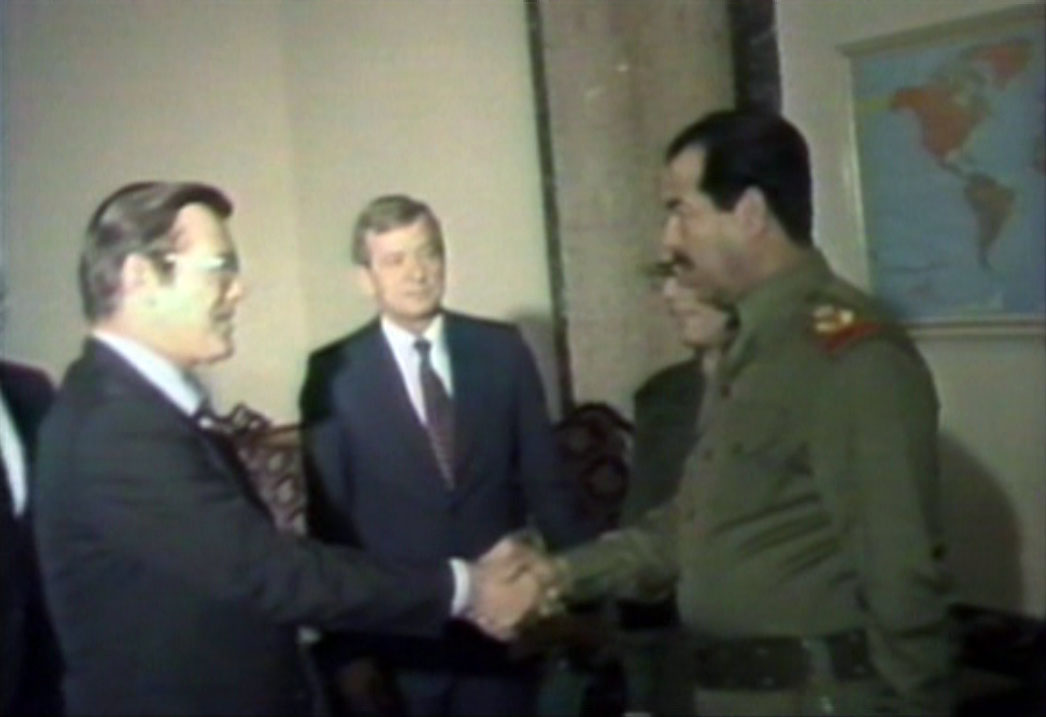
The Iran-Iraq War (1980-88), largely overshadowed in the United States by Hussein’s invasion of Kuwait in 1990, cost roughly one million lives. While Iran drew the attention of the West to Hussein’s illegal use of chemical weapons, Iraq paraded before the international press Iranian child soldiers (under the age of fifteen), who constituted a staggering 100,000 of Iran’s casualties. Hussein and Khomeini, both egregious violators of human rights, caused Iranians and Iraqis tremendous trauma.
A few scholars in the West, most notably Dina Khoury, Amatzia Baram, and Hamid Dabashi, have seriously contended with the effects of the devastating total war. Most historians have instead emphasized the political revolutions that shaped the two nations. For Iraqi studies, much ink has been spilt on Abd al-Karim Qasim’s Republican Revolution of 1958 and the Bathist coup led by Hasan al-Bakr and Saddam Hussein in 1968. Iran too has had its important political upheavals, including the CIA-backed 1953 coup that ousted democratically elected Prime Minister Mohammad Mossadegh as well as the 1979 Islamic Revolution that finally resulted in the end of monarchy, and the rise of a fundamentalist Shi‘i government, in Iran. Other scholars and commentators are concerned with the pressing questions of today’s Middle East. As Iraq now falls apart along ethnic and religious lines after over a decade of US intervention and Iran emerges from decades of painful sanctions, many rightfully preoccupy themselves with lamenting or celebrating present circumstances...
https://notevenpast.org/remembering-the-iran-iraq-war/
20150124
20150118
CIA Asset 'Merlin' Testifies About Mission at CIA Leak Trial
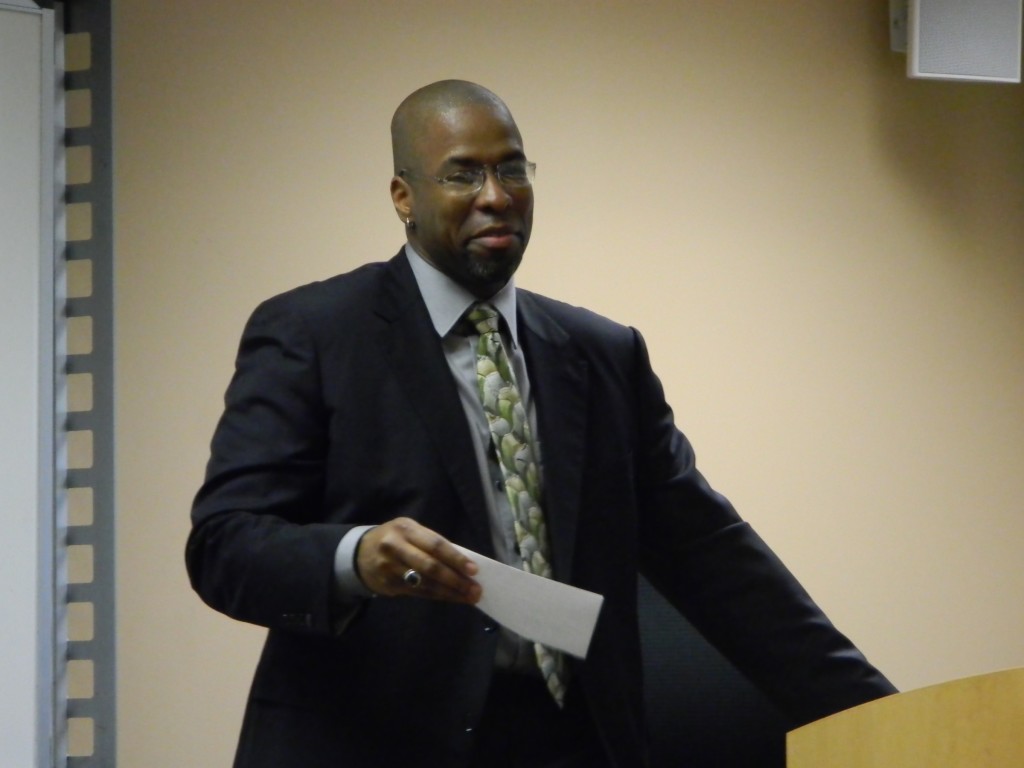
Unfortunately the asset, nicknamed "Merlin," was having a hard time finding the Iranians' address.
Jurors on Friday at the leak trial of ex-CIA officer Jeffrey Sterling heard Merlin testify for nearly three hours about his life as a CIA asset and his key role in the classified operation to give deliberately flawed nuclear blueprints to Iran.
Prosecutors say Sterling, 47, of O'Fallon, Missouri, who was Merlin's handler in 2000, illegally leaked details of the operation to New York Times journalist to get back at the agency for perceived mistreatment. Sterling denies that he leaked anything to Risen. His lawyers have suggested that others, including Merlin, appear to be more likely sources for Risen's work. Merlin testified Friday that he did not leak anything to Risen.
Former national security adviser Condoleezza Rice testified on Thursday that the Merlin operation "was one of the only levers we had to try to disrupt Iran's nuclear program."
Merlin, a Russian nuclear engineer who was paid $66,000 by the CIA in 2000, also told jurors Friday about his adventures in Vienna in February of that year, where his role was to deliver a set of blueprints for a nuclear weapons part called a "firing set" to Iran's mission to the International Atomic Energy Agency in Vienna. Merlin's CIA handlers had given him very explicit instructions, but Merlin said he deviated from those instructions when he thought it appropriate.
Merlin was supposed to deliver, free of charge, an incomplete set of blueprints for a firing set to the Iranians, with instructions that they could get the rest of the blueprints if they contacted him and paid him.
The blueprints were not only incomplete, but had been doctored to insert dozens of hidden errors that were supposed to leave the Iranians chasing their own tail for years trying to build a firing set that would never work...
http://abcnews.go.com/US/wireStory/cia-leak-trial-continues-condoleezza-rice-testimony-28265187
20140716
Part 1 of 4: Were Nuclear Reactors the Cause of the WTC Destruction?
Perhaps it was the boiling clouds—black, grey, white, and especially “nuclear brown”—surrounding the World Trade Center’s 110-story North and South Towers (WTC 1, 2) that made the world conclude the two hijacked airliners crashing into the buildings on September 11, 2001 had dropped nuclear bombs in elevator shafts. After all, the dreaded “stem-and-mushroom” cloud was rising from WTC 1 looking remarkably like a South Pacific atom-bomb test. How could they not, especially those familiar with media visuals of tests since 1946? Or those aware of a volcano’s powerful energy fields disgorging lava, pyroclastic flows, and lahars? [i]
The principal advocate for the theory that reactors were the primary causal agent that ultimately destroyed all seven WTC buildings is William Tahil, a British aerospace/technological consultant. He is the author of Ground Zero: The Nuclear Demolition of the World Trade Centre. He contends that 9/11 not only was the first nuclear attack against the United States, but “the world’s first nuclear controlled demolition.” [ii]
Tahil argues that signatures of a reactor were plentiful, beyond just brown clouds of dust and the curious application of the 1946 term “Ground Zero,” to the WTC. Its dictionary definition is the geographical point of a nuclear explosion.
As evidence, he cites radioactive fallout found by the U.S. Geological Survey in samples from 35 sites surrounding the WTC for nearly a mile. Other signs were the speed of the Towers disintegrations (8 to 10 seconds), the shock and blast waves, the pyroclastic main cloud, base-surges of street-level dust clouds, electromagnetic pulses (EMPs), upwellings of clouds from street gratings blocks away, the 2,800ºF heat under the WTC debris, and, possibly, the giveaway light-blue Cerenkov Radiation when the debris “pile” was cleared in mid-March. Add to all these signs, the molten metal in the footprints of WTC 1, 2, and 7 that for three months could not be extinguished by water or daily soil changes as it consumed concrete, steel, glass, office combustibles. The increasing incidence of radiation-only cancers from residents is another tell-tale sign of a nuclear “event.”
In short, reactors would seem to merit as much consideration as a causal theory to be investigated as any of the others suggested since September 11, 2001...
http://norfidid.wordpress.com/part-1-of-4-were-nuclear-reactors-the-cause-of-the-wtc-destruction/
The principal advocate for the theory that reactors were the primary causal agent that ultimately destroyed all seven WTC buildings is William Tahil, a British aerospace/technological consultant. He is the author of Ground Zero: The Nuclear Demolition of the World Trade Centre. He contends that 9/11 not only was the first nuclear attack against the United States, but “the world’s first nuclear controlled demolition.” [ii]
Tahil argues that signatures of a reactor were plentiful, beyond just brown clouds of dust and the curious application of the 1946 term “Ground Zero,” to the WTC. Its dictionary definition is the geographical point of a nuclear explosion.
As evidence, he cites radioactive fallout found by the U.S. Geological Survey in samples from 35 sites surrounding the WTC for nearly a mile. Other signs were the speed of the Towers disintegrations (8 to 10 seconds), the shock and blast waves, the pyroclastic main cloud, base-surges of street-level dust clouds, electromagnetic pulses (EMPs), upwellings of clouds from street gratings blocks away, the 2,800ºF heat under the WTC debris, and, possibly, the giveaway light-blue Cerenkov Radiation when the debris “pile” was cleared in mid-March. Add to all these signs, the molten metal in the footprints of WTC 1, 2, and 7 that for three months could not be extinguished by water or daily soil changes as it consumed concrete, steel, glass, office combustibles. The increasing incidence of radiation-only cancers from residents is another tell-tale sign of a nuclear “event.”
In short, reactors would seem to merit as much consideration as a causal theory to be investigated as any of the others suggested since September 11, 2001...
http://norfidid.wordpress.com/part-1-of-4-were-nuclear-reactors-the-cause-of-the-wtc-destruction/
20140226
Nun, 84, gets 3 years in prison for breaking into nuclear weapons complex
Two other activists who broke into the facility with Megan Rice were sentenced to more than five years in prison, in part because they had much longer criminal histories.
Although officials claimed there was never any danger of the protesters reaching materials that could be detonated or made into a dirty bomb, the break-in raised questions about the safekeeping at the Y-12 National Security Complex. The facility holds the nation's primary supply of bomb-grade uranium.
After the protest, the complex had to be shut down, security forces were re-trained and contractors were replaced.
In her closing statement, Rice asked the judge to sentence her to life in prison, even though sentencing guidelines called for about six years...
http://www.cbsnews.com/news/nun-84-gets-3-years-in-prison-for-breaking-in-nuclear-weapons-complex/
20131219

20131210
Whose sarin?
Seymour M. Hersh
Barack Obama did not tell the whole story this autumn when he tried to make the case that Bashar al-Assad was responsible for the chemical weapons attack near Damascus on 21 August. In some instances, he omitted important intelligence, and in others he presented assumptions as facts. Most significant, he failed to acknowledge something known to the US intelligence community: that the Syrian army is not the only party in the country’s civil war with access to sarin, the nerve agent that a UN study concluded – without assessing responsibility – had been used in the rocket attack. In the months before the attack, the American intelligence agencies produced a series of highly classified reports, culminating in a formal Operations Order – a planning document that precedes a ground invasion – citing evidence that the al-Nusra Front, a jihadi group affiliated with al-Qaida, had mastered the mechanics of creating sarin and was capable of manufacturing it in quantity. When the attack occurred al-Nusra should have been a suspect, but the administration cherry-picked intelligence to justify a strike against Assad.
In his nationally televised speech about Syria on 10 September, Obama laid the blame for the nerve gas attack on the rebel-held suburb of Eastern Ghouta firmly on Assad’s government, and made it clear he was prepared to back up his earlier public warnings that any use of chemical weapons would cross a ‘red line’: ‘Assad’s government gassed to death over a thousand people,’ he said. ‘We know the Assad regime was responsible … And that is why, after careful deliberation, I determined that it is in the national security interests of the United States to respond to the Assad regime’s use of chemical weapons through a targeted military strike.’ Obama was going to war to back up a public threat, but he was doing so without knowing for sure who did what in the early morning of 21 August.
He cited a list of what appeared to be hard-won evidence of Assad’s culpability: ‘In the days leading up to August 21st, we know that Assad’s chemical weapons personnel prepared for an attack near an area where they mix sarin gas. They distributed gas masks to their troops. Then they fired rockets from a regime-controlled area into 11 neighbourhoods that the regime has been trying to wipe clear of opposition forces.’ Obama’s certainty was echoed at the time by Denis McDonough, his chief of staff, who told the New York Times: ‘No one with whom I’ve spoken doubts the intelligence’ directly linking Assad and his regime to the sarin attacks...
http://www.lrb.co.uk/2013/12/08/seymour-m-hersh/whose-sarin
Barack Obama did not tell the whole story this autumn when he tried to make the case that Bashar al-Assad was responsible for the chemical weapons attack near Damascus on 21 August. In some instances, he omitted important intelligence, and in others he presented assumptions as facts. Most significant, he failed to acknowledge something known to the US intelligence community: that the Syrian army is not the only party in the country’s civil war with access to sarin, the nerve agent that a UN study concluded – without assessing responsibility – had been used in the rocket attack. In the months before the attack, the American intelligence agencies produced a series of highly classified reports, culminating in a formal Operations Order – a planning document that precedes a ground invasion – citing evidence that the al-Nusra Front, a jihadi group affiliated with al-Qaida, had mastered the mechanics of creating sarin and was capable of manufacturing it in quantity. When the attack occurred al-Nusra should have been a suspect, but the administration cherry-picked intelligence to justify a strike against Assad.
In his nationally televised speech about Syria on 10 September, Obama laid the blame for the nerve gas attack on the rebel-held suburb of Eastern Ghouta firmly on Assad’s government, and made it clear he was prepared to back up his earlier public warnings that any use of chemical weapons would cross a ‘red line’: ‘Assad’s government gassed to death over a thousand people,’ he said. ‘We know the Assad regime was responsible … And that is why, after careful deliberation, I determined that it is in the national security interests of the United States to respond to the Assad regime’s use of chemical weapons through a targeted military strike.’ Obama was going to war to back up a public threat, but he was doing so without knowing for sure who did what in the early morning of 21 August.
He cited a list of what appeared to be hard-won evidence of Assad’s culpability: ‘In the days leading up to August 21st, we know that Assad’s chemical weapons personnel prepared for an attack near an area where they mix sarin gas. They distributed gas masks to their troops. Then they fired rockets from a regime-controlled area into 11 neighbourhoods that the regime has been trying to wipe clear of opposition forces.’ Obama’s certainty was echoed at the time by Denis McDonough, his chief of staff, who told the New York Times: ‘No one with whom I’ve spoken doubts the intelligence’ directly linking Assad and his regime to the sarin attacks...
http://www.lrb.co.uk/2013/12/08/seymour-m-hersh/whose-sarin
20131201
For Nearly Two Decades the Nuclear Launch Code at all Minuteman Silos in the United States Was 00000000
Today I found out that during the height of the Cold War, the US military put such an emphasis on a rapid response to an attack on American soil, that to minimize any foreseeable delay in launching a nuclear missile, for nearly two decades they intentionally set the launch codes at every silo in the US to 8 zeroes.
We guess the first thing we need to address is how this even came to be in the first place. Well, in 1962 JFK signed the National Security Action Memorandum 160, which was supposed to ensure that every nuclear weapon the US had be fitted with a Permissive Action Link (PAL), basically a small device that ensured that the missile could only be launched with the right code and with the right authority.
There was particularly a concern that the nuclear missiles the United States had stationed in other countries, some of which with somewhat unstable leadership, could potentially be seized by those governments and launched. With the PAL system, this became much less of a problem...
http://www.todayifoundout.com/index.php/2013/11/nearly-two-decades-nuclear-launch-code-minuteman-silos-united-states-00000000/
We guess the first thing we need to address is how this even came to be in the first place. Well, in 1962 JFK signed the National Security Action Memorandum 160, which was supposed to ensure that every nuclear weapon the US had be fitted with a Permissive Action Link (PAL), basically a small device that ensured that the missile could only be launched with the right code and with the right authority.
There was particularly a concern that the nuclear missiles the United States had stationed in other countries, some of which with somewhat unstable leadership, could potentially be seized by those governments and launched. With the PAL system, this became much less of a problem...
http://www.todayifoundout.com/index.php/2013/11/nearly-two-decades-nuclear-launch-code-minuteman-silos-united-states-00000000/
20130825
Exclusive: CIA Files Prove America Helped Saddam as He Gassed Iran
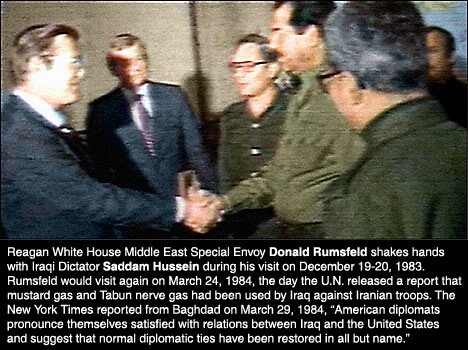
In 1988, during the waning days of Iraq's war with Iran, the United States learned through satellite imagery that Iran was about to gain a major strategic advantage by exploiting a hole in Iraqi defenses. U.S. intelligence officials conveyed the location of the Iranian troops to Iraq, fully aware that Hussein's military would attack with chemical weapons, including sarin, a lethal nerve agent.
The intelligence included imagery and maps about Iranian troop movements, as well as the locations of Iranian logistics facilities and details about Iranian air defenses. The Iraqis used mustard gas and sarin prior to four major offensives in early 1988 that relied on U.S. satellite imagery, maps, and other intelligence. These attacks helped to tilt the war in Iraq's favor and bring Iran to the negotiating table, and they ensured that the Reagan administration's long-standing policy of securing an Iraqi victory would succeed. But they were also the last in a series of chemical strikes stretching back several years that the Reagan administration knew about and didn't disclose...
Subscribe to:
Posts (Atom)