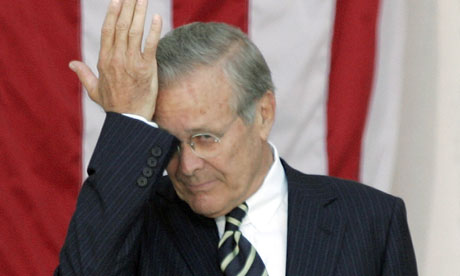
2000: director of a company which wins $200m contract to sell nuclear reactors to North Korea
2002: declares North Korea a terrorist state, part of the axis of evil and a target for regime change
Donald Rumsfeld, the US defence secretary, sat on the board of a company which three years ago sold two light water nuclear reactors to North Korea - a country he now regards as part of the "axis of evil" and which has been targeted for regime change by Washington because of its efforts to build nuclear weapons.
Mr Rumsfeld was a non-executive director of ABB, a European engineering giant based in Zurich, when it won a $200m (£125m) contract to provide the design and key components for the reactors. The current defence secretary sat on the board from 1990 to 2001, earning $190,000 a year. He left to join the Bush administration.
The reactor deal was part of President Bill Clinton's policy of persuading the North Korean regime to positively engage with the west.
The sale of the nuclear technology was a high-profile contract. ABB's then chief executive, Goran Lindahl, visited North Korea in November 1999 to announce ABB's "wide-ranging, long-term cooperation agreement" with the communist government.
The company also opened an office in the country's capital, Pyongyang, and the deal was signed a year later in 2000. Despite this, Mr Rumsfeld's office said that the de fence secretary did not "recall it being brought before the board at any time".
https://www.theguardian.com/world/2003/may/09/nuclear.northkorea
Showing posts with label Switzerland. Show all posts
20160613
20160221
Wiki: Bank for International Settlements
The Bank for International Settlements (BIS; French: Banque des règlements internationaux, BRI) is an international company limited by shares owned by central banks which "fosters international monetary and financial cooperation and serves as a bank for central banks".[2] The BIS carries out its work through subcommittees, the secretariats it hosts and through an annual general meeting of all member banks. It also provides banking services, but only to central banks and other international organizations. It is based in Basel, Switzerland, with representative offices in Hong Kong and Mexico City...
...The BIS was established on May 17, 1930, by an intergovernmental agreement by Germany, Belgium, France, the United Kingdom, Italy, Japan, the United States and Switzerland.[3][4]
The BIS was originally intended to facilitate reparations imposed on Germany by the Treaty of Versailles after World War I.[5] The need to establish a dedicated institution for this purpose was suggested in 1929 by the Young Committee, and was agreed to in August of that year at a conference at The Hague. A charter for the bank was drafted at the International Bankers Conference at Baden-Baden in November, and its charter was adopted at a second Hague Conference on January 20, 1930. According to the charter, shares in the bank could be held by individuals and non-governmental entities. The BIS was constituted as having corporate existence in Switzerland on the basis of an agreement with Switzerland acting as headquarters state for the bank. It also enjoyed immunity in all the contracting states.
The evidence had been mounting throughout the war that the BIS had helped the Germans loot assets from occupied countries, including gold rings and other items from labor and prison camp victims.[6] The most notorious incident was the Bank of England's transfer to the BIS gold looted by the Nazis after their invasion of Czechoslovakia in 1939.'[7] The fact that top level German industrialists and advisors sat on the BIS board is ample evidence to understand how the BIS was used by Hitler throughout the war, with the help of American, British and French banks. Between 1933 and 1945 the BIS board of directors included Walther Funk, a prominent Nazi official, and Emil Puhl, as well as Hermann Schmitz, the director of IG Farben and Baron von Schroeder, the owner of the J.H. Stein Bank....
Members
The number of countries represented in each continent are: 35 in Europe, 13 in Asia, 5 in South America, 3 in North America, 2 in Oceania, and 2 in Africa. Sixty member central banks or monetary authorities of these countries...
https://en.wikipedia.org/wiki/Bank_for_International_Settlements
20160104
Switzerland signs deal to end banking secrecy
Switzerland, in an effort to combat tax evasion and money laundering activities, has agreed to a deal with the Organisation for Economic Co-operation and Development (OECD) agreeing to exchange data with 60 other countries that will effectively end its banking secrecy.
Switzerland is the world’s largest offshore wealth center, with an estimated $2.2 trillion in assets compared to a $632.2 billion GDP.
The fight to open up Switzerland’s infamous banking system to assess tax evasion and illicit funds has been ongoing on for the past few years. It already has bilateral tax collection agreements with the UK and Austria.
This tax agreement, was brought forward by the OECD and includes all G20 states and most European States. With the signing of this convention, the Swiss government can now ask large private banks like UBS AG, Julius Baer, and Credit Suisse Group AG to release information on their clients to tax auditors both locally and internationally.
There was much resistance from the Swiss bankers, including the chairman of the Swiss Bankers Associated, Patrick Odier who does not think that this automatic release of information is compliant with international standards...
http://internationalbanker.com/banking/switzerland-signs-deal-to-end-banking-secrecy/
Switzerland is the world’s largest offshore wealth center, with an estimated $2.2 trillion in assets compared to a $632.2 billion GDP.
The fight to open up Switzerland’s infamous banking system to assess tax evasion and illicit funds has been ongoing on for the past few years. It already has bilateral tax collection agreements with the UK and Austria.
This tax agreement, was brought forward by the OECD and includes all G20 states and most European States. With the signing of this convention, the Swiss government can now ask large private banks like UBS AG, Julius Baer, and Credit Suisse Group AG to release information on their clients to tax auditors both locally and internationally.
There was much resistance from the Swiss bankers, including the chairman of the Swiss Bankers Associated, Patrick Odier who does not think that this automatic release of information is compliant with international standards...
http://internationalbanker.com/banking/switzerland-signs-deal-to-end-banking-secrecy/
Subscribe to:
Posts (Atom)