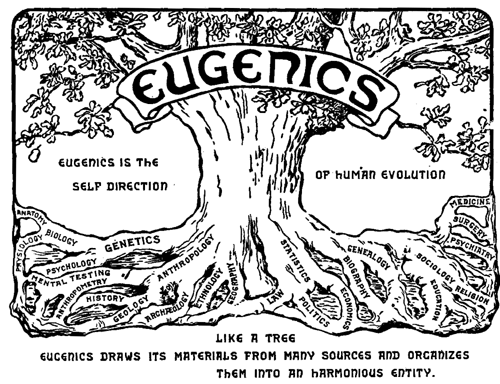
In the 1920s, some American families competed in state and county fairs to be judged the “fittest human stock.” Families deemed the “most perfectly developed” were awarded blue ribbons, just like cows and pigs.
These Fitter Family Contests were but one reflection then of the infatuation with eugenics across the United States—especially by the elite institutions of science, law, and academia—in an effort to purge the nation of the unfit. Eugenists promoted the reproduction of the healthiest citizens while eliminating the “feebleminded” through policies such as immigration restriction and anti-miscegenation and compulsory sterilization laws.
Acclaimed author Adam Cohen traces the grim history of American eugenics in his groundbreaking new book Imbeciles: The Supreme Court, American Eugenics, and the Sterilization of Carrie Buck (Penguin Press). The book focuses on one of vilest Supreme Court decisions in U.S. history when, in 1927, celebrated Justice Oliver Wendell Holmes wrote a brief and disturbing opinion allowing the forced sterilization of Carrie Buck, a young Virginia woman with a limited education (Buck v. Bell, 274 U.S. 200 (1927)). The decision led to the mass forced sterilization of tens of thousands more Americans, mostly poor and powerless women, who were considered “feebleminded.”
As he illuminates this gross injustice, Mr. Cohen limns the world of Carrie Buck and the prominent scientists, lawyers and judges who wanted to end her family line. He also explores the wide influence of the American eugenics movement that demonized the weak and vulnerable as it inspired Hitler’s ideas on creating an Aryan master race. His book is based on exhaustive research into materials from medical, legal, academic, and other archives, including extensive documents on the legal proceedings against Ms. Buck from the trial court stage to the Supreme Court proceedings...
http://historynewsnetwork.org/article/162904
Showing posts with label eugenics. Show all posts
20160626
20160425
Plato, Nazism, CRISPR: The long shadow of eugenics
Eugenics is inextricably linked in the public consciousness to Nazi policies of sterilisation and euthanasia. But the concept of hereditary human improvement didn't vanish after the war. Is gene editing technology its modern manifestation? Amanda Smith investigates.
Going back to the ancient Greeks, it was all about breeding. In his Republic, Plato suggests that people should only be allowed to marry under controlled circumstances.
Plato, you see, regarded people much the same as livestock: you breed the best ones and not the others.
There's a new group out there who are unashamedly saying it's not that eugenics was wrong, it's that it was done wrong.
'A lot of people trace the idea of eugenics back to that,' says Nathaniel Comfort, author of The Science of Human Perfection. 'It has a certain logic to it.'
The term 'eugenics' was coined by 19th century British polymath Francis Galton.
'At first he called it viticulture, and then he decided that eugenics was a more euphonious word,' says Comfort. The root of the word is the Greek eugenes, meaning 'well born'...
http://www.abc.net.au/radionational/programs/bodysphere/long-shadow-of-eugenics/7329050
20160411
Harvard Acknowledges Its Slaves and Its Role in Eugenics: A Cautionary Tale
President Drew Faust says this is part of a new push by the college to recognize the role of slavery in its history because, she says, “Harvard was directly complicit in America’s system of racial bondage.” Faust, a Civil War historian, has established a committee of historians to advise her on further steps, which may include a conference.
“We name the names to remember these stolen lives,” Faust said.
Jonathan L. Walton, a Harvard Divinity School professor and minister at Harvard’s Memorial Church, was at the unveiling of the plaque, “This institution has always been a complicated place, and there are ghosts all around us,” Walton said. “There are ghosts that speak to us and they inform us and they challenge us, they challenge us to do more.”
Around the time the plaque was being put in place, an article in Harvard Magazinedocumented the institution’s role in eugenics, the forced sterilization of people declared to be “feebleminded,” physically disabled, “criminalistic,” or otherwise flawed. The movement led to the sterilization of an estimated 70,000 Americans, and its concepts were eventually adapted and put into practice by the Nazi regime. Adam S. Cohen writes:
As eugenics grew in popularity, it took hold at the highest levels of Harvard. A. Lawrence Lowell, who served as president from 1909 to 1933, was an active supporter. Lowell, who worked to impose a quota on Jewish students and to keep black students from living in the Yard, was particularly concerned about immigration—and he joined the eugenicists in calling for sharp limits. “The need for homogeneity in a democracy,” he insisted, justified laws “resisting the influx of great numbers of a greatly different race.”...
https://nonprofitquarterly.org/2016/04/08/harvard-acknowledges-its-slaves-and-its-role-in-eugenics-a-cautionary-tale/
20151113
Wiki: Eugenics in the United States
Eugenics was practised in the United States many years before eugenics programs in Nazi Germany[4] and U.S. programs provided much of the inspiration for the latter.[5][6][7] Stefan Kühl has documented the consensus between Nazi race policies and those of eugenicists in other countries, including the United States, and points out that eugenicists understood Nazi policies and measures as the realization of their goals and demands.[5]
During the Progressive Era of the late 19th and early 20th century, eugenics was considered[by whom?] a method of preserving and improving the dominant groups in the population; it is now generally associated with racist and nativist elements[citation needed] (as the movement was to some extent a reaction to a change in emigration from Europe) rather than scientific genetics...
https://en.wikipedia.org/wiki/Eugenics_in_the_United_States
https://en.wikipedia.org/wiki/Carnegie_Institution_for_Science
20151011
Subscribe to:
Posts (Atom)