Showing posts with label DoD. Show all posts

20161202

Solar Warden - The Secret Space Program


Since approximately 1980, a secret space fleet code named ‘Solar Warden’ has been in operation unknown to the public...

Is this nonsense, is it a conspiracy or is it simply so sensitive that it will cause uproar around the world?

These are my own words after conducting research into the secret program. Whilst conducting an FOI (freedom of information) request with the DoD (department of defence) in 2010, I had a very unexpected response by email from them which read:

“About an hour ago I spoke to a NASA rep who confirmed this was their program and that it was terminated by the President. He also informed me that it was not a joint program with the DoD. The NASA rep informed me that you should be directed to the Johnson Space Center FOIA Manager.

I have ran your request through one of our space-related directorates and I’m waiting on one other division with the Command to respond back to me. I will contact you once I have a response from the other division. Did NASA refer you to us?”...


http://www.huffingtonpost.co.uk/darren-perks/solar-warden-the-secret-space-program_b_1659192.html

20161111

Newsbud Exclusive Report- A Distillation DOD Spending Spree for October 2016

The Pentagon issues a jumbled list of contracts every business day around 5:00PM local time. Our project distills an entire month of these contracts into an accessible form.

The U.S. Department of Defense (DOD) spent at least $10,635,283,000 on 142 individual contracts during October 2016. This amount does not include Foreign Military Sales transactions worth $481,384,637.

FOREIGN MILITARY SALES (FMS) – Through FMS, the U.S. government procures and transfers materiel to allied nations and international organizations.

CFM International Inc. received $14,724,356 to provide Australia with supplies and services required for CFM56 engine field assessment, unscheduled engine repair, and technical assistance. Non-competitive, per FAR 6.302-1a2.

Conti Federal Services received $64,580,000 for construction at site 13414 in Israel.

Lockheed Martin received $31,069,159 to provide shipboard testing and integration in support of Japan’s Aegis modernization program.

Lockheed Martin received $20,564,338 to upgrade Italy’s C-130J Operational Flight Trainer and Cockpit Avionics Part Task Trainer.

Lockheed Martin received $11,815,569 for engineering & logistics on MK 92 Fire Control System life-cycle maintenance (overhaul, install, maintain) to USA and FMS (Poland, Saudi Arabia).

Nibor Enterprises Inc. received $11,470,618 to work on “projects 13372, 13416, and 13493” for Israel.

Northrop Grumman received $14,375,411 to provide Japan E-2D spares and support equipment

Swiftships LLC received $14,591,075 for continuous lifecycle support (maintenance, repairs, platform overhaul support) on Iraqi Navy patrol boats, offshore vessels, and defender boats. Work at Umm Qasr Naval Base, Iraq.

Textron (AAI) received $206,561,704 to provide Australia with RQ-7B Shadow contractor logistics sustainment services.

http://www.newsbud.com/2016/11/07/newsbud-exclusive-report-a-distillation-dod-spending-spree-for-october-2016/

20160910

The Pentagon has shipped more than a million small arms to Iraq and Afghanistan’s defense forces


The Pentagon has spent billions of dollars since 2001 funneling roughly more than a million assault rifles, pistols, shotguns, and machine guns into Iraq and Afghanistan, helping to fuel lasting conflict there, according to a new report by a London-based nonprofit research and advocacy group Action on Armed Violence.

At least 949,582 of these small arms were given to security forces in Iraq, and at least 503,328 small arms were given to local forces in Afghanistan, the group said. They called this an “under-estimate” based on the information they were able to acquire.

If the figures are correct, the US exports amounted to more than one small arm for each member of Afghanistan’s security forces, which totaled roughly 355,000 soldiers, police, and airmen in February 2015, according to a NATO operational update on the force. The number of armaments sent to Iraq also vastly exceeded the current size of that country’s active military and paramilitaries - 209,000, according to the International Institute for Strategic Studies’ 2016 Military Balance report.

Until now, the Pentagon hasn’t published such a tally of its own, so the group’s researchers spent a year scouring multiple databases to arrive at its estimate: a general Pentagon contract list, a government-wide contracting list, and multiple government reports on military spending. They finally calculated that the overall value of the contractually-agreed small arms shipments, just to those two countries, was roughly $2.16 billion.

U.S. intelligence reports and eyewitnesses have previously said that a significant fraction of the U.S.-financed arms were either lost or stolen, and that many wound up in the hands of forces opposed to US interests, including terrorist groups such as the Islamic State, or ISIS...

https://www.publicintegrity.org/2016/08/26/20146/pentagon-has-shipped-more-million-small-arms-iraq-and-afghanistan-s-defense-forces

20160812

The Pentagon Money Pit

What if the inspector general of the Department of Health and Human Services were to report that $6.5 billion in spending by that federal agency was unaccounted for and untraceable? You can imagine the headlines, right? What if it was $65 billion? The headlines would be as big as for the first moon landing or for troops landing on Omaha Beach in World War II.

But how about a report by the Pentagon’s Office of Inspector General saying that the US Army had $6.5 trillion in unaccountable expenditures for which there is simply no paper trail? That is 6,500 billion dollars! Have you heard about that? Probably not. That damning report was issued back on July 26 — two whole weeks ago — but as of today it has not even been reported anywhere in the corporate media.

It’s not that it’s secret information, or hard to come by. The report is available online at the Department of Defense’s OIG website. And as it states:

The Office of the Assistant Secretary of the Army (Financial Management & Comptroller) (OASA[FM&C]) and the Defense Finance and Accounting Service Indianapolis (DFAS Indianapolis) did not adequately support $2.8 trillion in third quarter journal voucher (JV) adjustments and $6.5 trillion in yearend JV adjustments made to AGF data during FY 2015 financial statement compilation.2 The unsupported JV adjustments occurred because OASA(FM&C) and DFAS Indianapolis did not prioritize correcting the system deficiencies that caused errors resulting in JV adjustments, and did not provide sufficient guidance for supporting system‑generated adjustments.

In addition, DFAS Indianapolis did not document or support why the Defense Departmental Reporting System‑Budgetary (DDRS-B), a budgetary reporting system, removed at least 16,513 of 1.3 million records during third quarter FY 2015. This occurred because DFAS Indianapolis did not have detailed documentation describing the DDRS-B import process or have accurate or complete system reports.

As a result, the data used to prepare the FY 2015 AGF third quarter and yearend financial statements were unreliable and lacked an adequate audit trail. Furthermore, DoD and Army managers could not rely on the data in their accounting systems when making management and resource decisions...

http://www.counterpunch.org/2016/08/11/pentagon-money-pit/

20160518

Battelle Fielding 100 Drone Zappers to Pentagon, Homeland Security


The military has turned to a directed energy frequency jammer mounted on an assault rifle-type frame to deal with the growing threat of small drones to military bases and troops in the field.

Officials of Battelle, the non-profit research and development organization based in Columbus, Ohio, said Monday the Defense Department and the Department of Homeland Security had signed off on buying 100 of its “DroneDefender,” billed as the “safe” solution to warding off intruding unmanned aerial vehicles.

Battelle officials at the Navy League’s 2016 Sea-Air-Space Exposition at National Harbor in Maryland outside Washington, D.C., said they could not discuss the unit cost or the total cost of the sales to the departments.

“It’s a portable solution to stop portable drones,” said Rich Granger, a Battelle business development director for Mission and Defense Technologies.

The DroneDefender has two triggers — a “command and control” trigger to sever the link between the pilot and the UAV, and a second trigger to jam GPS links to the drone.

The device can intercept drones out to 400 meters. Once the drones are disabled, they are programmed to hover safely to the ground, said Kim Stambler, a Batelle business development and sales leader...

http://www.defensetech.org/2016/05/16/battelle-fielding-100-drone-zappers-to-pentagon-homeland-security/

20160421

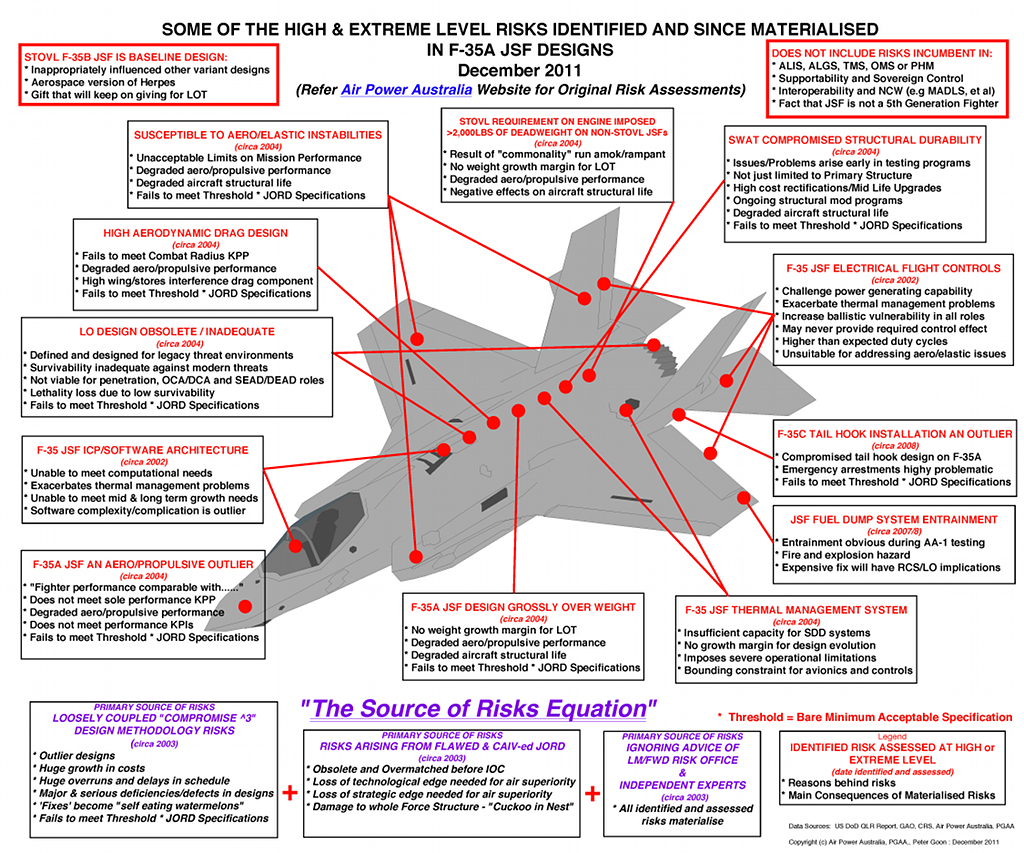
Is the $400 billion F-35's 'brain' broken?


(CNN) Almost 2,500 of the world's most advanced warplanes, with a total price tag of $400 billion, and they may not have a "brain" in the bunch?

That's the fear of federal watchdogs who say problems with the F-35 Joint Strike Fighter's complex logistics software system could lead to a grounding of the entire fleet, not to mention future cost increases and schedule delays.

Documenting risks to the F-35's Autonomic Logistics Information System, which Department of Defense officials have described as the "brains" of the fifth-generation fighter, an April 14 Government Accountability Office report says a failure "could take the entire fleet offline," in part, due to the lack of a backup system.

The report also outlines concerns related to the lack of testing done to ensure the software will work properly by the time the Air Force plans to declare its version of the aircraft ready for deployment this August and the Navy reaches that milestone in 2018...

...Another major concern highlighted by the GAO's findings is that under its current design, all the F-35 data produced by the entire U.S. fleet is routed to a single main operating unit that does not have any backup system or redundancy.

If this main server were to fail it could take the entire F-35 fleet offline, according to the GAO report...

http://www.cnn.com/2016/04/21/politics/f-35-software-system-gao-report/index.html

20160225

US court case reveals Tor attack deal

The FBI made security researchers hand over data that helped identify people suspected of using the Tor anonymising network, a court case has revealed.

It used a court order to access data gathered by two researchers during a 2014 Carnegie Mellon University project funded by the US Department of Defense.

The home IP address of American Brian Farrell was among those obtained by the FBI via its analysis of the CMU data.

He denies helping to run the Silk Road 2.0 website, which sold drugs via Tor.

Tor, also known as The Onion Router, lets people browse the web anonymously by bouncing data through a series of routers that encrypt it at each step.

This has also given rise to a number of hidden sites, including many markets selling drugs and other illegal items and services, that sit on the Tor network.

Once identified, the researchers said they would give a talk at the Black Hat security conference about the methods they had used to "de-anonymise hundreds of thousands Tor clients and thousands of hidden services".

The talk never went ahead - but later in 2014, the FBI mounted a series of raids on people suspected of running sites sitting on Tor.

The revelation comes as the FBI is embroiled in a row with Apple over a request to unlock an iPhone that belonged to Syed Rizwan Farook who, with his wife, killed 14 people in California last year.

The trial against Mr Farrell is due to start in April...

http://www.bbc.com/news/technology-35658761

20160219

Wiki: Able Danger

Able Danger was a classified military planning effort led by the U.S. Special Operations Command (SOCOM) and the Defense Intelligence Agency (DIA). It was created as a result of a directive from the Joint Chiefs of Staff in early October 1999 by Chairman of the Joint Chiefs of Staff Hugh Shelton, to develop an information operations campaign plan against transnational terrorism.

According to statements by Lt. Col. Anthony Shaffer and those of four others, Able Danger had identified 2 of 3 Al Qaeda cells active in the 9/11 attacks; the 'Brooklyn cell' linked to "Blind Sheik" Omar Abdel-Rahman, including September 11 attacks leader Mohamed Atta, and three of the 9/11 plot's other 19 hijackers.

In December 2006, a sixteen-month investigation by the US Senate Intelligence Committee concluded "Able Danger did not identify Mohamed Atta or any other 9/11 hijacker at any time prior to September 11, 2001," and dismissed other assertions that have fueled 9/11 conspiracy theories. The Senate Judiciary Committee first attempted to investigate the matter for the Senate in September, 2005. The Pentagon "ordered five key witnesses not to testify", according to Senate Judiciary Committee Chairman Arlen Specter. "That looks to me as if it may be obstruction of the committee's activities," Specter, R-Pennsylvania, said at the start of his committee's hearing into the unit.[1]

Attorney Mark Zaid, representing Lt. Colonel Anthony Shaffer and the other four Able Danger employees at the Senate Judiciary Committee hearing in September 2005, pointed out to the Committee that his clients had been forbidden by the Pentagon to testify to the Committee. He also discussed the Defense Intelligence Agency's decision to suspend Lt. Colonel Shaffer's security clearance shortly after it became known that he had provided information to the 9/11 Commission on Able Danger. "Based on years of experience I can say categorically that the basis for the revocation was questionable at best."[2] [3]

An investigation by the Defense Department Inspector General's office (IG) in September 2006 concluded that "the evidence did not support assertions that Able Danger identified the September 11, 2001, terrorists nearly a year before the attack, that Able Danger team members were prohibited from sharing information with law enforcement authorities, or that DoD officials acted against LTC Shaffer for his disclosures regarding Able Danger." However, some of the people questioned by the IG claimed their statements to the IG were distorted by investigators in the final IG's report, and the report omitted essential information that they had provided. Lt. Col Tony Shaffer has claimed that the DOD retaliated against him for speaking out publicly about the IG report's distortions.[4]

The Senate panel of investigators said there was no evidence DoD lawyers stopped analysts from sharing findings with the FBI before the attacks. Analysts had created charts that included pictures of then-known Al Qaeda operatives, but none including Atta. A follow-up chart made after the attacks did show Atta. The Senate Committee said its findings were consistent with those of the DoD inspector general, released in September 2006. [5] [6]..

https://en.wikipedia.org/wiki/Able_Danger

20160217

U.S. Hacked Into Iran’s Critical Civilian Infrastructure For Massive Cyberattack, New Film Claims

The United States hacked into critical civilian and military infrastructure in Iran to allow its operatives to disable the country with a devastating series of cyberattacks at a moment’s notice, a documentary will claim this week.

The targets of the U.S. hacking operations, covered by the code name “NITRO ZEUS,” include power plants, transport infrastructure, and air defenses, the film will state, with agents entering these protected systems nightly to make sure the attacks were still deployable.

The film, Zero Days, by Oscar-winning director Alex Gibney, which is set to premiere at the Berlin film festival on Wednesday, will claim that the U.S.-Israel “Stuxnet” worm — which destroyed around 1 in 5 of the centrifuges used in Iran’s nuclear program — was just a small part of a much larger set of offensive capabilities developed against the nation.

Citing at least five confidential U.S. military or intelligence sources with direct knowledge of the programs, the film claims:

• U.S. hackers working from the Remote Operations Center (ROC) in Fort Meade, Maryland, have penetrated huge swaths of Iran’s critical infrastructure, and were ready to launch disabling attacks alongside any military operation;...

http://www.buzzfeed.com/jamesball/us-hacked-into-irans-critical-civilian-infrastructure-for-ma

20160214

From railguns to AK knockoffs – Pentagon’s weapons shopping cart

While requesting $71.4 billion to fund the research and development of futuristic weapons for the US military, the Pentagon is turning to Soviet-era weapons for its proxies in Syria – and trying to get even more bang for the buck by buying Bulgarian.

Unveiling the military’s 2017 budget proposal, Secretary of Defense Ash Carter spoke of the importance of weapons research in tackling threats 10, 20 or 30 years down the road. Carter mentioned sci-fi-sounding technologies such as miniature drones, “swarming autonomous vehicles,” and railguns, which the US military is looking to adopt in the coming years.

The US Navy is already testing energy weapons as a point-defense system to bring down missiles and drones, and is looking to add railguns to the mix. A staple of science-fiction storytelling, the railguns – or Gauss rifles – use magnetic rails to launch shells at three times the speed of current naval cannons, far faster than cruise missiles. Prototype railguns are supposed to be installed aboard the USS Zumwalt, an experimental destroyer the size of a WW1 battleship currently undergoing sea trials.

Another futuristic system likely to cost the Pentagon millions is the 'Black Hornet.' The six-inch (16 cm) hand-held drone has a range of about a mile (1.6 kilometers), weighs less than an ounce, and carries three cameras for scouting in any weather – day or night. Officially designated UAS PD-100, the 'Black Hornet' is made by the Norwegian company Prox Dynamics, and sold through the Dutch-based consultancy Broadfield Security Services (BSS)...

https://www.rt.com/usa/332222-pentagon-wacky-weapons-shopping/

20151223

Wiki: Minerva Initiative

The Minerva Initiative is a research program sponsored by the U.S. Department of Defense (DoD) that provides grants to sustain university-based, social science studies on areas of strategic importance to U.S. national security policy. The program looks to tap into the community of area specialists and other university researchers, particularly those who work on Islam, Iraq, China, and related areas.[1] Since its establishment in 2008, the Department of Defense has awarded over 70 grants to private researchers.[2] Grants are awarded on an annual basis for research projects that typically last three years.

In 2011 the DoD hosted the first annual Minerva Conference. The event has since become an annual gathering in September for Minerva researchers, DoD keynote speakers, and scholars to highlight the most relevant research conducted through the program’s support...

Controversy

The program's funding of social science research for national security purposes has proven controversial.[8] Although many scholars support Minerva, at the program’s start a number of academic researchers sounded public alarm about the prospect of Defense Department funding for research. In 2008 the American Anthropological Association sent a public letter suggesting that the funding be transferred to a different body, such as the National Science Foundation (NSF). Hugh Gusterson, a prominent anthropologist at George Mason University, wrote a series of articles in a variety of venues that have attracted significant attention,[9]

"any attempt to centralize thinking about culture and terrorism under the Pentagon’s roof will inevitably produce an intellectually shrunken outcome....The Pentagon will have the false comfort of believing that it has harnessed the best and the brightest minds, when in fact it will have only received a very limited slice of what the ivory tower has to offer—academics who have no problem taking Pentagon funds. Social scientists call this “selection bias,” and it can lead to dangerous analytical errors."[10]
More recently, some observers have expressed concern that Minerva research, in its effort to understand mass mobilization, may be targeting peaceful activists, NGOs and protest movements, and has labeled non-violent radical activists "supporters of political violence."[11] Others believe social science should continue to emphasize security issues but worry that DoD funding will bias findings. One article notes:

"In an incentive structure that rewards an emphasis on countering global threats and securing the homeland, the devil lies in the definitions. In this framework, the Boston Marathon bombing becomes a national security problem, whereas the Sandy Hook massacre remains a matter for the police and psychologists—a distinction that is both absurd as social science and troubling as public policy."[12]
https://en.wikipedia.org/wiki/Minerva_Initiative

20140226

THE SPENDAGON: The Men Who Really Run the Pentagon


Before Chuck Hagel was nominated to be secretary of defense about a year ago, he made a reputation for himself as a independent Republican politician who described Pentagon spending as "bloated." In office, however, the former Nebraska senator has argued that the Pentagon should be rescued from historically minor and appropriate reductions. In doing so, he seeks to reverse one of the few real reforms that Secretary of Defense Robert Gates before him enforced on high spenders inside the Pentagon and in Congress.

Hagel and the director of the Office of Management and Budget (OMB), Sylvia Mathews Burwell, say they want to revive the old "wish list" process in which the Joint Chiefs of Staff used to connive with each other and Congress, behind the back of secretaries of defense and OMB, to make additions that couldn't cut the mustard in the regular budget review process.

Hagel has shown himself to be the individual of lesser stature that many were stunned to observe at his infamous confirmation hearing at the Senate Armed Services Committee last year. The Hagel-OMB undertaking also reveals who or what is really running the Pentagon these days: As with feckless secretaries of defense in the past, it's the Joint Chiefs of Staff (JCS) that run the show.

Gates deserved some real praise for stopping the JCS from running behind the backs of defense secretaries (and presidents) to solicit spending above and beyond officially approved defense budgets. For years, the JCS had pre-arranged with high-spending members of the Senate and House Armed Services Committees to be asked at hearings to submit lists of programs for extra spending. The JCS preferred to call these lists "unfunded requirements;" everyone else called them "wish lists."

http://www.foreignpolicy.com/articles/2014/02/13/the_men_who_really_run_the_pentagon_chuck_hagel

20130724

Watchdog critical of State Department contracting in Afghanistan

A U.S. government watchdog found "serious deficiencies" in how the State Department awarded a contract job in Afghanistan, according to a letter from the organization to Secretary of State John Kerry released Thursday.

In the letter dated Monday, the special inspector general for Afghanistan reconstruction, John Sopko, raised a number of concerns on the oversight practices of the Bureau of International Narcotics and Law Enforcement Affairs (INL) at the State Department and how they awarded a contract for the training of Afghan justice workers.

Sopko said the International Development Law Organization (IDLO), the nongovernmental organization awarded the contract, is "ill-prepared to manage and account for how U.S.-taxpayer funds will be spent," while also criticizing the State Department's role in awarding the contract...

...A second audit found the State Department and the United States Agency for International Development lack the same authority the Pentagon has to terminate contracts with an entity later found to be affiliated with insurgent groups in Afghanistan or those deemed to be an enemy of the United States....

http://security.blogs.cnn.com/2013/07/25/watchdog-critical-of-state-department-contracting-in-afghanistan-2/

20130709

U.S. Government Foreign Telecommunications Providers Network Security Agreements

The following are Network Security Agreements (NSAs) entered into with foreign communications infrastructure providers ensuring U.S. government agencies the ability to access communications data when legally requested. The agreements range in date from 1999 to 2011 and involve a rotating group of government agencies including the Federal Bureau of Investigation (FBI), Department of Homeland Security (DHS), Department of Justice (DoJ), Department of Defense (DoD) and sometimes the Department of the Treasury. According to the Washington Post, the agreements require companies to maintain what amounts to an “internal corporate cell of American citizens with government clearances” ensuring that “when U.S. government agencies seek access to the massive amounts of data flowing through their networks, the companies have systems in place to provide it securely.”...

http://publicintelligence.net/us-nsas/

20130413

DoD Communications Systems Breach in 9/11 Trials

---------- Forwarded message ---------- 

From: Ruiz, Walter B, CDR OSD OMC Defense <Walter.Ruiz@osd.mil> Date: Thu, Apr 11, 2013 at 9:07 AM Subject: CDC Orders Defense to Stop Using Communications Systems. To: "Ruiz, Walter B, CDR OSD OMC Defense" <Walter.Ruiz@osd.mil> 

 Yesterday the CDC, Colonel Mayberry issued an office wide order to seize and desist from using our e-mail communications to transmit any matters that are confidential or privileged. All OCDC Personnel including all civilian counsel been directed not to save any files that contain privileged materials onto our personal or common drives. 

 This measure was taken as the CDC has determined that the integrity of these systems is not sufficient to ensure that we safeguard confidential and privileged materials, as it is our ethical duty to do. This follows on the heels of the seizure of over 500,000 e-mail containing attorney-client privileged communications as well as the loss of significant amount of defense work-product contained in shared folders.

http://cryptome.org/2013/04/dod-911-trial-breach.htm

20130408

Defense Contracts over $6.5m

"Contracts valued at $6.5 million or more are announced each business day at 5 p.m. Contract announcements issued within the past 30 days are listed below. Older contract announcements are available from the contract archive page. Contract announcements are also available by e-mail subscription. Go to DOD News for more information and for links to other news items..."

http://www.defense.gov/contracts/

20120129

U.S. Defense Department can't account for billions for Iraq, audit finds

(CNN) -- The U.S. Defense Department cannot account for about $2 billion it was given to cover Iraq-related expenses and is not providing Iraq with a complete list of U.S.-funded reconstruction projects, according to two new government audits.

The reports come from the office of the Special Inspector General for Iraq Reconstruction.

The Iraqi government in 2004 gave the Department of Defense access to about $3 billion to pay bills for certain contracts, and the department can only show what happened to about a third of that, the inspector general says in an audit published Friday.